Small Business Lawyer in South Africa: When and How to Hire
What a small business lawyer does in South Africa, when to hire one, what it costs in rand, and how to check an attorney is LPC-registered before you pay.
Published

A small business lawyer is an LPC-registered attorney who handles the legal side of running a company: contracts, ownership structure, employees, compliance and disputes. You hire one before a commitment becomes hard to undo, not after a dispute lands. You pay by the hour, by fixed fee for set documents, or through a monthly retainer. Before you pay anyone, check their registration with the Legal Practice Council (LPC).
This guide explains what to hand over to a lawyer, what the work costs in rand, and how to pick someone you can trust.
TL;DR
- Get advice early: when choosing a business structure, signing a major contract, taking on an investor or at the first sign of a dispute.
- Common work includes company structuring, shareholder agreements, contracts, employment documents, POPIA compliance and debt recovery.
- Published fixed fees for single documents start around R950 to R1,500. Open-ended matters often start with a deposit and hourly billing.
- Verify the attorney on the LPC register and, if they will hold your money, confirm a valid Fidelity Fund Certificate.
- Bring the documents and the full paper trail, including the parts that do not help your case.
Table of Contents
- What a small business lawyer actually does
- When to hire a lawyer, and when to wait
- What it costs: published South African figures
- How to choose a lawyer you can trust
- What to prepare before the first meeting
- Our perspective
- Find an LPC-registered attorney for your business
- A simple plan for your first year
- FAQ
- Sources
What a small business lawyer actually does
The job is wider than court work. According to a South African commercial law firm, a commercial lawyer helps with contracts, shareholder arrangements, business transactions, governance, regulatory questions and commercial disputes.
A business lawyer's own service list is more specific. It covers:
- incorporation and structuring
- CIPC compliance and licensing
- shareholder agreements
- contract drafting and review
- employment agreements and NDAs
- IP registration
- litigation and mediation
- debt recovery
- ongoing POPIA and B-BBEE compliance
- risk management
A trade publication adds the everyday problems: contractor or supplier disputes, security breaches, product liability, employee theft, tax audits and threats of customer lawsuits. You do not need all of this at once. Most owners need two or three of these in the first year, and the rest as the business grows.
The five foundations
One South African legal training provider says every formalised small enterprise rests on five legal foundations: a compliant structure, valid contracts, the applicable paperwork, protected intellectual property and a clean tax position. It also notes that the 2026 Budget moved the compulsory VAT threshold and the turnover tax threshold to R2.3 million, the first change to those figures in seventeen years. Your accountant handles the tax numbers. A lawyer helps make sure the structure and contracts match them.
When to hire a lawyer, and when to wait
The rule that holds up best: hire before you commit. The same commercial firm says the right moment is before a commitment becomes difficult to change. Its examples are choosing an ownership structure, negotiating a major contract, accepting an investor, or responding to the first sign of a dispute.
Size is not the test. The firm points out that a sole trader's lease, a founder's personal guarantee, or a small company's only supply agreement can justify focused advice. A contract matters because of what it could do to the business or your personal assets, not because of its price tag.
A practical filter: ask yourself three questions before you sign.
- Could this contract end my business if it goes wrong?
- Could it make me personally liable, for example through a guarantee or surety?
- Is it the only agreement I have with a customer or supplier that I cannot replace?
If the answer to any is yes, get it reviewed.
Employment is where owners wait too long
A firm offering labour law retainers notes that most SMEs only seek labour law support once a matter has escalated. Earlier guidance on employees, process, documentation and disputes is cheaper than a CCMA or Labour Court fight. Our guides on employment contract requirements in South Africa and the 30-day labour law checklist are a good place to start. If you already face a dispute, the Labour Court in Johannesburg, Cape Town and Durban pages explain where matters are heard.
Co-founders and investors
If more than one person owns the business, put the rules in writing early: who decides what, what happens if someone leaves, how shares are valued. Our guide to what a shareholders agreement must say lists the clauses to raise with your attorney.
What it costs: published South African figures
Fees vary by firm, city and the complexity of the matter. The figures below come from providers who publish prices on their own pages. They show the shape of the market, not a quote for you.
| Type of work | Published figure | Billing style |
|---|---|---|
| Contract drafting | From R1,500 | Fixed fee |
| Contract review and advice | From R950 | Fixed fee |
| Shareholders' agreement | From R3,900 | Fixed fee |
| Custom MOI | From R2,900 | Fixed fee |
| Employment contract | From R1,200 (another provider lists R5,250 per agreement) | Fixed fee |
| NDA or confidentiality agreement | From R950 | Fixed fee |
| POPIA/PAIA compliance, public-facing business | R15,000 (Package A) | Fixed fee |
| Comprehensive POPIA/PAIA package | R34,500 (Package B) | Fixed fee |
| Labour law retainer | R1,500 per month, including 3 hours | Monthly retainer |
Two things stand out. First, the same document can cost very different amounts depending on who drafts it and how tailored it is, so compare what is included, not only the number. Second, fixed fees suit defined tasks. Disputes are harder to price.
Hourly rates and deposits
For open-ended work, expect hourly billing. One legal-cover provider says that under normal circumstances lawyers in South Africa can charge up to R4,000 per hour, and that drafting a contract can cost up to R5,000. A business newsletter reports that junior counsel start at around R900 per hour and advocates can reach R5,000, and that SMEs may be asked for a deposit of R5,000 to R15,000 before a lawyer looks at a matter.
That last number is why you should ask three things at the first call: what is the hourly rate, will you quote a fixed fee for this task, and what does the deposit cover? A good attorney answers all three without fuss.

Ways to keep costs under control
A trade publication observes that cost is a real barrier and that many firms now offer value-based and on-demand services, as well as startup or small business packages. Options to ask about:
- Fixed-fee documents for contracts, MOIs and NDAs.
- A monthly retainer if you need regular access, especially for employment questions.
- A scoped review instead of a full redraft: you send the contract and ask for the main risks.
- Legal expenses cover, sold by some insurers, for businesses that want help with legal costs. Read what it covers before relying on it.
If you only need a quick answer to get oriented, our guide to free legal advice in South Africa lists where to start, and you can post a question to attorneys on the Justibly Q&A. For small unpaid invoices, see how Small Claims Court works.
How to choose a lawyer you can trust
Price matters, but registration matters first. The checks below take about ten minutes.
1. Confirm LPC registration
According to a South African law firm's verification guide, practising attorneys must be on the roll of legal practitioners and regulated by the Legal Practice Council. Ask for the attorney's LPC number and confirm it. Media reporting in April 2026 says the LPC has launched an online tool that lets anyone check whether a lawyer is registered and authorised to practise and holds a valid Fidelity Fund Certificate.
The same report says the tool followed court cases where practitioners were struck from the roll, including one who could not account for more than R300,000 in client trust money. That is the risk the check protects against.

2. Check the Fidelity Fund Certificate if money will change hands
If an attorney receives, holds or pays out money on your behalf, they need a valid Fidelity Fund Certificate for that year, renewed annually. This matters for deposits, property transactions and debt collections. Confirm it before you pay a deposit into a trust account.
3. Confirm firm details and get an engagement letter
The same guide recommends confirming the firm's physical details and asking for a proper engagement letter or mandate. The letter should say what the attorney will do, how they will bill and what is not included. If the scope is vague, ask them to tighten it.
4. Look for relevant experience
A lawyer who knows your sector will spot problems faster. Ask how many businesses of your size and industry they have helped, and which documents they use most often. Match the practice area to your need: a commercial attorney for contracts and structure, a labour attorney for employment disputes, an IP attorney for trademarks.
If something goes wrong with a lawyer, our guide explains where to report lawyers in South Africa.
What to prepare before the first meeting
Preparation saves billable hours. Bring the documents, a one-page summary and a clear question.
For a contract review
A commercial firm lists what a review should address, and it makes a useful checklist for your own reading beforehand (source):
- the parties, their authority and exactly what each must deliver
- payment triggers, price changes, interest and security
- performance standards, acceptance and responsibility for delays
- liability limits, indemnities, insurance and excluded losses
- ownership and permitted use of intellectual property and data
- duration, renewal, termination, handover and dispute resolution
Mark the clauses you do not understand, and write down what you actually want from the deal. A lawyer can then advise on your goals instead of reading everything cold.
For a dispute
The same firm advises giving your lawyer the agreement and the full correspondence, including material that does not support your preferred position. It also warns against assuming that stopping payment or cancelling immediately is the lawful response to every breach. Talk to your attorney before you act, because a hasty cancellation can put you in breach yourself.
For a new company or partnership
Bring the names and ID details of everyone involved, what each person will contribute, how you expect to split profit and decisions, and any existing agreements. Our legal guides cover several of these topics in plain language.
Our perspective
Most small business owners we hear from do not lack a lawyer because they distrust the profession. They lack one because they do not know who is registered, who works with businesses their size, and what a first conversation will cost.
That is why Justibly lists attorneys using verified Legal Practice Council data, and why listings are not ranked by who pays. When you search for a commercial or labour attorney by location, you see practitioners with validated registration status, not whoever bought the top spot. Answers on our Q&A forum come only from LPC-registered lawyers, so a quick question about a supplier contract or a retrenchment gets an answer from someone accountable to the regulator.
Our advice is simple. Pick an attorney before you need one. Ask a short question on the forum, shortlist two or three attorneys in your area, and hold the first call while the stakes are still low. A relationship built when you are signing a lease is far cheaper than one started during a dispute.
Nkosi
Find an LPC-registered attorney for your business
Justibly is a directory of LPC-registered South African attorneys, searchable by practice area and location. Our network covers more than 44,351 practising lawyers across all nine provinces. You can browse commercial and labour attorneys, compare profiles and request an appointment through a three-step process.
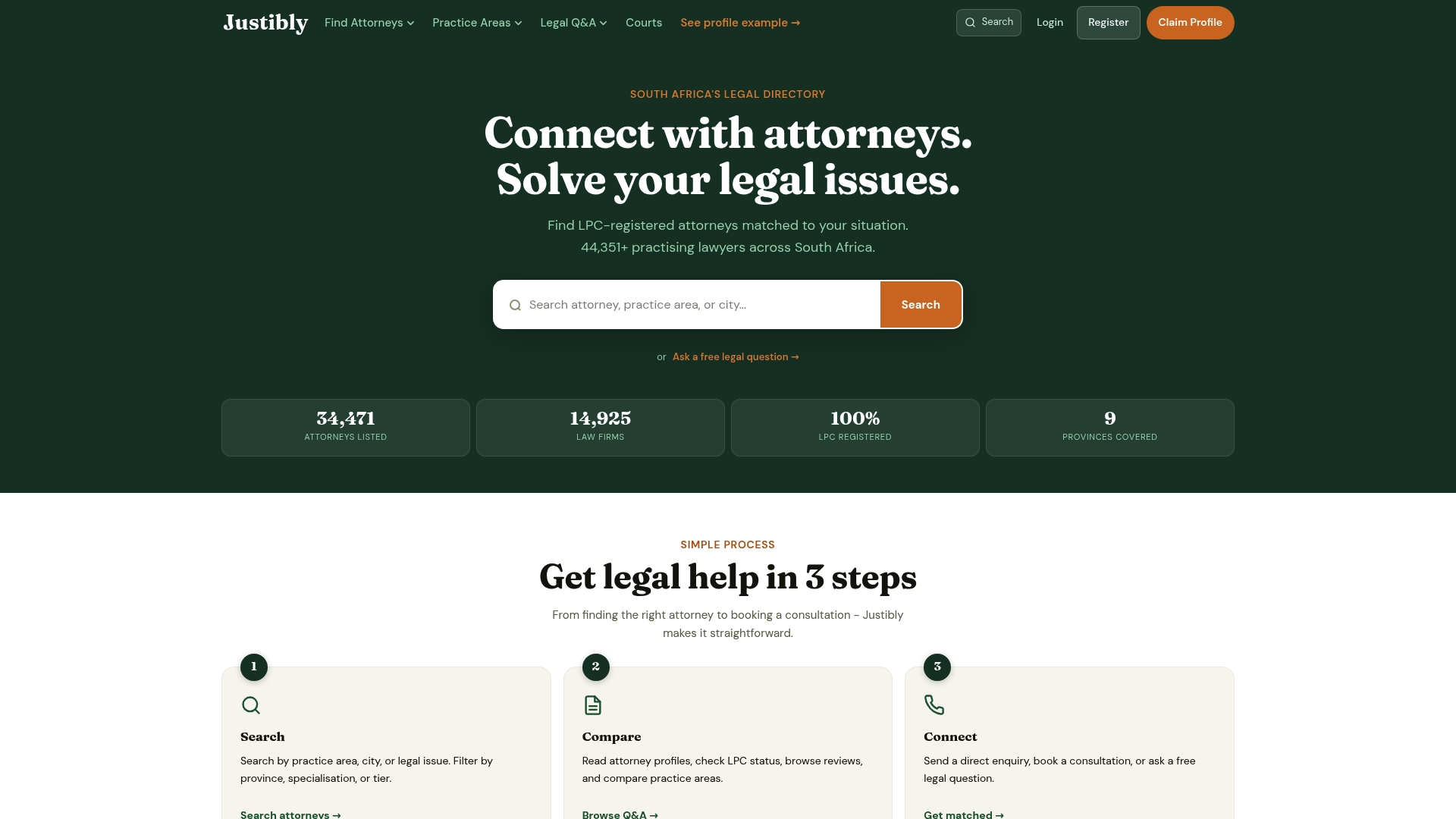
Start on the Justibly home page to find a lawyer near you. Prefer a quick question first? Post it on the free legal Q&A. If you are in the Western Cape, our Cape Town labour law attorneys page is a good starting point for employment matters.
A simple plan for your first year
You do not have to buy every service at once. A sensible order for most new owners:
- Structure first. Choose a sole proprietorship, partnership or company with your attorney and accountant, and make sure the registration paperwork matches.
- Core contracts second. Have your standard customer terms and your most important supplier agreement reviewed. These are the documents you will reuse most.
- People third. Put written employment contracts in place before day one. The first hire is where informal habits start.
- Compliance fourth. Handle POPIA once you hold customer data, which is almost immediately for most businesses.
- Protect what you build. Register your trademark or secure IP ownership before you invest heavily in the brand.
Templates have a place. One legal training provider says none of the foundations has to come from an expensive template mill or a generic overseas document, and that the question is when a template is enough and when it is not. The answer usually depends on the stakes: a standard NDA is a different matter from your only supply agreement.
FAQ
How much does a small business lawyer cost in South Africa?
It depends on the work. Published fixed fees for single documents start around R950 for a contract review and R1,500 for contract drafting. Open-ended matters are billed hourly, and one provider says rates can reach R4,000 per hour. Ask for a fixed fee or a retainer when the task is clearly defined.
Do I need a lawyer to register a company?
Not strictly, but it helps when there is more than one owner or when you want a custom memorandum of incorporation. A lawyer can draft the MOI and a shareholders agreement so ownership rules are clear from the start. Published fixed fees for these start from R2,900 for a custom MOI and R3,900 for a shareholders agreement.
How do I check that a lawyer is registered?
Ask for the attorney's LPC number and verify it with the Legal Practice Council. The LPC has launched an online tool that confirms registration and whether the attorney holds a valid Fidelity Fund Certificate. You can also search Justibly, where attorney listings reflect verified LPC data.
When should a small business hire a lawyer instead of using a template?
Hire one when the document could materially affect the business or your personal assets, such as a lease, a guarantee, an investor agreement or your only supply contract. Size alone is not the test. For routine, low-stakes documents, a reviewed template may be enough.
Sources
- When to Hire a Commercial Lawyer in South Africa
- Legal Retainer, Kellerman Joubert Heyns Inc
- When Does Your Business Actually Need a Commercial Lawyer?
- The Top Commercial Law Service Providers in South Africa
- MSME Legal
- Legal Services for Business: Contracts, MOIs & More
- Services and Price List, Lay Law
- Clientèle Legal Plans for business
- Lower Legal Costs for SMEs
- How to verify an attorney in South Africa
- Forged documents and misconduct cases: why you should verify your lawyer
Recommended
By the Justibly editorial team
Published
General legal information for South Africa, checked against the Legal Practice Act, the relevant court rules and the Legal Practice Council roll. It is not legal advice and does not create an attorney-client relationship. For advice on your situation, consult an admitted attorney.
How we research and review · How the Trust Score works · Report an error