12 Questions to Ask a Lawyer in South Africa, with LPC Checks and Answer Cues
A consultation-ready checklist of 12 questions to ask a lawyer in South Africa, with sample good answers, LPC checks and Justibly.
Published

Ask about years of practicing, experience with cases like yours, who on the team will actually handle your file, the fee structure in writing, and how often you'll get updates. These five questions to ask a lawyer expose more about competence and honesty than anything on a website bio. Write down every answer, and don't leave the first meeting without a written fee agreement.
TL;DR:
- Avoid hiring a lawyer who cannot specify their experience handling cases similar to yours, especially in the specific practice area you need help with.
- Confirm who will be managing your case daily and ensure their name and role are clearly communicated upfront to prevent surprises later.
- Insist on a written fee agreement that outlines the billing structure, estimated total costs, and disbursements to prevent hidden charges.
- Assess each lawyer’s responses for specificity, realism, transparency, and documentation to identify red flags and avoid ineffective representation.
- Use verified directories to shortlist LPC-registered attorneys and prepare your questions in advance to streamline the consultation process.
Table of Contents
- The essential questions to ask a lawyer at your first meeting
- What to bring to your first legal consultation
- How to verify a lawyer's credentials before hiring
- Evaluating answers: a simple rubric for spotting red flags
- Availability for in-person or remote meetings
- Ask about mediation and arbitration experience
- How involved will you be as your case moves forward?
- Common mistakes clients make when hiring a lawyer
- Find and verify an attorney faster with Justibly
- Sources
- FAQ
The essential questions to ask a lawyer at your first meeting
A first consultation is really an interview, and you're the one hiring. Most people walk in nervous about their legal problem and forget they're also evaluating a professional they might pay thousands of rand to. The questions below cover experience, money, process, and character, roughly in the order a good conversation would raise them.
1. How long have you practiced, and how much of that time was in this area of law? General experience means little if it's not in the field you need. A strong answer names a specific number of years and describes a shift into specialization, not just "a long time." A red flag is vague deflection like "long enough."
2. What's your primary practice area, and have you handled cases like mine? You want a lawyer whose daily work overlaps with your problem, not someone who dabbles. A good answer describes two or three comparable matters and their general shape. Watch for a lawyer who can't recall a single similar case.
3. Who will actually handle my file, day to day? Many firms quote a senior partner's experience, then hand the file to a junior associate you never meet. Attorney-selection guidance recommends asking this outright, because clarity here prevents surprises later. A credible answer names the person and their role plainly.
4. What's your fee structure, and can I get it in writing? Hourly, fixed, or contingency, each suits different matters, and written fee agreements are standard practice. A good lawyer offers a written estimate without being pushed. Reluctance to put numbers on paper is one of the clearest red flags going.
5. What will the total cost likely look like, including disbursements? Hourly rates alone don't tell you much. Ask for a range covering filing fees, expert costs, and estimated total hours.
6. How do you handle client trust funds and billing transparency? Failure to account for client money is one of the most common complaint triggers the Law Society tracks. A trustworthy answer explains statements and audit practices without hesitation.
7. What outcomes are realistic, and how long will this take? Nobody can promise a result, but a competent lawyer can frame probabilities and timelines. Listen for ranges and conditions rather than certainty.
8. How often will you update me, and through which channel? Email, phone, or a client portal, the method matters less than the commitment. Vague answers like "we'll be in touch" tend to predict poor communication later.
9. Do you have any conflicts of interest with this matter? A lawyer should check this before agreeing to take you on, not after. Silence or hesitation here deserves a follow-up question, not a shrug.
10. Can you share examples of similar matters you've resolved? Specifics beat generalities. Ask for the shape of the outcome, not confidential details.
11. What's your strategy for a case like mine? Even a preliminary answer shows how the lawyer thinks. A non-answer at this stage often means underprepared, not just cautious.
12. What happens next, and when? Every consultation should end with clear next steps and a rough timeline for the first move.
Pro Tip: Ask permission to record the meeting on your phone, and request the fee agreement in writing before you leave. Verbal promises are hard to enforce, but a signed document backs you up if a dispute ever arises.
What to bring to your first legal consultation
Preparation shortens the meeting and sharpens the answers you get. Consultations typically run 30 to 60 minutes, and some lawyers charge for that time while others offer it free, so ask when you book.
- Government-issued ID and, where relevant, proof of address
- Any contracts, agreements, or documents tied to the dispute
- Correspondence with the other party, including emails and letters
- A written timeline of events with dates, even a rough one
- Notes on what outcome you're hoping for and any deadlines you're facing
Bring a notebook or your phone for typed notes, and ask upfront whether recording is acceptable. Before you leave, confirm the fee structure, who will handle your file, and the next concrete step, so nothing gets lost between the handshake and the follow-up email.
How to verify a lawyer's credentials before hiring
Confirming a lawyer's standing takes minutes and removes most of the guesswork. Start with the Legal Practice Council's practitioner search, which confirms whether someone holds a valid practicing certificate and is properly admitted.
- Search the LPC register by full name to check admission status and certificate validity
- If the name doesn't appear, treat that as a serious warning sign, not a clerical oversight
- Ask the practice directly for clarification if the register shows anything unclear
- Request references or examples of past clients in comparable matters
- Review the LSSA's client rights guidance to understand what reasonable service looks like
A valid certificate confirms someone is legally entitled to practice, though it says nothing about how responsive or transparent that person will be with you specifically.
Evaluating answers: a simple rubric for spotting red flags
Judge each answer on four things: specificity, realism, documentation, and transparency. A lawyer who names dates, numbers, and comparable cases scores higher than one who speaks only in generalities.
- Specificity — Vague answers about experience or strategy usually mean thin preparation, not modesty.
- Realism — Guarantees of outcome are a professional red flag; honest lawyers speak in probabilities and options, never certainties.
- Documentation — A lawyer willing to put fees and scope in writing signals confidence in their own process.
- Transparency — Evasive answers about billing, trust accounting, or communication frequency should push you toward a second opinion.
If two or more of these categories raise concerns, don't feel obligated to commit on the spot. A second consultation with another attorney costs little compared to a bad hire.
Availability for in-person or remote meetings
Ask directly whether the lawyer offers remote consultations, and how quickly they can schedule an in-person meeting if your matter requires it. Some firms still default to office visits only, which becomes a real obstacle if you live far from their practice or have mobility or scheduling constraints.

A lawyer working across multiple matters should be able to offer video calls for routine updates and reserve in-person time for signing documents, mediation sessions, or court appearances. Ask what platform they use for calls, whether they answer emails on weekends, and what the typical gap is between sending a message and getting a reply.
This matters more than it sounds. A drawn-out property dispute or a divorce that stretches over months means dozens of small check-ins, and a lawyer who's hard to reach turns every one of those into friction. Confirm this upfront rather than discovering it three weeks into your case, when switching lawyers becomes expensive and disruptive.
If your matter is straightforward, a lawyer who only meets in person might still work fine. But if you're juggling work, family, or distance, ask this question early and weigh the answer against how complicated your matter is likely to get.
Ask about mediation and arbitration experience
Not every legal problem needs a courtroom. Ask whether the lawyer has handled mediation or arbitration, and how often they steer clients toward those routes instead of litigation.
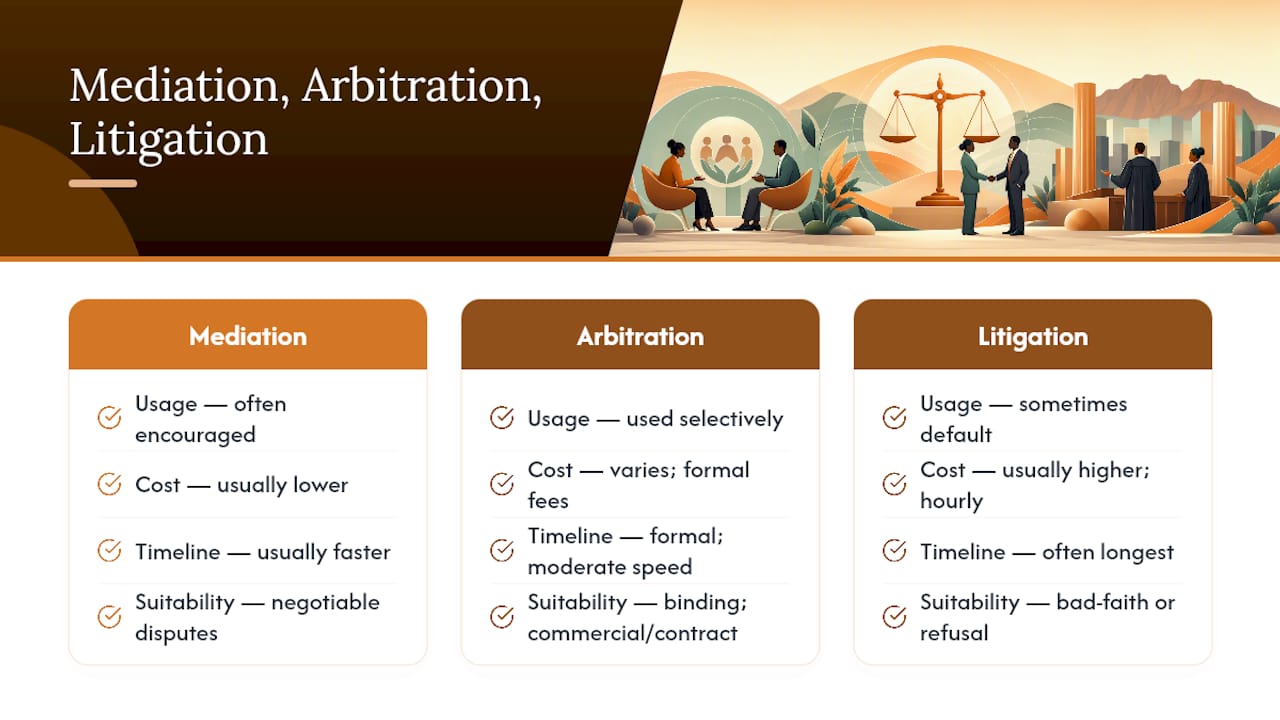
Mediation puts both sides in a room with a neutral third party to negotiate a settlement, usually faster and cheaper than a trial. Arbitration is more formal, with a decision-maker who issues a binding ruling outside the court system. Divorce, workplace disputes, and many commercial disagreements often settle through one of these paths before ever reaching a judge.
A lawyer with genuine ADR experience should describe specific cases where mediation worked, and be honest about when it doesn't. Some disputes, particularly ones involving bad faith or a party unwilling to negotiate, genuinely need litigation. What matters is whether the lawyer defaults to court because that's familiar, or actually weighs which path suits your situation and budget.
Ask how they charge for mediation sessions compared to litigation hours, since the cost structure often differs. A lawyer who can't answer this clearly, or who dismisses ADR outright without explaining why, may be steering you toward the more expensive, more adversarial option by default rather than by judgment.
How involved will you be as your case moves forward?
Ask how much input you'll have at each stage, and how decisions get made when strategy shifts. Some lawyers run the file almost entirely on their own judgment and only loop you in for signatures. Others check in constantly, sometimes more than clients want.
Neither style is wrong, but you need to know which one you're getting. Ask specifically: will you be consulted before major decisions, like accepting a settlement offer or changing legal strategy? Will you get copies of filed documents and correspondence, or summaries only?
A good answer describes a rhythm, weekly updates, milestone check-ins after filings or hearings, and a clear channel for questions in between. Communication failures rank among the most common client complaints the Law Society tracks, and most of those complaints trace back to expectations that were never set clearly at the start.
Ask what happens if you disagree with a proposed strategy. A lawyer who bristles at the question, or insists you'll simply trust their judgment without explanation, is telling you something about how the relationship will run once the pressure is on.
Common mistakes clients make when hiring a lawyer
People hire on gut feeling, skip the Legal Practice Council check, or never confirm who's actually handling their file until weeks in. Verified profiles and practice-area filters cut that guesswork down fast. Whatever you agree on, get the fee terms and communication commitments in writing. That single habit prevents most disputes before they start.
— Nkosi
Find and verify an attorney faster with Justibly
Running down all twelve questions and checking a name against the LPC register takes real time, especially when you're already stressed about a legal problem. Justibly's directory lists only LPC-registered attorneys, filtered by practice area and province, so you skip straight to candidates who've already cleared the credential check this article walks through.
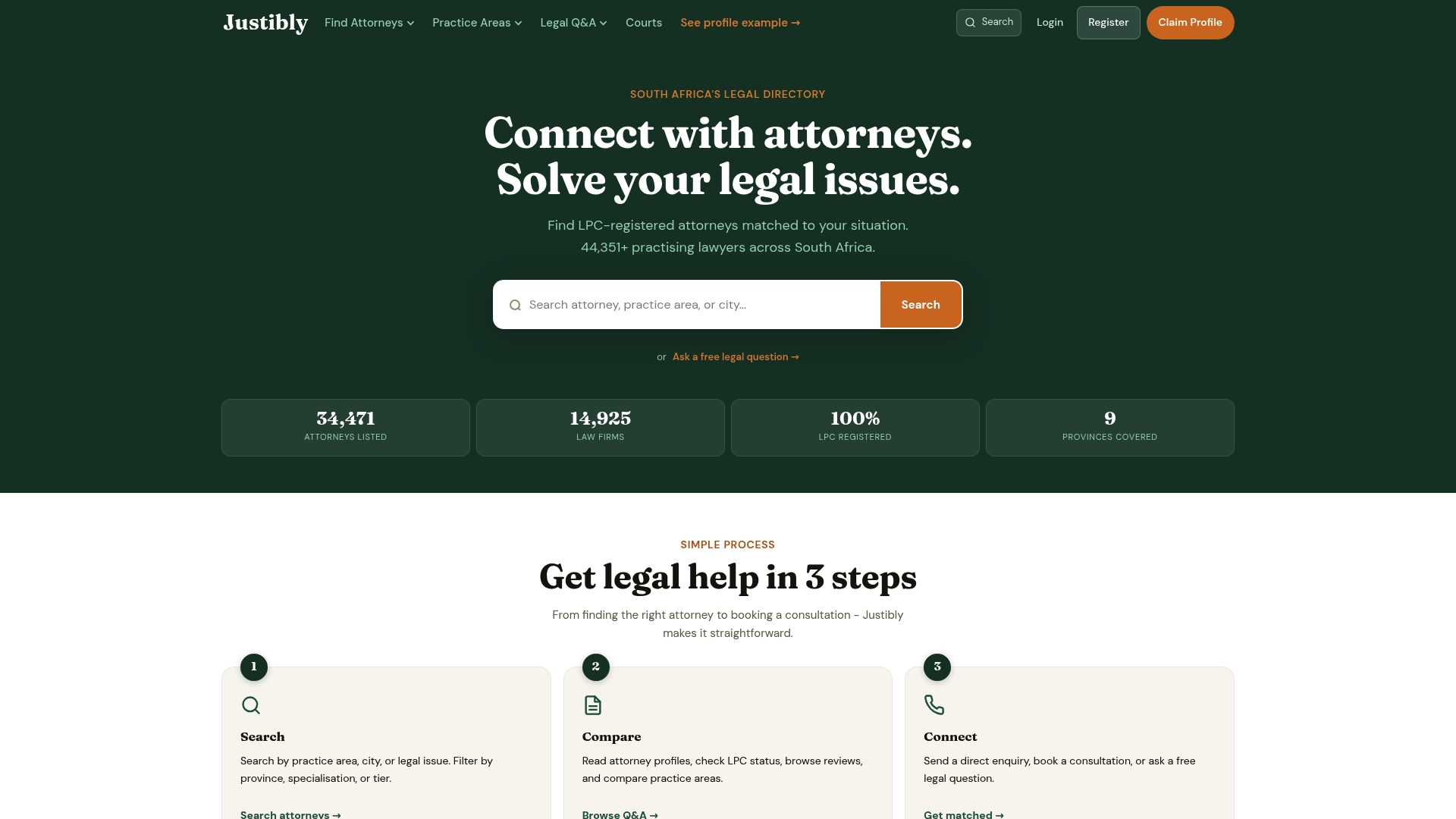
Every profile shows practice focus and location, which helps you shortlist lawyers before you've spent a single consultation slot. If your question is small enough that a full consultation feels like overkill, Justibly's free legal Q&A forum connects you with registered attorneys for a quick answer at no cost. For deeper prep, the site's legal guides walk through specific processes like divorce or debt review in more depth than any single consultation can. Start your search on Justibly's attorney directory and bring your shortlist, and your questions, into the first meeting ready to go.
Sources
- Search Practitioners - Legal Practice Council
- Your rights as a client - LSSA
- Client expectations and the professional duties of a legal practitioner
This article is general information, not a substitute for advice from a qualified lawyer. Consult a qualified legal professional about your own circumstances before acting on anything here.
FAQ
What is the best question to ask a lawyer?
Ask who will actually handle your file day to day, since many firms quote senior experience but assign junior associates to the real work.
What are red flags when hiring a lawyer?
Guarantees of a specific outcome, evasive answers about fees, slow communication, and unclear handling of trust funds all signal you should look elsewhere.
How do I check if a lawyer is properly registered?
Search the Legal Practice Council's practitioner register by full name to confirm admission status and a valid practicing certificate.
Should I get the fee agreement in writing?
Yes, always request a written fee agreement covering the billing structure and an estimate of total costs before work begins.
How can I compare lawyers before choosing one?
Use a directory like Justibly to filter LPC-registered attorneys by practice area and location, then run the same question checklist across two or three candidates before deciding.
Recommended
By the Justibly editorial team
Published
General legal information for South Africa, checked against the Legal Practice Act, the relevant court rules and the Legal Practice Council roll. It is not legal advice and does not create an attorney-client relationship. For advice on your situation, consult an admitted attorney.
How we research and review · How the Trust Score works · Report an error