Employment Contract Requirements in South Africa
What South African law requires in an employment contract: written particulars under the BCEA, fixed-term rules, ending a contract, and the CCMA steps and forms.
Published

South African law does not strictly require an employment contract to be in writing. It does require the employer to give every covered employee written particulars of the job when work starts, and those particulars are what a good contract is built around. This guide covers what must be in the contract, how permanent and fixed-term contracts differ, what happens when a fixed-term contract ends, and how the CCMA process and forms work if a dispute follows.
TL;DR
- A verbal agreement can be a valid contract, but section 29 of the Basic Conditions of Employment Act (BCEA) obliges the employer to hand over written particulars when employment begins.
- The particulars cover who the parties are, the work, hours, pay, deductions and more. Putting them in a signed contract is the safest way to comply.
- Fixed-term contracts are lawful, but repeated renewals can create a reasonable expectation of permanent work, and non-renewal can then count as a dismissal.
- In a dismissal dispute you generally have 30 days to refer to the CCMA, so act quickly.
- Not sure what your contract says? Compare it with the checklist below, then speak to a registered labour attorney.
Table of Contents
- Does an employment contract have to be in writing?
- What must be in an employment contract
- Types of employment contract
- Fixed-term contracts: when and how long
- Ending a fixed-term contract
- Notice of termination
- If a dispute arises: the CCMA process
- Common mistakes to avoid
- Perspective: why a registered attorney matters here
- Find an attorney to review your contract
- FAQ
- Sources
Does an employment contract have to be in writing?
No. At common law the parties do not have to observe any formalities, and professional guidance on South African employment law confirms that a contract need not be written. A handshake or an email exchange can create a binding employment relationship.
The catch is the BCEA. Section 29 of the Act says the employer must supply written particulars of employment when the employee starts. So even if nobody signs a formal document, a written record is still owed. The same guidance calls a written contract highly advisable for exactly this reason: one document does both jobs.
There are limits to who is covered:
- The BCEA chapter on particulars does not apply to employees who work fewer than 24 hours a month.
- Employers with fewer than five employees get an exception, but only for certain specified particulars and provisions, not for the whole duty.
- Senior employees above the earnings threshold keep many BCEA rights, but some protections, such as the fixed-term rules discussed below, apply only below it. The threshold is adjusted by the Minister of Employment and Labour, so check the current figure on the Department's website.
In practice, the question is rarely "do we need a contract?" It is "can we prove what was agreed?" A written contract answers that for both sides.
What must be in an employment contract
Section 29 lists the written particulars. Here is a working checklist based on that section, grouped the way you would draft them. Confirm the details against the Act itself.
The parties and the job
- The full name and address of the employer.
- The name and occupation of the employee, or a brief description of the work.
- The place of work. If the employee works at various places, an indication of that.
- The date employment begins.
Hours, pay and deductions
- The employee's ordinary hours of work and days of work.
- The wage or the rate and method of calculating it, and any other cash payments.
- The value and nature of payments in kind, such as accommodation.
- How frequently remuneration is paid.
- Any deductions to be made from remuneration.
Leave, notice and other terms
- The leave to which the employee is entitled.
- The period of notice required to terminate employment, or, if employment is for a specified period, the date it ends.
- A description of any council or sectoral determination that covers the employer's business.
- Any period of employment with a previous employer that counts as employment with the present one.
- A list of any other documents that form part of the contract, and where the employee can see them.
The Consolidated Employers Organisation advises that building these particulars straight into the contract promotes consistent compliance, and that is sound practice. A contract that also covers confidentiality, restraint of trade, disciplinary procedure, probation and intellectual property is stronger still, though those are additions, not statutory minimums.
Terms you cannot contract out of
The BCEA sets minimum conditions: maximum ordinary hours, overtime rules, leave, notice and more. A contract can give an employee more than the minimum, but a term that gives less is not enforceable against the Act. If your contract says something that sounds below the legal floor, ask a labour attorney before you sign.
Types of employment contract
The SME Labour Support table of employment contracts describes the two main types: permanent contracts and fixed-term contracts. It also describes full-time, part-time and variable-time arrangements. A South African recruitment group adds casual work, apprenticeships and project-based work to the list.
| Type | How long it runs | How it ends |
|---|---|---|
| Permanent | Ongoing, no end date | Resignation, retirement, or dismissal for misconduct, incapacity or operational requirements |
| Fixed-term | A set period, or until a task or event | At the end date or event, or earlier by agreement or lawful termination |
| Part-time | Permanent or fixed, with fewer hours | As for the underlying contract |
| Project-based | Until the project is done | When the project ends |
The permanent-contract description comes from SME Labour Support. One arrangement to be careful with is the zero-hour contract. The recruitment group above notes that South African law does not formally recognise it, and that using one risks being labelled exploitative. If you are offered "work when we call you" with no guaranteed hours, get the hours and pay terms in writing.
Fixed-term contracts: when and how long
A fixed-term contract is valid, and it is the second most searched contract question on this topic. But it is regulated. Section 198B of the Labour Relations Act (LRA) came into operation on 1 January 2015, as the Labour Appeal Court records, and it limits how long an employer can keep someone on successive fixed terms without a good reason.
The working rule is often called the three-month rule. For employees below the earnings threshold, an employer who wants to fix the term beyond three months should have a justifiable reason, and should state it in the contract. Examples of justifiable reasons in the section include replacing an employee who is temporarily absent, a temporary increase in work that is not expected to last, a specific seasonal task, a project with a defined end, and a student or recent graduate in a training programme. The full list is in section 198B itself, which you can read through our explanation of the Labour Relations Act.
The Key Recruitment Group puts the practical point plainly: repeated renewals beyond three months can create a reasonable expectation of permanent employment, so employers should record the justification for fixing the term.
Two cautions for employees:
- Section 198B protects employees below the earnings threshold. Above it, the contract terms govern, along with the BCEA minimums.
- Some employers and some kinds of work are excluded, so the section does not fit every situation. If you are unsure, ask an attorney.
A fixed-term contract checklist
If you are signing one, look for:
- The exact start and end date, or the event that ends it.
- The reason the term is fixed, if it runs beyond three months.
- What happens at the end: is renewal possible, and on what terms?
- Notice and early termination rights for both sides.
- Pay, leave and benefits, and whether they match permanent staff doing similar work.
The last point matters. The LRA generally requires that employees on fixed terms beyond three months are not treated less favourably than comparable permanent employees, unless there is a justifiable reason.
Ending a fixed-term contract
A fixed-term contract ends automatically when the term expires. Normally no notice or dismissal procedure is needed. The risk starts when the employer does not renew.
SME Labour Support explains that non-renewal counts as a dismissal under section 186(1)(b) of the LRA only where the employee reasonably expected renewal on the same or similar terms, and the employer did not renew or offered less favourable terms. The employee has to establish that expectation. Things that tend to support it include:
- A promise or statement that the contract would be renewed.
- A history of renewals, especially several in a row.
- The same work continuing after you leave.
- An employer practice of keeping fixed-term staff on.
If the non-renewal is a dismissal, the employer must show it was fair. If you think that is your situation, read our guide to unfair dismissal and move fast, because the referral clock is short.
Terminating a fixed-term contract before its end date is a different matter. Unless the contract has an early termination clause, ending it early can amount to a breach, and a dismissal during the term must be procedurally and substantively fair. Probation periods have their own rules, which we cover in our probation guide.
Notice of termination
For permanent employees, the BCEA sets minimum notice periods that grow with service, and the contract may offer longer ones. Notice must be given in writing, except where it is given to or by an illiterate employee, in which case it must be explained orally in a language the employee understands. State the notice period in the contract so there is no argument later.

If a dispute arises: the CCMA process
The Commission for Conciliation, Mediation and Arbitration (CCMA) is where most employment contract disputes begin. The CCMA explains that the first meeting is usually conciliation. If there is no agreement, the dispute may go to arbitration or the Labour Court, depending on its nature.
Referral deadlines
| Type of dispute | Time limit to refer |
|---|---|
| Unfair dismissal | 30 days |
| Unfair labour practice | 90 days |
| Discrimination | Six months |
These limits come from the CCMA. Late referrals need an application for condonation, which is not guaranteed. Our 30-day labour law checklist lays out what to gather in that first month.
Step by step
- Complete LRA Form 7.11 to refer the dispute. The CCMA says the form is used to refer a dispute, and LRA Form 7.13 is used to request arbitration.
- Serve a copy on the other party and keep proof of service. You must submit that proof with the referral.
- File the form. According to the CCMA, referrals can be made at a CCMA office, by fax or post, by email to the relevant regional office, or on the CCMA's online referral platform.
- Attend conciliation. A commissioner tries to help the parties settle. If they do, the commissioner must help them draft an enforceable agreement that brings the dispute to an end, as the CCMA describes. A signed settlement that is not honoured can be made an arbitration award and enforced like a Labour Court order.
- If conciliation fails, request arbitration with LRA Form 7.13 within 90 days of the conciliation certificate, serving it on the other side as before.
Some disputes, such as certain probation-related dismissals or labour practices, run through Con-Arb, where conciliation and arbitration happen in one continuous process. Come to that first date ready to present your case, not only to talk.
For a fuller walkthrough, see our CCMA process guide. If the matter ends up in the Labour Court, you will find the relevant registry on our pages for Johannesburg, Cape Town, Durban and Gqeberha.
Common mistakes to avoid
- Signing without reading the clauses on pay and deductions. Deductions must be agreed or lawful. Check them before day one.
- Leaving the end date vague. A fixed-term contract should say exactly when and why it ends.
- Relying on promises. If a manager says the contract will be renewed, ask for it in writing. It also helps show a reasonable expectation later.
- Missing the deadline. Thirty days passes quickly after a dismissal. Do not wait for an internal appeal to finish before checking your referral dates.
- Using a generic template without adapting it. A template that ignores a sectoral determination or bargaining council agreement can leave out terms that apply to you by law.
Perspective: why a registered attorney matters here
We see the same pattern in the questions people bring to Justibly. A contract is signed in a hurry, nobody checks the particulars, and the problem only appears when the job ends and the 30-day clock is already running.
Our view is that a short review by an LPC-registered attorney before you sign, or at the first sign of trouble, costs far less than a dispute. That is why every attorney listing on Justibly reflects verified Legal Practice Council data, with no paid positioning, and why answers on our free Q&A forum come only from registered lawyers.
Use the forum for a quick first opinion on a clause. Use the directory when you need someone to draft, review or represent you at the CCMA.
Nkosi
Find an attorney to review your contract
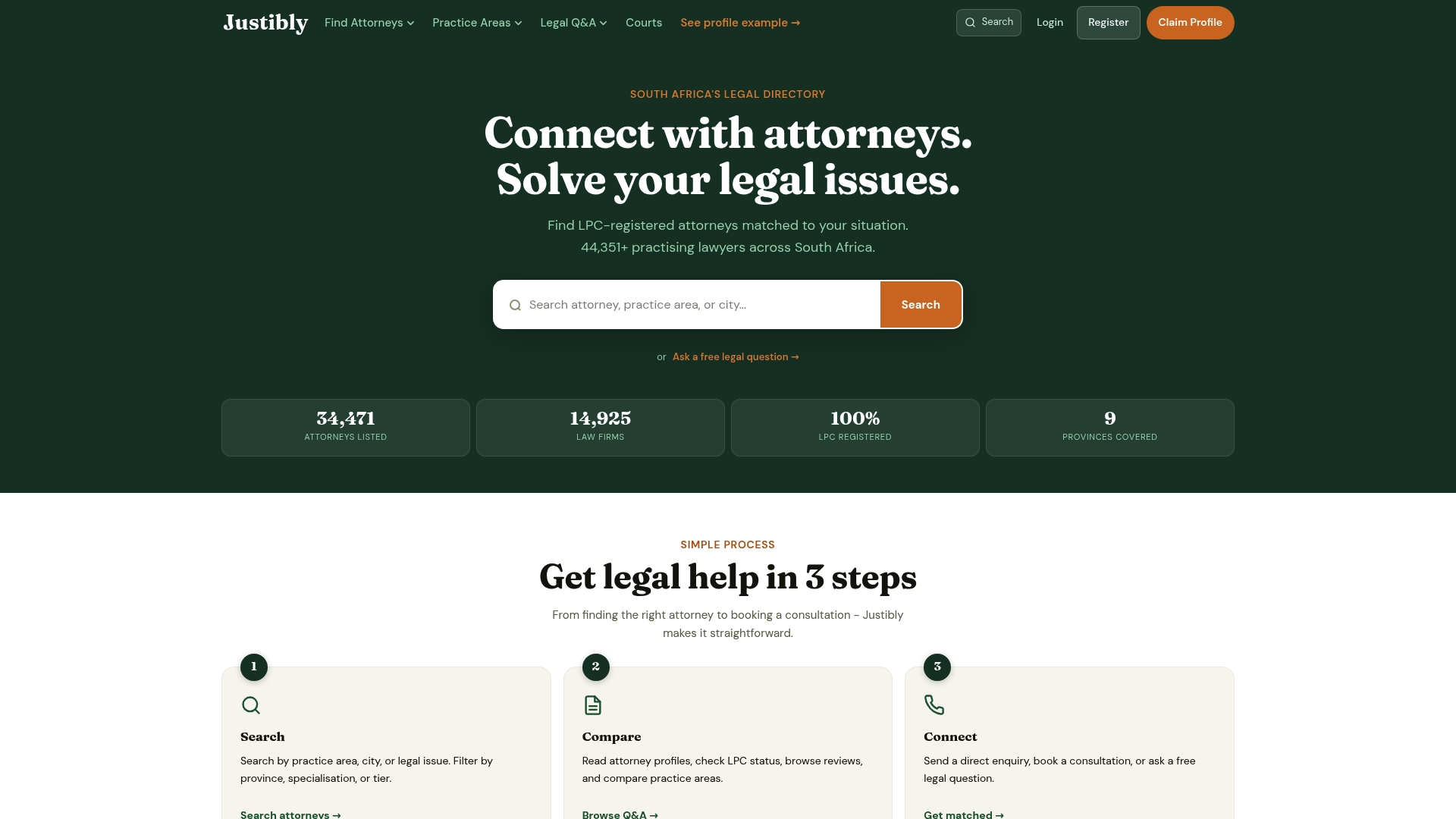
If you want a labour attorney to check a contract, or to help with a CCMA referral, search the Justibly directory by practice area and location. Listings are drawn from LPC data, and you can ask a question on the free forum first if you only need a quick answer.
Attorneys and firms can claim their profile and reach people searching for employment law help. Professional is R499 per month, Premium is R999 per month and Firm Professional is R1499 per month, with the full list on our pricing page.
FAQ
Is a verbal employment contract valid in South Africa?
Yes, a verbal agreement can create a valid employment relationship. The employer must still give the employee written particulars under section 29 of the BCEA. Proving verbal terms is hard, so ask for everything in writing.
How long can a fixed-term contract last?
The law does not set one maximum for all cases. For employees below the earnings threshold, fixing the term beyond three months needs a justifiable reason, and the employer should record it. Repeated renewals can create an expectation of permanent employment.
What happens if my fixed-term contract is not renewed?
It is a dismissal only if you reasonably expected renewal on the same or similar terms and the employer did not renew or offered worse terms. You must show that expectation. If you think this applies, refer the dispute to the CCMA within 30 days.
Which CCMA forms do I need?
LRA Form 7.11 refers a dispute to the CCMA, and LRA Form 7.13 requests arbitration after a failed conciliation. Serve a copy of each on the other party and keep proof of service. Check the CCMA website for the current versions.
Can I be given a contract after I have started work?
The employer must supply written particulars when employment starts. If you have worked without them, ask in writing for them now. If the employer refuses, a labour attorney or the Department of Employment and Labour can advise.
Sources
- Basic Conditions of Employment Act, Department of Employment and Labour
- Global Employment Compass: South Africa
- Should I add this to my employment contract? The BCEA's written particulars
- Table: Employment Contracts, SME Labour Support
- Understanding Employment Contracts in South Africa
- Labour Appeal Court judgment on section 198B
- What happens when a fixed-term contract comes to an end?
- CCMA: Have you been unfairly dismissed or unfairly treated at work?
- CCMA: Get advice
- CCMA: Conciliation
- CCMA: Con-Arb
Recommended
By the Justibly editorial team
Published
General legal information for South Africa, checked against the Legal Practice Act, the relevant court rules and the Legal Practice Council roll. It is not legal advice and does not create an attorney-client relationship. For advice on your situation, consult an admitted attorney.
How we research and review · How the Trust Score works · Report an error