Act Within 30 Days: South African Labour Law Checklist
South African labour law made practical: CCMA forms and referral deadlines, enforcement steps, and how to find LPC lawyers on Justibly.
Published

Labour law governs every part of the employment relationship: what must be in a contract, how much someone must be paid, when a dismissal is fair, and where to complain when it isn't. If you have a workplace problem right now, do three things immediately: check your written particulars of employment, keep every payslip and message you have, and note the deadline for your type of dispute before it runs out.
TL;DR:
- Most employment disputes are settled on procedural failures, such as missing written particulars or failing to keep proper records, rather than on the merits of the case.
- Employers must issue written particulars on day one, ensure payslips are accurate and timely, and follow sector-specific or industry-specific minimum requirements to avoid CCMA losses.
- Non-compliance penalties include fines, criminal prosecution, or enforcement actions based on violations of the BCEA, OHSA, COIDA, or EEA, often long after the initial breach.
- Clear documentation of disciplinary procedures, fair notice, and proper consultation during retrenchments are crucial to defending against unfair dismissal claims.
- Accurate sector and industry knowledge, including current minimum wages and sectoral regulations, is essential to correctly classify workers and avoid backdated employment liabilities.
Table of Contents
- What does labour law actually cover? The main statutes explained
- What rights does the BCEA give employees around pay, leave and safety?
- What must employers do to stay compliant?
- Contracts, fixed-term work and employee classification
- When is a dismissal fair? Grounds and procedure explained
- How do you resolve a labour dispute? CCMA, bargaining councils and the Labour Court
- What remedies are available and what should you do right now?
- What's changing in labour law right now?
- Protected disclosures: what happens if you report wrongdoing?
- Do domestic workers, temporary workers and young workers get different protections?
- How is labour law actually enforced, and what are the penalties for breaking it?
- What are the basic rules for a valid employment contract?
- The gap between the law on paper and how disputes actually play out
- How Justibly helps you find a labour law attorney or a fast answer
- Primary sources worth bookmarking
- Sources
- FAQ
What does labour law actually cover? The main statutes explained
South African labour law is not one document. It is a cluster of Acts, each covering a different slice of the employment relationship, and knowing which one applies to your problem saves weeks of confusion.
The Labour Relations Act (LRA) governs dismissals, disciplinary procedures, collective bargaining, strikes, and the machinery of dispute resolution itself: the CCMA, bargaining councils, and the Labour Court. If you've been fired, demoted, or subjected to unfair treatment at work, the LRA sets the test for whether that was lawful. It requires dismissals to satisfy both substantive and procedural fairness, and it built the entire statutory framework for conciliation, arbitration and the Labour Court.
The Basic Conditions of Employment Act (BCEA) deals with the mechanics of the job itself: hours of work, overtime, leave, notice periods, and what must be written down. Every employer must provide written particulars of employment from day one, covering the parties, place of work, start date, job description, hours, pay, overtime rates, deductions, and notice terms. Miss this and you've already breached the Act before any dispute even starts.
The Employment Equity Act (EEA) targets discrimination and workplace equity. It bars unfair discrimination on grounds like race, gender, disability, and religion, and it requires designated employers to run affirmative action programmes and report annually.
The National Minimum Wage Act (NMWA) sets the wage floor below which no employer, in any sector, may pay a worker (subject to specific exemptions for some categories).
The Occupational Health and Safety Act (OHSA) puts the legal duty for a safe workplace on the employer, covering everything from machinery guarding to the right to refuse genuinely dangerous work.
The Compensation for Occupational Injuries and Diseases Act (COIDA) provides no-fault compensation for workers injured or made ill on the job, replacing the right to sue the employer directly in most cases.
The Skills Development Act funds and regulates workplace training through Sector Education and Training Authorities (SETAs), and it's the reason your payslip shows a Skills Development Levy deduction.
A few things to keep straight when you're trying to figure out which Act applies:
- The BCEA sets minimums that cannot be contracted below, only improved on.
- The EEA's affirmative-action duties fall mainly on "designated employers" (usually those above a certain headcount), not every small business.
- Domestic workers, farmworkers, and some other categories fall under sector-specific determinations layered on top of the general Acts.
- OHSA duties apply regardless of company size; there is no small-employer exemption for basic safety obligations.
Reading the Acts directly matters more than most guides suggest. Summaries simplify, and simplification is exactly where disputes get lost. If a "typical" explanation of notice periods doesn't match what your contract says, the Basic Conditions of Employment Act itself, not a blog post, settles it.
What rights does the BCEA give employees around pay, leave and safety?
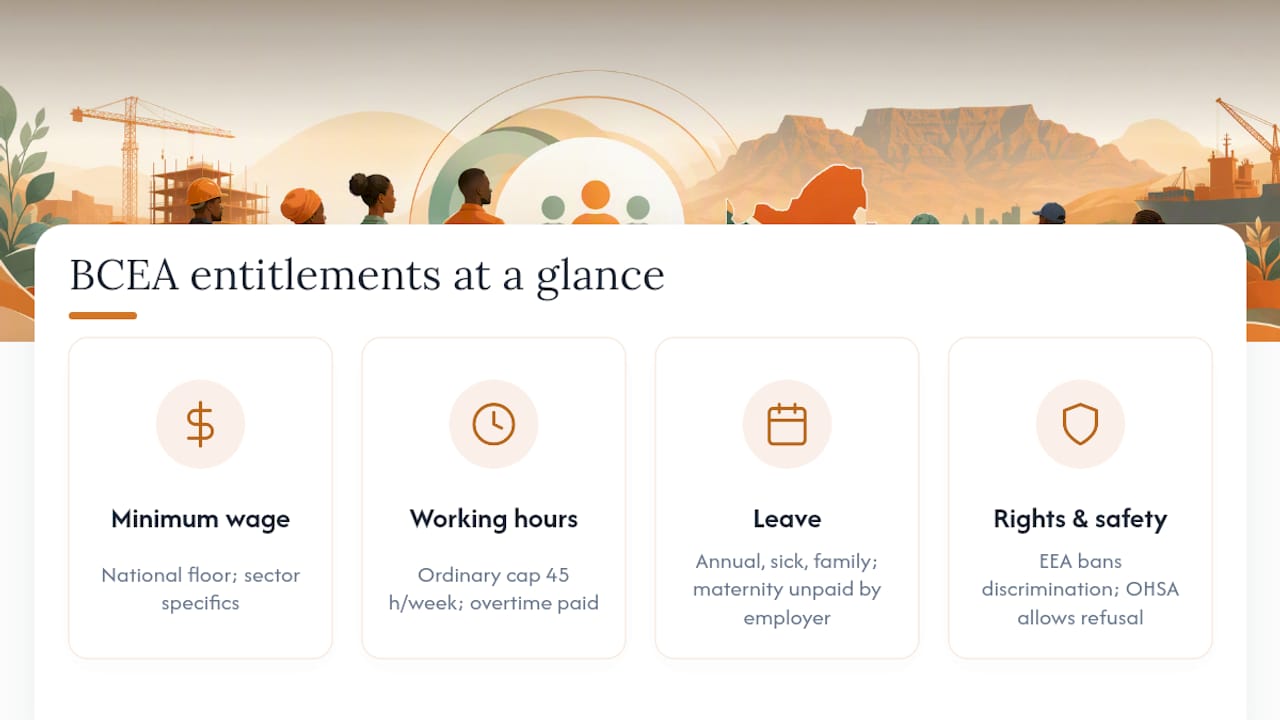
Every full-time employee in South Africa has statutory floors on pay, hours, and leave that no contract can undercut. Here's what those floors actually look like.
Minimum wage. The national minimum wage applies across virtually all sectors, with limited variations for specific categories like farmworkers and domestic workers in earlier years (these have largely converged with the general rate, though it's worth checking the current gazetted figure before assuming). Sectoral determinations can set additional terms for particular industries, so always check the specific determination for your sector rather than assuming the general NMWA rate is the whole story.
Working hours. The BCEA caps ordinary working time at 45 hours a week for most employees, with overtime capped and paid at a premium rate (generally time and a half) unless a valid exemption or collective agreement says otherwise. Employees are entitled to a daily rest period and a weekly rest period, and there are specific rules on Sunday work and night work allowances.
Leave. Employees earn annual leave, sick leave, and family responsibility leave under the BCEA, alongside parental and maternity leave provisions. This is where a common misunderstanding causes real financial stress: maternity leave itself is generally unpaid by the employer under the BCEA. The employee doesn't go without income by default, but they must apply separately to the Unemployment Insurance Fund (UIF) for maternity benefits, which pay out on a sliding scale up to a ceiling. Waiting until the leave starts to apply for UIF benefits is one of the most common, and most avoidable, mistakes employees make.
Equal treatment and safety. The EEA prohibits unfair discrimination in any employment policy or practice, from recruitment through to dismissal, and gives employees a route to challenge it. Separately, OHSA gives every employee the right to refuse work that poses a serious and imminent danger to health or safety, without that refusal itself being treated as misconduct, provided the danger is genuine and the refusal is reported properly.
Pro Tip: Keep a personal folder, physical or digital, with every payslip, your written particulars, and any leave or disciplinary correspondence. Employers are required to keep these records too, but disputes move faster when you're not waiting on someone else to produce them.
One structural point that changes how you should read every one of these entitlements: the BCEA functions as a legal floor. Terms that fall below the BCEA minimums are simply unenforceable, even if you signed a contract agreeing to them. Employers and employees can agree to better terms. They cannot agree to worse ones, no matter what the signed document says.
What must employers do to stay compliant?
Compliance isn't optional documentation. It's the difference between winning and losing a CCMA case months from now, because a commissioner will ask for the paper trail before asking for your side of the story.
Run through this checklist against your own business:
- Issue written particulars on day one. Every employee needs a document covering the role, hours, pay, deductions, notice period, and any applicable collective agreement or sectoral determination, matching the BCEA's specific list of required particulars.
- Issue compliant payslips every pay period, itemizing gross pay, every deduction, and net pay, as required under BCEA section 33.
- Register for and remit UIF, PAYE, and the Skills Development Levy (SDL) correctly and on time; UIF contributions in particular are what fund the maternity, illness, and unemployment benefits your staff will one day rely on.
- Keep employment records for the statutory retention period, covering hours worked, leave taken, and remuneration paid.
- Run OHSA-compliant safety training and incident reporting, with a designated safety representative if headcount requires one, and report notifiable incidents to the Department of Employment and Labour.
- Register with COIDA and report workplace injuries promptly; failure to register doesn't remove the employer's liability, it just removes the no-fault protection that registration would have given them.
- Check whether a sectoral determination or bargaining council agreement overrides your default obligations. Industries like security, hospitality, and cleaning often carry sector-specific minimums that sit above the general BCEA floor.
The employers who end up losing CCMA cases rarely lose on the facts of the dismissal itself. They lose because misclassification, missing contracts, and mishandled leave leave no defensible paper trail when a commissioner asks for one. A dismissal can be entirely justified on the merits and still get overturned because the employer can't prove the process was followed.
Pro Tip: If you're not sure whether a bargaining council agreement applies to your sector, check before you finalize a dismissal or disciplinary process, not after. Council agreements can impose stricter procedural requirements than the general LRA, and "we didn't know" is not a defence at arbitration.
Contracts, fixed-term work and employee classification
Most disputes that reach the CCMA didn't start as dismissal disputes. They started as arguments about what the contract actually said, or whether there was a real contract at all.
Written particulars aren't optional paperwork. The BCEA requires them from the first day of employment, and the list is specific: parties, place of work, job title and brief description, start date, ordinary hours, pay and how it's calculated, overtime rate, other cash payments, deductions, leave entitlement, notice period, and any collective agreement or sectoral determination that applies.
Fixed-term contracts create their own trap. A fixed-term contract that gets renewed repeatedly, especially where the work performed is genuinely permanent in nature, starts to look like an indefinite employment relationship in the eyes of the law. Non-renewal at the end of a fixed term can, in certain circumstances, be treated as a dismissal under the LRA if the employee had a reasonable expectation of renewal. Employers who use back-to-back fixed-term contracts to avoid permanent employment obligations are taking on real legal risk, not avoiding it.
Employee versus independent contractor is a factual test, not a label. Calling someone a "contractor" in a written agreement doesn't make them one if the underlying relationship looks like employment. Commissioners and courts weigh factors including:
- Whether the person works set hours dictated by the business, or sets their own schedule.
- Whether they use the business's tools, premises, and systems, or their own.
- Whether they work for one client exclusively or serve multiple clients.
- Whether they carry the financial risk of the work, or the business does.
- The degree of control the business exercises over how the work gets done.
Misclassification exposes an employer to backdated claims for BCEA leave, UIF contributions, and potentially unfair dismissal remedies, all calculated as if the "contractor" had been an employee the entire time.
Before offering someone contractor status instead of employment, ask honestly: does this person work exclusively for us, on our schedule, using our equipment? If the answer is yes to most of that, the label on the contract will not protect the business at arbitration.
When is a dismissal fair? Grounds and procedure explained
A dismissal in South Africa has to clear two separate hurdles, and employers who clear only one of them routinely lose at the CCMA. The LRA requires both substantive and procedural fairness: a valid reason, and a fair process for reaching that decision.
There are three recognised grounds for dismissal:
- Misconduct. The employee did something wrong, whether that's theft, insubordination, gross negligence, or breach of a workplace policy, and the employer followed a fair disciplinary process before deciding to dismiss.
- Incapacity. The employee genuinely cannot perform the job, whether due to poor performance despite support and warnings, or ill health/injury that prevents them from doing the work even with reasonable accommodation.
- Operational requirements. The employer's economic, technological, structural, or similar needs make the role redundant, commonly called retrenchment.
Procedure differs sharply depending on the ground:
- For misconduct, the employee is entitled to a disciplinary hearing: notice of the allegations, an opportunity to state a case, usually the right to representation by a colleague or union official, and a decision from someone reasonably independent of the initial complaint.
- For incapacity, the employer must show it gave the employee a fair opportunity to improve, or explored reasonable alternatives to dismissal for health-related incapacity, before terminating.
- For retrenchment, section 189 of the LRA requires meaningful consultation before any final decision, covering ways to avoid the retrenchments, the selection criteria for who is affected, and severance terms. Larger retrenchments (as defined by employer size and numbers affected) trigger the more formal section 189A process, which can involve CCMA facilitation.
Notice periods scale with length of service: generally one week for employees with less than six months' service, two weeks for six months to a year, and four weeks beyond that (longer minimums can apply under sectoral determinations). Severance pay for operational-requirements dismissals is set at one week's remuneration for every completed year of service as a statutory minimum, subject to ministerial variation, meaning an employer can offer more but not less.
The mistake that sinks employers most often at arbitration isn't a weak case on the merits. It's skipping consultation before deciding, treating a disciplinary hearing as a formality after the decision was already made, or applying selection criteria for retrenchment that look arbitrary or discriminatory once a commissioner examines them. Read through what a fair disciplinary hearing procedure actually requires before running one, because retrofitting fairness after the fact almost never works.
How do you resolve a labour dispute? CCMA, bargaining councils and the Labour Court
Most disputes go to the CCMA first, not the Labour Court, and getting the referral timing right matters more than almost anything else in the process.
Where to refer depends on your sector. If your industry has a registered bargaining council (common in metal, motor, and several other sectors), disputes covered by that council's jurisdiction go there instead of the CCMA. Otherwise, the CCMA is the default forum for conciliation and arbitration nationwide.
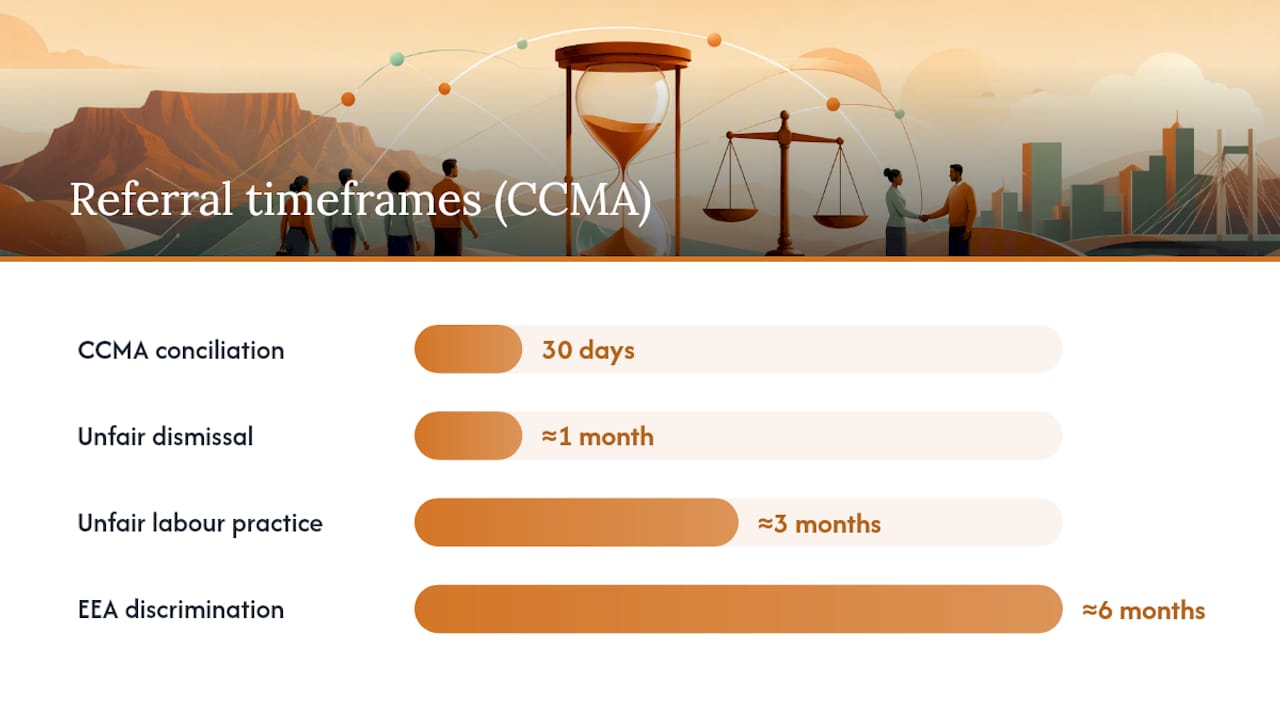
Timeframes are strict, and they matter. The CCMA's own guidance sets these referral windows:
- a statutory deadline to refer an unfair dismissal dispute to the CCMA exists and is generally about one month from the date of dismissal
- a statutory deadline to refer an unfair labour practice dispute exists and is generally about three months from the date of the act or omission
- a statutory deadline to refer a discrimination dispute under the EEA exists and is generally about six months from the date of the act or omission
These deadlines can be extended in limited circumstances (the CCMA can condone a late referral for good cause), but relying on that is a gamble. Acting inside the window materially improves your prospects and avoids an entirely separate fight just to get your case heard at all.
The process runs conciliation first, then arbitration. Once you file a referral (typically LRA Form 7.11 for dismissal disputes), the CCMA must hold the initial conciliation within 30 days. Conciliation is an informal, facilitated attempt to settle the dispute; if it fails, the matter proceeds to arbitration, a more formal hearing where a commissioner hears evidence and issues a binding award. Legal representation at CCMA arbitration isn't automatic; it's allowed only where both parties agree, or where the commissioner decides it's warranted because of legal complexity or a serious imbalance between the parties.
Serious or unresolved disputes, particularly those involving disputed points of law rather than just facts, can proceed to the Labour Court, which has the power to review CCMA arbitration awards and hear certain disputes directly.
Before your hearing, get these together:
- Your written particulars of employment and any contract or offer letter.
- Every payslip covering the disputed period.
- A written, dated chronology of events, not a memory reconstructed the night before.
- Contact details and brief statements from any witnesses.
- The completed referral form and proof of the date you submitted it.
Pro Tip: If your dispute involves discrimination or a complex legal question, ask your union or a labour attorney to review your case before the arbitration date, not during it. Commissioners rarely grant a postponement just because one side wasn't ready. You can find specialists in CCMA disputes and arbitration if you'd rather not walk into a hearing alone.
What remedies are available and what should you do right now?
If you win at arbitration, the remedy depends on what the commissioner finds and what you asked for. The most common outcomes are reinstatement (getting your job back, often with back pay), compensation (a monetary award, capped at set multiples of monthly salary depending on the dispute type), or in some cases an order for specific relief like retraining or reinstatement of a benefit.
Winning an award isn't the end of the process if the employer doesn't comply. Here's the practical sequence to follow:
- Preserve your evidence immediately. Save payslips, contracts, disciplinary letters, and any relevant messages or emails before an employer relationship sours further and access to systems disappears.
- File your referral inside the statutory window (30, 90, or 180 days depending on the dispute type) rather than waiting for things to "settle down."
- If you win an award and the employer ignores it, the award can be made an order of the Labour Court and enforced through the same mechanisms as any court judgment, including via the sheriff.
- Involve your union early if you belong to one; unions can represent members at conciliation and arbitration and often have institutional experience with a specific employer or sector.
- Get legal advice when the case involves discrimination, a large severance calculation, or a disputed point of law, rather than complex facts alone. A labour law attorney can assess whether your case is straightforward enough for self-representation or genuinely needs counsel.
What's changing in labour law right now?
Labour law isn't static, and a rule you read about two years ago may already be superseded.
NEDLAC reform process. The National Economic Development and Labour Council has been working through proposed amendment bills touching the LRA, BCEA, EEA, and National Minimum Wage Act. These proposals move through consultation before becoming law, so treat draft bills as directional rather than binding until they're actually promulgated.
Court rulings with immediate effect. Labour Court and Constitutional Court judgments can change entitlements overnight, sometimes ahead of formal legislative amendment; parental leave rights have been an active area of litigation, for instance. A ruling from the bench can bind employers before Parliament ever updates the written Act.
Minimum wage adjustments. The national minimum wage is reviewed and gazetted, typically with annual adjustments. Check current notices on the Department of Employment and Labour's official pages rather than trusting a figure from an older article, including this one.
If a rule matters to a decision you're making now, whether that's structuring a retrenchment or calculating severance, verify it against the current gazette or Act text, not a summary written before the latest amendment.
Protected disclosures: what happens if you report wrongdoing?
Reporting your employer's misconduct, whether that's fraud, safety violations, or unlawful conduct, carries legal protection in South Africa, but that protection has boundaries workers often misunderstand.
The Protected Disclosures Act shields employees who make a disclosure about unlawful or irregular conduct through a recognised channel: internally to management, to a legal adviser, to a regulator with jurisdiction over the matter, or in limited circumstances, more widely. The core protection is against occupational detriment, meaning an employer cannot dismiss, demote, harass, or otherwise penalize an employee for making a disclosure that qualifies as protected.
The protection isn't unconditional. It generally requires the employee to have acted in good faith and to have reasonably believed the information was substantially true. Disclosures made maliciously, or ones that skip appropriate internal or regulatory channels in favor of, say, immediate public exposure without good reason, can fall outside the Act's protection depending on the circumstances.
Where this intersects with the LRA matters practically: if an employee is dismissed and can show the real reason was retaliation for a protected disclosure, that dismissal is automatically unfair, a category treated more seriously than an ordinary unfair dismissal, with different remedy considerations at the CCMA or Labour Court.
If you're considering blowing the whistle on an employer, document the wrongdoing before you disclose it, and disclose through a legitimate channel rather than informally to colleagues, which weakens the legal protection you can later rely on.
Do domestic workers, temporary workers and young workers get different protections?
Not every employee sits under the same general rules. Several categories carry protections layered specifically for their situation, and treating them as identical to standard full-time employment is a common source of disputes.
Domestic workers are covered by the BCEA and the National Minimum Wage Act, and their minimum wage has largely converged with the general national rate in recent years. They're entitled to UIF coverage, written particulars, leave, and notice periods just like other employees, a protection many households still overlook because the relationship feels informal.
Temporary workers, including those placed through labour brokers (formally "temporary employment services" under the LRA), gained significant protection through 2015 amendments. Workers earning below the earnings threshold who are placed with a client for longer than three months are, in most cases, deemed to be employees of that client, not just the labour broker, unless the broker can show the placement is genuinely temporary and time bound.
Young workers face an absolute floor: the Basic Conditions of Employment Act prohibits employing children under 15, and work by children aged 15 to 18 is restricted where it's hazardous or interferes with schooling. This isn't a sector where employers get discretion; the restrictions are close to absolute.
Each of these categories still gets the substantive and procedural fairness protections of the LRA for dismissal. What changes is eligibility for certain benefits, minimum wage specifics, and, for temporary workers, who legally counts as the employer.
How is labour law actually enforced, and what are the penalties for breaking it?
Non-compliance with labour law carries consequences that go well beyond losing a CCMA case, and enforcement runs through several separate bodies depending on which Act is breached.
The Department of Employment and Labour employs labour inspectors with the power to enter workplaces, demand records, and issue compliance orders under the BCEA. An employer who ignores a compliance order can face escalating penalties, and repeated or serious non-compliance can result in criminal prosecution in some circumstances, particularly around child labour and forced labour provisions.
For OHSA breaches, penalties scale with severity: from fines for administrative failures like missing safety training records, up to criminal liability for employers whose negligence directly causes serious injury or death. The Department can issue prohibition notices halting dangerous operations immediately.
CCMA and Labour Court awards carry their own enforcement teeth. An arbitration award that an employer ignores can be certified and enforced exactly like a civil court judgment, including through a writ of execution against the employer's assets. Deliberately ignoring a binding award doesn't make it disappear; it just adds enforcement costs on top of the original liability.
EEA non-compliance for designated employers, particularly around reporting failures, can trigger fines calculated as a percentage of annual turnover, which scale up sharply for repeated contraventions.
The practical lesson: enforcement in South African labour law rarely happens on the spot. It happens weeks or months later, through inspection, referral, or a certified award, which is exactly why the paper trail an employer builds on day one determines the outcome of a dispute that hasn't even started yet.
What are the basic rules for a valid employment contract?
An employment contract in South Africa doesn't need to be a lengthy document to be valid, but it does need to meet a few core requirements, and getting these wrong creates problems that surface months or years later.
Validity requires only that the parties have capacity to contract, there's a lawful purpose, and there's consensus on the essential terms: the work to be done, and the remuneration for it. Verbal contracts are legally valid in South Africa. That said, the BCEA still requires written particulars covering the key terms within the first days of employment, regardless of whether the underlying agreement was made verbally or in writing.
Variation of contract terms requires agreement from both sides. An employer cannot unilaterally cut pay, change hours, or alter core terms just by issuing a memo, doing so without consent can itself constitute a breach, or in serious cases, a constructive dismissal if the employee resigns because of it. Legitimate variation usually happens through negotiation, a formal addendum, or in unionized workplaces, a collective bargaining process.
Termination can happen through resignation, mutual agreement, expiry of a fixed term, or dismissal, but each route carries different legal consequences. A resignation that's actually forced by intolerable conduct from the employer can be treated as a constructive dismissal, giving the employee the same remedies as if they'd been fired outright.
The thread running through all three principles: written particulars matter enormously, not because verbal agreements are invalid, but because they're the first thing a commissioner asks for when a variation or termination dispute lands at the CCMA.
The gap between the law on paper and how disputes actually play out
Most guides to labour law read like the process is linear: contract, breach, CCMA, resolution. Working through the referral timelines and the paper-trail requirements that actually decide cases tells a different story. The technical merits of a dispute matter less than most people assume; the documentation and the deadlines decide far more outcomes than the underlying facts do.
What people underestimate most is how fast the clock runs. Thirty days from dismissal to referral sounds generous until you spend three of those weeks hoping the employer will "sort it out informally." By the time most employees decide to act, they've already burned through a third of their window.
For employers, the pattern is the mirror image: the businesses that get burned at arbitration usually had a defensible reason to dismiss. They just never wrote anything down until the CCMA asked for it. Compliance isn't about fearing the law. It's about being able to prove, months later, that you followed it.
If you're facing a dispute, gather your documents first, try conciliation honestly before assuming it will fail, and use a resource like Justibly to find an LPC-registered labour attorney if the matter turns complex or the other side brings one. That's not an admission your case is weak. It's how you stop a strong case from being lost on a technicality.
— Nkosi
How Justibly helps you find a labour law attorney or a fast answer
If you've read this far because you're staring down a dismissal letter or a CCMA deadline, you don't need another summary of the Act. You need a qualified person to look at your specific facts, and you need to find them without weeks of cold-calling law firms.
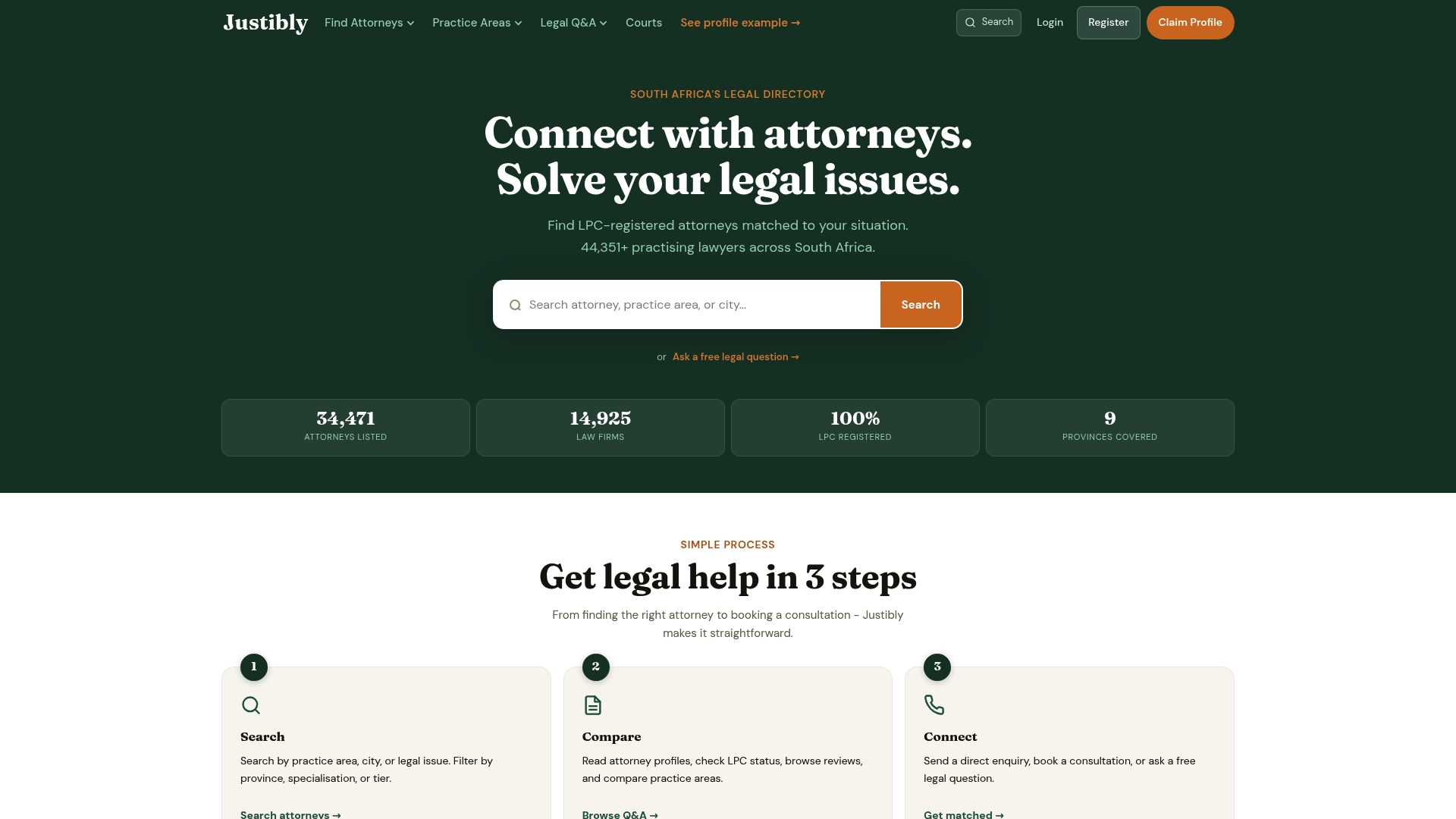
There are searchable directories of LPC-registered attorneys across South African provinces, with listings reflecting Legal Practice Council data. Search by practice area for a labour law attorney near you, whether you're in Cape Town, Pretoria, or elsewhere, and you get attorneys verified against LPC records, not a paid ranking. If your question is smaller than a full case, the free Legal Q&A forum lets you post the specifics, your referral deadline, your notice period, your severance calculation, and get input from a registered attorney before you decide whether you need full representation.
Start with the labour law guides for a deeper walk through your specific situation, then use the directory to request an appointment once you know what kind of help you need.
Primary sources worth bookmarking
Legal certainty comes from the Acts themselves, not from summaries of them:
- Basic Conditions of Employment Act — full text (PDF)
- Labour Relations Act, 1995 — full text (PDF)
- Department of Employment and Labour: Acts — official Acts index
- CCMA: Get Advice — referral forms and timeframes
Bookmark these before you need them. The gazette gets amended more often than the average guide gets updated.
This article is general information, not a substitute for advice from a qualified lawyer. Consult a qualified legal professional about your own circumstances before acting on anything here.
Sources
FAQ
What are the five rights of employees under South African labour law?
Employees are generally understood to have the right to fair labour practices, to written particulars of employment, to a safe working environment, to fair pay meeting minimum wage standards, and to fair dismissal procedures, drawn collectively from the BCEA, LRA, EEA, and OHSA rather than a single list in one Act.
What are the seven major labour laws in South Africa?
The core statutes are the Labour Relations Act, the Basic Conditions of Employment Act, the Employment Equity Act, the National Minimum Wage Act, the Occupational Health and Safety Act, the Compensation for Occupational Injuries and Diseases Act, and the Skills Development Act.
What are my rights as an employee if I think I've been unfairly dismissed?
You have the right to refer your dispute to the CCMA, or a bargaining council if one covers your sector, within 30 days of the dismissal, and to have that referral conciliated within a statutory 30 day window. If conciliation fails, you can proceed to arbitration, where remedies can include reinstatement or compensation.
What are the requirements for a valid employment contract under labour law?
A valid contract needs agreement on the work and pay, capacity to contract, and a lawful purpose; it can be verbal, but the BCEA still requires written particulars covering key terms from the first day of employment.
How do I file a labour claim or dispute in South Africa?
Complete the relevant referral form (commonly LRA Form 7.11 for dismissals) and submit it to the CCMA or your sector's bargaining council within the statutory deadline, 30 days for dismissal, 90 days for unfair labour practices, or 6 months for discrimination claims, then attend the scheduled conciliation hearing.
Recommended
By the Justibly editorial team
Published
General legal information for South Africa, checked against the Legal Practice Act, the relevant court rules and the Legal Practice Council roll. It is not legal advice and does not create an attorney-client relationship. For advice on your situation, consult an admitted attorney.
How we research and review · How the Trust Score works · Report an error