Disciplinary hearing procedure in South Africa: what fairness requires
Learn how to navigate the disciplinary hearing procedure in South Africa effectively, ensuring fairness and transparency at every step.
Published

A disciplinary hearing procedure is the employer-led process used to test allegations of misconduct or incapacity against an employee, and it must satisfy both section 188 of the Labour Relations Act / Code of Good Practice: Dismissal (Schedule 8) and the fairness standards it sets out. The verdict up front: fairness rests on two legs, a fair reason for the sanction and a fair process to get there, meaning notice, a genuine chance to respond, and an impartial chairperson.
Before you run or attend one, know the non-negotiables:
- Clear written notice of the charges, not vague references to "poor conduct"
- Reasonable time to prepare a response
- The right to representation by a colleague or union representative
- The chance to hear and question the evidence, and call your own witnesses
- A reasoned written outcome, plus information on referral rights
Every one of these traces back to the same three institutions: the LRA, the Code of Good Practice: Dismissal, and the Commission for Conciliation, Mediation and Arbitration, which will test whatever internal process you followed against that Code if the matter is disputed.
Key Takeaways
A fair disciplinary hearing procedure in South Africa depends on both a fair reason for the sanction and a fair process, built on reasonable notice, real opportunity to respond, and an impartial chair.
| Point | Details |
|---|---|
| Notice matters most | Give at least 48 hours for straightforward cases, more for complex evidence or multiple witnesses. |
| Separate investigator from chair | A chairperson who investigated the case risks tainting the hearing with bias. |
| Match sanction to conduct | Weigh mitigating and aggravating factors before choosing between a warning, demotion, or dismissal. |
| Document everything | Keep minutes, notices, and written outcomes on file in case of a CCMA referral. |
| Get specialist help early | Justibly matches employees and employers with LPC-registered labour law attorneys for hearings and CCMA disputes. |
This article is general information, not a substitute for advice from a qualified lawyer. Consult a qualified legal professional about your own circumstances before acting on anything here.
Table of Contents
- How does the disciplinary hearing procedure work step by step?
- What must a notice of disciplinary hearing include?
- Who can represent an employee at a disciplinary hearing?
- What are the stages of a fair disciplinary hearing?
- How are findings and sanctions decided?
- What causes a disciplinary hearing to be found unfair?
- What happens after the hearing ends?
- What the 2025 Code changes about fairness
- Templates worth keeping on file
- Where to get help with a disciplinary hearing
- Sources
- FAQ
How does the disciplinary hearing procedure work step by step?
Running a fair hearing is less about theatre and more about sequence. The 2025 Code frames it as genuine dialogue rather than a criminal trial, but the chairperson still needs a checklist to avoid a costly CCMA loss.
Before the hearing:
- Confirm the chair had no role in the investigation and has no personal stake in the outcome
- Bundle the evidence and share it with the employee in advance
- Confirm the employee received notice and understands their representation options
- Check that the notice period was reasonable given the complexity of the case
During the hearing:
- Open by confirming the employee's rights and the charges
- Let the employer present its case and call witnesses first
- Give the employee a full opportunity to respond and call witnesses
- Question fairly, without badgering, and keep written minutes throughout
After the hearing:
- Weigh mitigating and aggravating factors before deciding on sanction
- Apply progressive discipline principles unless the offence is serious enough to justify a single-act dismissal
- Issue a written outcome with reasons and referral information
- Keep the file. If the matter reaches arbitration, your records are your defence
Pro Tip: Never let the person who investigated the case also chair the hearing. Even a well-run process can be tainted by that overlap, and it's one of the fastest ways to lose a fairness argument at the CCMA.
Copy this checklist onto a single page and keep it with your disciplinary code. It costs nothing and it is usually the difference between a defensible process and an embarrassing one.
What must a notice of disciplinary hearing include?
A proper notice does more than announce a date. It must set out the specific allegations, the date, time and venue (or virtual platform), the possible sanctions if the employee is found guilty, which documents will be relied on, and the right to bring a representative or request a postponement.
There is no fixed statutory hours-rule for notice. Reasonableness is contextual, but 48 hours is a widely used practical minimum for straightforward misconduct cases.
Complex matters need more room:
- Fraud or financial misconduct involving multiple transactions: allow several days for the employee to review records
- Cases relying on CCTV footage or forensic evidence: give the employee time to view the footage and prepare a response
- Matters with several witnesses or voluminous documents: extend notice so the employee can meaningfully engage with the evidence, not just skim it
Always document how and when the notice was served, and write it in language the employee can reasonably understand. A notice handed over five minutes before the hearing, even if technically "delivered", rarely survives scrutiny.
Who can represent an employee at a disciplinary hearing?
Employees are generally entitled to be assisted by a trade union representative, where organisational rights exist, or a fellow employee. Full legal representation by an attorney is not automatically guaranteed under the Code. Workplace disciplinary procedures sometimes extend that right, so check your own policy before assuming either way.
Beyond who sits next to them, employees keep several core procedural rights: to understand the charge in plain terms, to state their case, to call and question witnesses, and to stay silent without that silence being treated as an admission of guilt.
Pro Tip: If a representative genuinely cannot attend, a short postponement usually costs less than the fairness challenge that follows a refusal. But don't confuse a legitimate scheduling conflict with a stalling tactic. Chairs are entitled to push back on repeated, unexplained delay requests.
Always cross-check the company's own disciplinary code. Some employers voluntarily grant broader representation rights than the statutory minimum, and those internal rules become binding once adopted.
What are the stages of a fair disciplinary hearing?
The sequence matters as much as the content. A recognisable structure protects both sides from later arguments about what actually happened.
- Investigation. The employer gathers facts, interviews witnesses, and decides whether there's a case to answer. This stage sets up everything that follows, so sloppy investigation notes tend to unravel later.
- Notice and preparation. The employee receives the charge and reasonable time to prepare, as covered above.
- Opening of the hearing. The chair confirms the charges, confirms representation, and explains the process to both sides.
- Employer's case. The employer presents evidence and calls witnesses first, since it carries the burden of proof.
- Employee's response. The employee responds, calls witnesses, and cross-examines the employer's witnesses.
- Closing submissions and adjournment. Both sides summarise their position, then the chair adjourns to consider the finding.
Bundle documents and witness statements in advance, and arrange translation where an employee's home language differs from the hearing language. Skipping this step is a common, avoidable trigger for a fairness complaint.
The standard of proof is the balance of probabilities, meaning the chair must find it more likely than not that the misconduct occurred. That's a materially lower bar than the criminal standard of beyond reasonable doubt, and confusing the two is a frequent, costly error.
Pro Tip: When evidence turns technical (cell records, accounting entries, IT logs), don't force a same-day ruling. Adjourn, bring in someone who understands the material, or ask for a written clarification. A rushed finding on evidence nobody in the room actually understood rarely holds up.
How are findings and sanctions decided?
The chairperson weighs the evidence on a balance of probabilities, assessing credibility, consistency, and corroboration rather than demanding certainty. Once guilt is established, sanction isn't automatic. It's a separate judgment call shaped by mitigating and aggravating factors.

Mitigating factors typically include length of service, a clean disciplinary record, genuine remorse, and personal circumstances. Aggravating factors include the seriousness of the harm caused, breach of trust, and whether the conduct was premeditated.
Five outcomes cover most cases:
- No case to answer. The evidence doesn't support the charge.
- Written warning. Appropriate for a first, less serious offence.
- Final written warning. Used for repeat or more serious conduct.
- Demotion or transfer. An alternative to dismissal where trust can still be rebuilt.
- Dismissal. Reserved for serious misconduct or repeated offences after prior warnings.
The revised Code also confirms that a single serious act can justify dismissal even without a history of warnings, provided the offence is grave enough and the process leading to that decision was still fair. Consistency matters here too: two employees who did roughly the same thing should generally face roughly the same consequence, unless there's a genuine, documented reason for the difference.
What causes a disciplinary hearing to be found unfair?
Procedural fairness and substantive fairness are two different tests, and employers regularly pass one while failing the other. Procedural fairness asks whether the employee got a genuine opportunity to state their case, with proper notice and an impartial chair. Substantive fairness asks whether the sanction itself was justified by the facts.
Most successful CCMA challenges trace back to a handful of recurring mistakes:
- Vague charges that don't specify what the employee is alleged to have done
- Notice too short for the employee to reasonably prepare
- A chairperson who investigated the case or has an obvious conflict of interest
- Relying on evidence never shown to the employee beforehand
- Refusing representation the employee was entitled to
- Applying a rigid, one-size-fits-all policy without regard to context or company size
A recurring pattern in disputed hearings: an employee is given a same-day notice for a complex fraud allegation involving bank statements they've never seen. Even where the underlying conduct looks serious, the CCMA will often find the process unfair on notice alone, regardless of what the evidence eventually shows.
The fix is straightforward, if not always convenient. Document every decision, keep proper minutes, offer a reasonable postponement when circumstances genuinely warrant it, and scale your process to your business. A five-person shop doesn't need the same machinery as a listed company, and the 2025 Code explicitly makes room for that.
What happens after the hearing ends?
The employee is entitled to a written outcome with reasons, not just a verbal ruling in the corridor. That outcome must also explain referral rights: an unresolved dispute can be taken to the CCMA or a relevant Bargaining Council under section 191 of the LRA.
Timelines differ by role and sector. Certain public-sector and senior management positions carry specific regulatory timeframes around precautionary suspension and process, so check sector-specific rules before assuming the general framework applies unchanged.
For employees: note the outcome date, request the written reasons if not automatically given, and refer a dispute promptly rather than waiting.
For employers: issue the written outcome quickly, preserve all hearing records and minutes, and be ready to produce them if the matter proceeds to arbitration.
What the 2025 Code changes about fairness
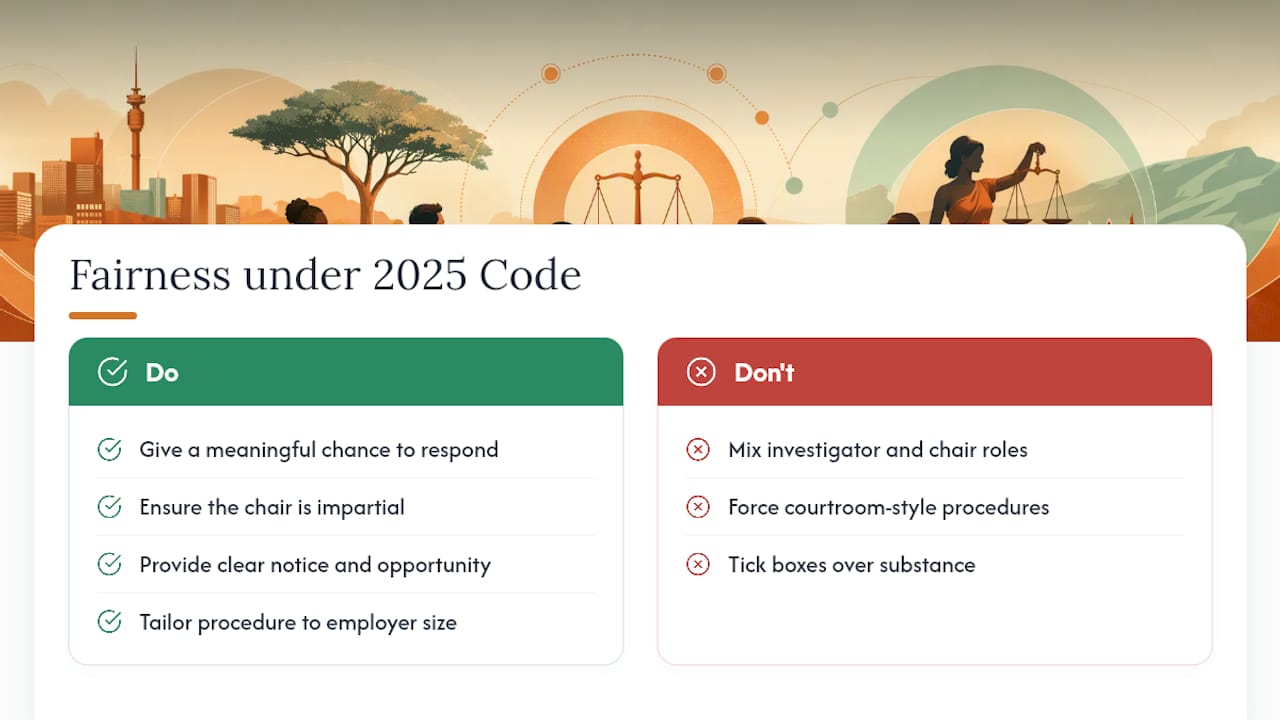
The revised Code moves away from treating a hearing as a mini criminal trial. It frames fairness as genuine dialogue, meaning the chair's real job is making sure the employee had a meaningful chance to respond, not ticking procedural boxes for their own sake.
Two threads run through the update. First, impartiality is non-negotiable: a chair with a personal stake or investigative involvement undermines the whole process. Second, the Code explicitly recognises that small employers can't and shouldn't mirror large-corporate procedures, so long as the core elements of notice and opportunity to respond survive.
The underlying principle predates the 2025 update: audi alteram partem, hear the other side. Tribunals consistently favour genuine dialogue over rigid technicality, which means an employer who skips form but delivers real substance often fares better than one who nails every procedural box while denying the employee a real hearing.
For employers, the practical consequence is simple: stop worrying about mimicking a courtroom and start focusing on whether the employee actually had a fair shot to be heard.
Templates worth keeping on file
A working file should include a sample notice of hearing, the chairperson checklist above, a sample written outcome letter, and a simple evidence bundle checklist. Small employers can trim the language; large employers may need a more formal version for HR sign-off. Keep a one-page version pinned to your disciplinary policy so nobody has to build one from scratch under pressure.
A practitioner's view on fairness and business reality
Handled well, a disciplinary hearing procedure protects both the business and the employee. The 2025 Code's flexibility isn't a loophole. It's permission to be proportionate, provided you document the reasoning behind every decision.
Where to get help with a disciplinary hearing
Running a hearing correctly, or defending yourself in one, often comes down to details a template can't fully cover: how much notice was actually reasonable for your specific case, whether the chair's conduct crossed into bias, or whether a dismissal will survive a CCMA challenge. That's where an LPC-registered labour law attorney earns their fee.

Justibly connects South African employees and employers with registered labour-law attorneys across all nine provinces, filtered by practice area so you're not scrolling through unrelated listings. If your question is quick, the free Q&A forum lets you ask a registered attorney directly before you commit to anything. If the matter is already heading toward the CCMA, or you're facing dismissal and want to understand your unfair dismissal options, browsing attorney profiles by specialty and location gets you to the right person faster than a general search.
This article gives you the framework. It doesn't replace advice tailored to your specific hearing, charges, or contract. Search Justibly's directory for a labour-law attorney near you, or post your question in the Q&A forum to get pointed in the right direction today.
Sources
- Revised Code of Good Practice: Dismissal - 2025 (guide for employers)
- Labour Relations Act / Code of Good Practice: Dismissal (Schedule 8) - Government of South Africa
- Adequate notice and procedural fairness in disciplinary hearings - LabourNet
- Publication of the 2025 Code of Good Practice: Dismissal - Cliffe Dekker Hofmeyr
- The disciplinary hearing process: roles, procedure & ensuring fairness - EOHCB
FAQ
What are the five possible outcomes of a disciplinary hearing?
The typical outcomes are no case to answer, a written warning, a final written warning, demotion or transfer, and dismissal, with referral rights to the CCMA or a Bargaining Council if either party disputes the result.
How can an employee best prepare for a disciplinary hearing?
Read the notice carefully, request any documents you haven't seen, arrange a representative if you're entitled to one, and prepare a clear, factual response rather than an emotional one. A calm, evidence-based response tends to carry more weight with a chairperson than a defensive one.
How long can a disciplinary hearing take?
The hearing itself can run from under an hour for a simple matter to a full day or more for complex cases with several witnesses; the full process, including notice period and any appeal or CCMA referral, commonly spans several weeks.
What questions are typically asked in a disciplinary hearing?
Expect questions confirming the facts alleged, your version of events, any documents or witnesses you rely on, and whether you understand the charges and your rights to representation.
Can I get legal help before or during a disciplinary hearing?
Yes. You can consult an LPC-registered attorney through Justibly's directory for advice on your specific case, or post a quick question in the free Q&A forum for initial guidance.
Recommended
By the Justibly editorial team
Published
General legal information for South Africa, checked against the Legal Practice Act, the relevant court rules and the Legal Practice Council roll. It is not legal advice and does not create an attorney-client relationship. For advice on your situation, consult an admitted attorney.
How we research and review · How the Trust Score works · Report an error