When to hire a lawyer: the situations that can't wait
Don't wait to hire a lawyer if facing legal issues like charges or injury. Delay can cost you evidence, money, or even your freedom.
Published

Hire a lawyer now if you've been charged with a crime, seriously injured, facing a contested divorce or property dispute, or staring down a court deadline. Waiting even a few days in these situations can cost you evidence, money, or your freedom. Everything else, from a small unpaid invoice to a straightforward will, usually gives you room to think first.
Here's your immediate triage list:
- Call a lawyer today if you've been arrested, charged, or questioned by police
- Call within 48 hours for a serious injury, a summons, or notice of eviction
- Preserve everything — photos, messages, medical records, contracts — before you speak to anyone else
- Check the lawyer's registration on the Legal Practice Council's public register before you hand over a cent
- Expect to pay something upfront — most attorneys ask for a deposit or retainer before opening a file
Every practising attorney in South Africa must be registered with the Legal Practice Council under the Legal Practice Act 28 of 2014. Anyone offering legal services without that registration is committing a criminal offence, which makes the register your first stop, not your last.
Key Takeaways
The right time to hire a lawyer is determined by urgency and risk to your rights, safety, or assets, not by how complicated the paperwork looks.
| Point | Details |
|---|---|
| Triage by urgency first | Criminal charges, injury, and court deadlines need a lawyer within days, not weeks. |
| Verify before you pay | Check LPC registration and, for trust money, a current Fidelity Fund Certificate. |
| Get fees in writing | Ask for a written mandate and fee agreement before any work begins. |
| Confirm who does the work | Ask whether a partner, associate, or candidate attorney handles your file day to day. |
| Use a verified directory | Justibly lists attorneys using real LPC data instead of pay-to-rank placement. |
Table of Contents
- Which situations need a lawyer immediately, and which can wait?
- How do you verify a lawyer before you hire one?
- What does a lawyer actually cost in South Africa?
- What happens after you hire a lawyer?
- What are the red flags when hiring a lawyer?
- How does Justibly help you find a verified attorney?
- Editorial perspective: what the checklists usually miss
- Find your next step with Justibly
- Sources
- FAQ
Which situations need a lawyer immediately, and which can wait?
Not every legal problem carries the same clock. Some situations start losing value the moment you delay; others sit patiently while you gather your thoughts. Knowing which category you're in changes everything about how you act.
Immediate priority covers criminal charges, arrests, serious injury (especially where liability is disputed), domestic violence, and any matter with a court date already set. In these cases, evidence degrades fast. Witnesses forget details within days. CCTV footage gets overwritten. Insurers close files. A criminal charge without representation at the first appearance can mean accepting bail conditions or a plea you didn't need to accept.

High priority, but not an emergency, includes contested divorces, disputed wills or estates, property boundary disputes, and employment disputes involving dismissal or unpaid wages. These matters do have limitation periods, but they're measured in months rather than hours. You still want a consultation soon, ideally within one to two weeks, because the earlier a lawyer sees your documents, the more options remain open.
Lower priority or self-serve territory includes small claims under the Small Claims Court monetary limit, simple uncontested wills, and basic lease disagreements where both parties want to resolve things amicably. You can often walk into Small Claims Court without a lawyer at all. That said, "manageable without a lawyer" isn't the same as "never worth a consultation." A 30-minute session can confirm you're not missing something that turns a simple matter complicated.
- Identify which category your situation falls into using the urgency tiers above.
- If immediate or high priority, gather documents and evidence before your first call, not after.
- If self-serve, still book one consultation to sanity-check your approach before you file anything.
- Note any date-driven deadlines (court dates, notice periods, limitation periods) and work backward from them.
Pro Tip: Take photos of everything relevant the same day something happens, not the week you finally decide to call a lawyer. Timestamps on photos have settled more disputes than memories ever will.
How do you verify a lawyer before you hire one?
Start with the Legal Practice Council's public register. It shows practising status, the province where an attorney is enrolled, and whether any disciplinary action is pending. This single check catches most of the people impersonating lawyers or working while struck off.
If your matter involves money held on your behalf, such as a property transfer, a deceased estate, or a personal injury settlement, confirm the attorney holds a current Fidelity Fund Certificate (FFC). The FFC is renewed annually and specifically authorises a practitioner to handle trust money. Being on the LPC register alone doesn't cover this. An attorney can be registered and still lack a valid FFC, and verifying an attorney properly means checking both, not just one.
Ask directly who will actually handle your file. Law firms often quote a senior partner's experience in the pitch, then hand the day-to-day work to an associate or candidate attorney. That's not automatically a problem. Junior staff often do excellent, closely supervised work at a lower hourly rate. But you need to know this upfront, because it affects both your bill and how quickly things move.
Before you leave the first meeting, insist on:
- A written mandate or engagement letter outlining the scope of work
- A clear fee agreement, whether hourly, flat, or contingency
- The name and role of whoever will do the actual drafting and correspondence
- A rough estimate of how many hours or how much the matter will likely cost
Roughly the same principle applies across most professional services: verify credentials before commitment, not after a deposit changes hands.
What does a lawyer actually cost in South Africa?
South African attorneys use several different fee models, and knowing which one applies to your matter changes how you budget. Hourly billing is the most common structure for litigation and ongoing advice. Flat fees suit predictable, bounded work like drafting a simple contract or an uncontested divorce. Retainers are upfront deposits held against future work, common in ongoing business or family matters. Contingency arrangements, where the lawyer only gets paid if you win, appear mostly in personal injury and Road Accident Fund claims.
Consultation fees typically run between R500 and R2,000 for an initial meeting. Hourly rates vary widely by seniority and specialisation, with junior counsel charging relatively lower fees and specialised practitioners charging higher fees for complex matters. Court complexity drives this too. Small Claims Court matters often need no lawyer at all, while High Court litigation brings in advocate fees on top of your attorney's bill.
Budget for extras beyond the headline rate:
- Sheriff fees for serving documents on the other party
- Advocate fees if your matter goes to court and needs counsel
- Expert witness fees for medical, engineering, or forensic opinions
- Travel and photocopying, which add up faster than people expect
Get the fee arrangement in writing before work starts, and ask whether phased payments are possible if the matter runs long. Legal insurance, sometimes bundled with home or vehicle cover, is worth checking if you anticipate recurring legal needs.
What happens after you hire a lawyer?
The first real step is signing an engagement letter or mandate that spells out scope, fees, and who's doing the work. If your matter involves trust money, the firm opens a dedicated trust ledger for it, separate from their operating account, which the FFC exists specifically to regulate. You'll be asked for identity documents, relevant contracts, correspondence, and anything else that establishes the facts.
- Urgent court matters (bail applications, urgent interdicts) typically move within days, sometimes hours.
- Standard civil litigation often takes six months to two years, depending on court backlogs and how contested the matter is.
- Family law matters, particularly contested divorces, commonly run from several months to over a year.
- Transactional work like property transfers or straightforward contracts often wraps up in four to eight weeks.
Ask early who specifically works on your file day to day, because that person's rate, not the senior partner's, usually drives your invoice. Keep your own record of every meeting: request written notes or a follow-up email after calls, and file every invoice as it arrives. If a dispute over billing ever comes up, your own paper trail matters as much as theirs.
What are the red flags when hiring a lawyer?
Certain behaviors should end the conversation immediately. Watch for these before you sign anything or pay a deposit:
- No LPC registration, or refusal to confirm it when asked directly
- Reluctance to put the mandate or fee agreement in writing
- A request to pay into a personal account rather than the firm's trust account
- Guaranteed outcomes, since no honest lawyer promises how a court or opponent will act
- Vague or shifting answers about hourly rates or total estimated cost
Bring this ten-question template to your first consultation:
- Have you handled matters like mine before?
- What's a realistic range of outcomes here?
- Who will actually work on my file day to day?
- What's your estimate of total hours or cost?
- Can you provide references or past case examples?
- Do you hold a current Fidelity Fund Certificate, if relevant?
- How often will you bill, and how often will you update me?
- Have you checked for any conflict of interest?
- How will we communicate, and how quickly should I expect replies?
- What happens if either of us wants to end the arrangement early?
Pro Tip: If you're comparing two attorneys, don't just compare their quoted fees. Compare how clearly each one answered these ten questions. The clearer answer usually predicts the smoother relationship.
How does Justibly help you find a verified attorney?
Justibly's directory pulls from real Legal Practice Council data rather than paid placement, so the attorneys you see reflect actual registration status, not who paid the most to appear first. That distinction matters more than it sounds, especially when you're trying to verify someone quickly during a stressful week.
Using it is straightforward:
- Search by practice area, whether that's family law, labour disputes, or another specialism
- Check the listed registration details against what you'd expect from an LPC-registered practitioner
- Send a short pre-consultation message, or post a quick question on the free Q&A forum if you're not yet sure you need a lawyer at all
It's particularly useful when you need to verify someone fast, when you're searching for a specialist outside your usual network, or when you simply want to avoid directories built around who pays the most to rank first.
Editorial perspective: what the checklists usually miss
Most advice on hiring a lawyer treats the decision as binary: hire or don't. That framing misses the actual skill involved, which is triage. The reader who benefits most from this article isn't the one facing a criminal charge. They already know they need help. It's the person sitting on a boundary dispute or a difficult employment exit, unsure whether their situation has crossed the line into "needs a professional."
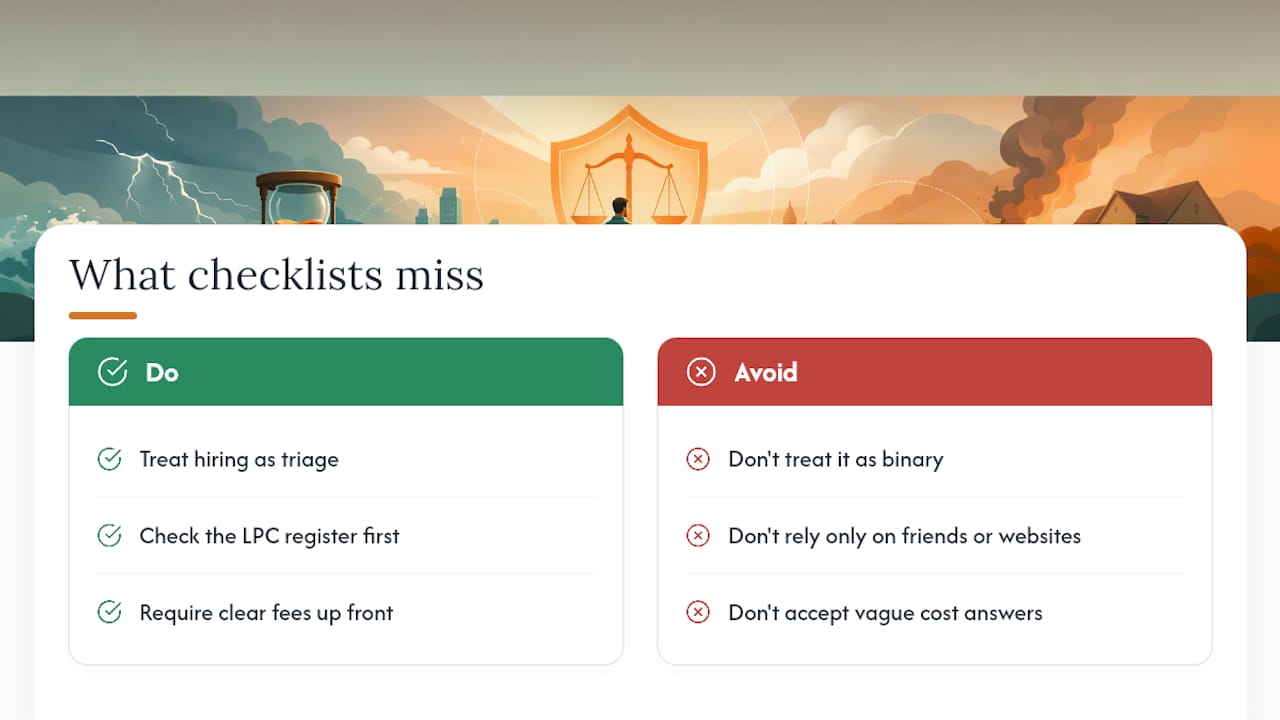
My honest read of the evidence here: verification gets treated as a formality when it should be the first move, not the last. People check a lawyer's reputation by asking friends or reading a website, and only think to check the LPC register after something goes wrong. Flip that order. A five-minute registration check before your first phone call costs nothing and eliminates an entire category of fraud risk.
The other overlooked point: fee clarity isn't a nice-to-have, it's a diagnostic. A lawyer who answers your cost questions vaguely in the first meeting will likely communicate vaguely throughout the matter. Prioritize that signal over credentials alone.
— Nkosi
Find your next step with Justibly
Justibly gives you what a generic search engine can't: a directory built directly from Legal Practice Council data, so every listing you see reflects real registration status rather than who paid to rank higher.

If you've read this far, you likely fall into one of two groups. Either you're facing something urgent and need a verified attorney fast, or you're still weighing whether your situation needs one at all. For the first group, Justibly's directory lets you search by practice area and location, whether that's Cape Town, Johannesburg, or elsewhere, and see registration details without wading through pay-to-rank listings. For the second, the free Q&A forum lets you ask a registered attorney a quick question before committing to a paid consultation.
Start by browsing attorneys near you and checking their listed details against what matters most to your situation.
Sources
- Legal Practice Act 28 of 2014 (Government of South Africa)
- Legal Practice Council (LPC)
- How much does a lawyer cost in South Africa? (Bidvest Insurance)
This article is general information, not a substitute for advice from a qualified lawyer. Consult a qualified legal professional about your own circumstances before acting on anything here.
FAQ
How much does it cost to hire a lawyer in South Africa?
Consultation fees typically run between R500 and R2,000, with hourly rates ranging from around R900 for junior counsel to R5,000 or more for specialists, plus extras like advocate or sheriff fees.
What are red flags for lawyers?
Refusing to confirm LPC registration, avoiding a written fee agreement, asking for payment into a personal account, and guaranteeing outcomes are all signs to walk away.
Do I need a lawyer for a small claims matter?
Usually not. Small Claims Court is designed for self-representation on lower-value disputes, though a quick consultation can still confirm you're not missing a complicating factor.
How do I check if a lawyer is legitimate?
Search the Legal Practice Council's public register for their practising status, and ask for their Fidelity Fund Certificate if your matter involves trust money.
What questions should I ask a lawyer before hiring them?
Ask about their experience with your type of matter, who will handle the day-to-day work, their estimated hours or costs, and whether they hold a current Fidelity Fund Certificate if relevant. Justibly's Q&A forum is a free way to get a preliminary answer before booking a paid consultation.
Recommended
By the Justibly editorial team
Published
General legal information for South Africa, checked against the Legal Practice Act, the relevant court rules and the Legal Practice Council roll. It is not legal advice and does not create an attorney-client relationship. For advice on your situation, consult an admitted attorney.
How we research and review · How the Trust Score works · Report an error