Draft Airtight Occupational Rent Clauses in South Africa
Practical South Africa guide to occupational rent: calculate amounts (0.55–0.7% monthly; R12,000 on R2,000,000), draft airtight OTP clauses, and find LPC...
Published

Occupational rent is the payment a buyer or seller makes to occupy a property before or after the transfer of ownership is registered. It typically applies when a buyer moves in early, before the Deeds Office registers the transfer, or when a seller stays on after registration while they finalize their own move. The single most important step for either side is simple: get the exact amount, payment date, and terms written into the Offer to Purchase.
TL;DR:
- Occupational rent is calculated typically as 0.55% to 0.7% of the purchase price per month, but some practitioners quote rates closer to 1%, depending on the property and demand.
- The rent is paid into the conveyancer’s trust account, which safeguards both parties and prevents disputes over direct payments to individuals.
- The Offer to Purchase must specify the exact occupation start date, the amount, payment timing, and responsibilities for rates, utilities, and insurance to avoid future legal complications.
- Disputes often arise from unclear or omitted written terms, making it crucial to have a conveyancer review the occupational rent clause before signing the contract.
- Professional legal advice is recommended when terms are vague, a party refuses vacate, or in any situation involving complicated negotiations or disputes.
Table of Contents
- What is occupational rent in South Africa, and when does it apply?
- How much occupational rent should you actually pay?
- Who gets paid, and how do conveyancers handle the money?
- What to put in the Offer to Purchase for occupational rent
- What happens when things go wrong: disputes and legal remedies
- A practical checklist before you agree to early occupation
- When to bring in a conveyancer or property attorney
- Why the paperwork matters more than the percentage
- Get help drafting your occupational rent clause
- Sources
- FAQ
What is occupational rent in South Africa, and when does it apply?
Occupation and ownership are two different legal events, and that gap is exactly where occupational rent lives. A buyer can sign transfer documents, pay a deposit, and even get keys weeks before the Deeds Office actually registers the transfer. Until that registration happens, the seller technically still owns the property.
Two scenarios trigger occupational rent:
- Buyer early occupation: the buyer moves in before transfer registers, and pays the seller for that early access.
- Seller overstay: the seller stays in the house after transfer has registered, and pays the new owner rent for the extra time.
Occupational rent isn't a lease. It's compensation for use of a property you don't yet own (or no longer own), and it carries different obligations than a rental agreement does. The occupier generally covers day to day running costs like utilities, while responsibility for rates, insurance, and major maintenance depends entirely on what the Offer to Purchase specifies. This applies whether the property is freehold or a sectional title unit, though sectional-title sales and new developments sometimes shift occupation timing around occupancy certificates or developer conditions.
How much occupational rent should you actually pay?
Most South African practitioners anchor occupational rent to a percentage of the purchase price, calculated monthly. Ooba cites a typical range of 0.55% to 0.7% of the purchase price per month as standard market guidance, though some practitioners quote figures closer to 1% depending on the property, the area, and current rental demand.
Quick reference: On a R2,000,000 property, a rate of 0.6% per month works out to R12,000 per month of occupation. At 1%, that jumps to R20,000.
Three calculation methods show up in practice:
- Percentage of purchase price — the most common approach, easy to apply and easy to write into a contract.
- Market-related rent — pegging the amount to what a similar property would fetch on the open rental market nearby.
- Fixed rand amount — a flat figure both parties agree on upfront, useful when the percentage feels too high or too low for the specific property.
There's no single "correct" percentage. The right figure reflects your property type, location, and how long occupation is expected to last, so it pays to run the numbers before you sign.
Who gets paid, and how do conveyancers handle the money?
Occupational rent is normally paid into the conveyancer's trust account, not directly to the seller or buyer. This one detail does more to protect both parties than almost anything else in the transaction.
From that trust account, the conveyancer may disburse funds in a few ways:
- Pay the seller directly, once entitlement is confirmed.
- Pay the seller's bank to cover outstanding bond arrears, keeping the sale on track.
- Hold funds pending resolution if there's a dispute over the amount owed.
Pro Tip: If anyone in the transaction asks you to pay occupational rent directly into a personal bank account rather than the conveyancer's trust account, treat that as a red flag. It removes the paper trail and the protection a trust account provides if the deal falls through.
Routing the money through a regulated trust account gives both sides a documented, traceable record. A Johannesburg conveyancing attorney or a firm in any other province will follow this process as standard practice.
What to put in the Offer to Purchase for occupational rent
The Offer to Purchase (OTP) is the document that actually governs occupational rent. Verbal agreements or vague assumptions don't hold up when a dispute lands in front of a court or the Rental Tribunal. Here's what should be spelled out, in writing, every time:
- Occupation date — the exact day occupation begins, not an approximate window.
- Monthly amount — the rand figure or percentage, calculated and agreed before signing.
- Payment recipient and timing — confirmation that funds go to the conveyancer's trust account, and by which date each month.
- Rates, levies, and utilities responsibility — who pays what, and from which date.
- Insurance start date — when the occupier's cover (or the seller's) takes effect.
- Property condition at handover — ideally backed by a joint inspection and photos.
- Consequences of delayed or early transfer — what happens if registration takes longer, or happens sooner, than expected.
Each item closes off a common argument later. Property law commentary from VDM Law makes the point plainly: if the OTP stays silent on occupational rent, a court may later have to determine a "reasonable" amount based on market rentals, a process that's slow, unpredictable, and often more expensive than simply agreeing a figure upfront.
Pro Tip: Have a conveyancer review the occupational rent clause before you sign the OTP, not after. A five-minute check at this stage can save weeks of dispute later.
What happens when things go wrong: disputes and legal remedies
Most occupational rent disputes trace back to one root cause: nothing was written down clearly enough. When that happens, the fallout tends to follow a few predictable paths.
- Non-payment: the affected party can approach the Rental Tribunal, but attempting a unilateral deduction from the amount owed carries real risk without legal advice first.
- Seller refuses to vacate: once transfer has registered, the new owner may need to pursue an eviction process, and in urgent cases apply for an interdict.
- Set-off against proceeds: conveyancers can, in limited circumstances, deduct unpaid occupational rent from sale proceeds before disbursing them, but this is a conveyancing tool, not a green light for either party to act alone.
Occupational rent disputes are rarely about the money itself. They're about the absence of a paper trail. Attempting to withhold proceeds or deny possession outside of proper legal channels can derail an otherwise straightforward sale.
Neither buyer nor seller should attempt self-help remedies here. Legal advice at the first sign of a dispute is cheaper than legal advice after one has escalated.
A practical checklist before you agree to early occupation
Before anyone moves boxes, both sides benefit from running through a short list of checks.
Buyers should:
- Confirm every occupational rent term is written into the OTP, not just discussed verbally.
- Pay only into the conveyancer's trust account, and keep the receipt.
- Arrange insurance to start exactly on the occupation date.
- Budget for the possibility that transfer takes longer than expected, since occupational rent keeps accruing until registration.
Sellers should:
- Insist the conveyancer, not the buyer directly, handles all occupational rent payments.
- Document the property's condition with photos and a signed inspection report before handover.
- Get a clear, written vacate timeline in place in case the sale collapses after occupation has begun.
Pro Tip: A joint inspection with both parties present, followed by written receipts for every payment, resolves more future arguments than any clause you could draft.
When to bring in a conveyancer or property attorney
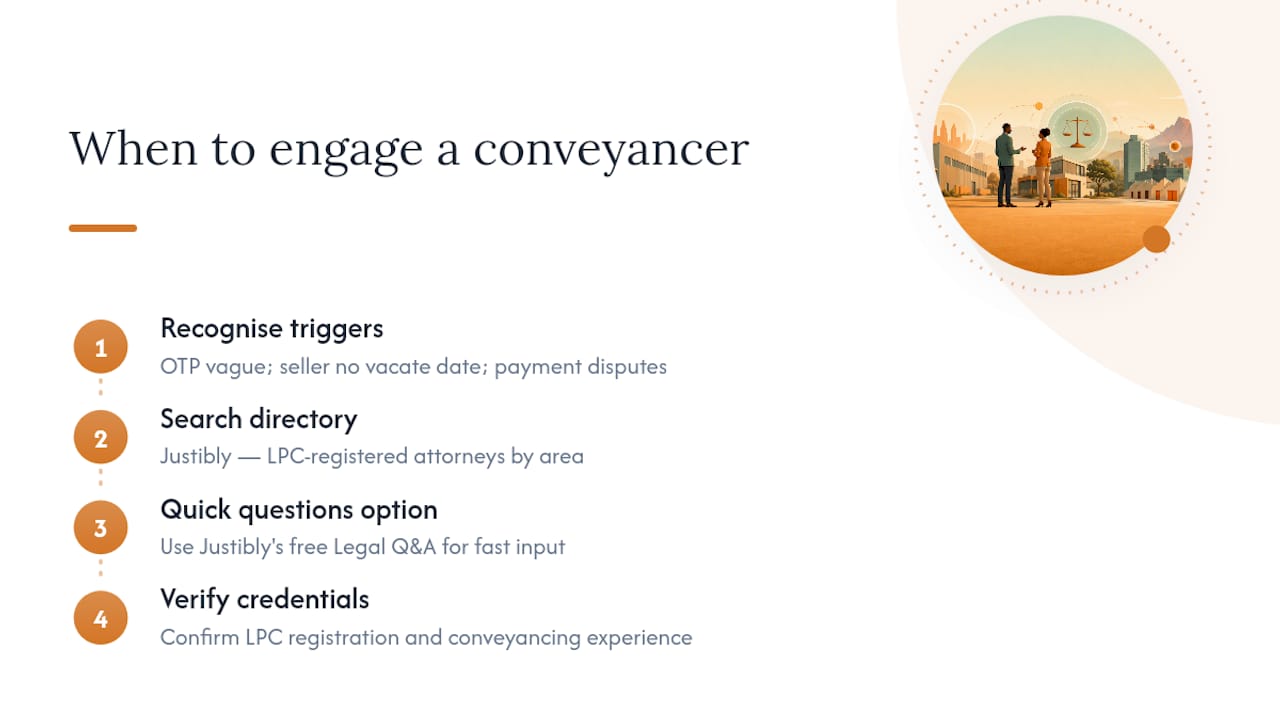
Some situations call for professional input rather than a DIY approach: an OTP that's silent or vague on occupational rent, a seller who won't confirm a vacate date, or any dispute over amounts already paid. These aren't situations to negotiate informally.
Justibly's directory lists LPC-registered attorneys across all nine provinces, searchable by practice area and location, including conveyancing specialists in Cape Town. If your question is quick and doesn't need a full consultation yet, Justibly's free Legal Q&A forum connects you with registered attorneys for fast, no-cost input. Whichever route you take, confirm the attorney's LPC registration and ask specifically about their conveyancing experience before engaging them.
Why the paperwork matters more than the percentage
That's the wrong question to obsess over first. The real risk in almost every occupational rent dispute isn't that someone picked an unfair percentage. It's that nobody wrote the figure down, or wrote it down loosely enough that two people can read it two different ways.
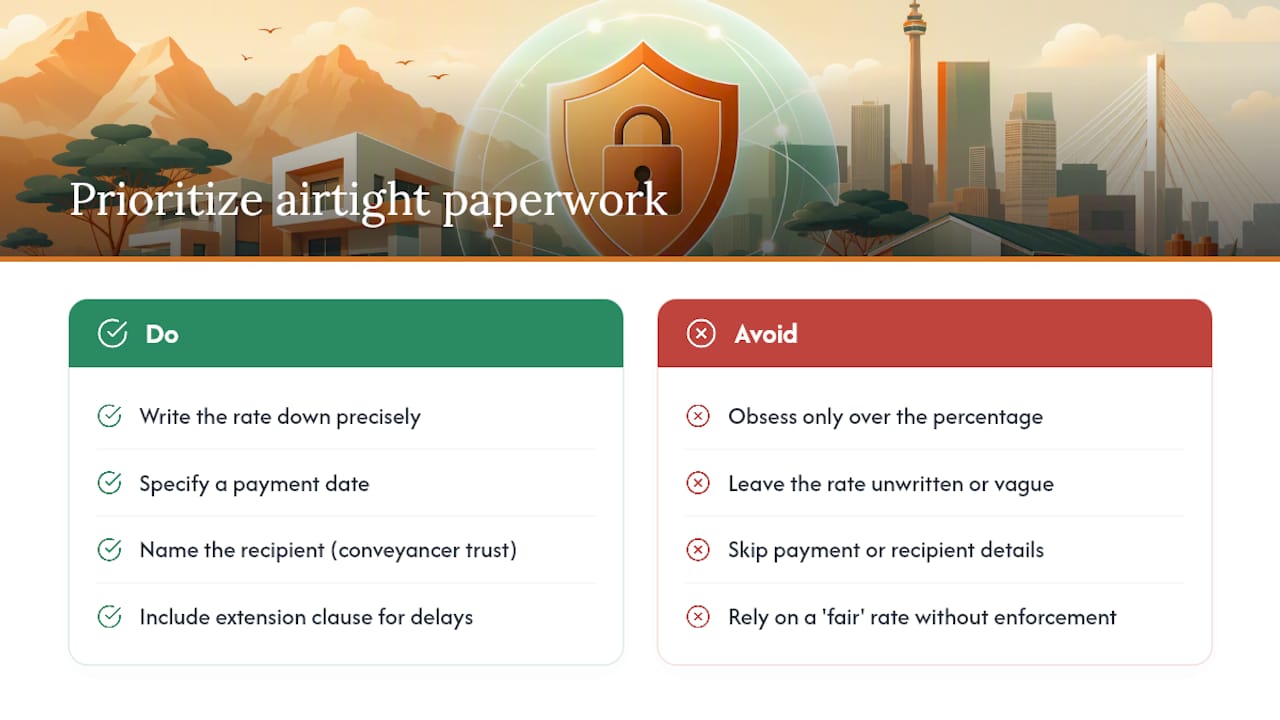
Conventional advice tends to stop at "agree on a rate." That's incomplete. The rate is worthless without a payment date, a named recipient (the conveyancer's trust account, always), and a clause covering what happens if transfer drags on for three extra months. I'd go further than most guides: treat the occupational rent clause in your OTP with the same seriousness as the purchase price itself, because functionally, it behaves like a second, smaller transaction sitting inside the main one.
If you take one thing from this article, prioritize precision over generosity. A slightly lower rate with airtight terms beats a "fair" rate with no enforcement mechanism, every time a dispute actually lands.
— Nkosi
Get help drafting your occupational rent clause
Getting the wording right in your OTP is the difference between a clean transaction and months of back and forth. Legal directories provide ways to find LPC-registered attorneys to check clauses before signing, listing verified data without pay-to-rank placements.

If your situation is straightforward, start with Justibly's legal guides on property transactions to see how similar OTP clauses are typically structured. If you have a specific question, whether it's about a disputed amount or a seller who won't confirm a vacate date, post it on Justibly's free Legal Q&A forum and get input from a registered attorney directly. For a full contract review, search the directory for a conveyancer in your area and book a consultation before you sign anything.
Sources
- What you need to know: Occupation rent & early occupation
- Occupational rent explained for buyers and sellers
This article is general information, not a substitute for advice from a qualified lawyer. Consult a qualified legal professional about your own circumstances before acting on anything here.
FAQ
How much occupational rent should I pay?
The exact figure should be agreed and written into the Offer to Purchase before occupation begins.
Does occupational rent include water and electricity?
Not automatically. Responsibility for utilities depends entirely on what the Offer to Purchase specifies, so this needs to be spelled out explicitly rather than assumed.
What are the new landlord rules in South Africa in 2026?
Occupational rent itself isn't governed by landlord-tenant legislation since it isn't a lease; it's compensation for occupying a property outside a formal rental agreement, and disputes typically route through the Rental Tribunal or the courts rather than tenancy law specifically.
Can a party refuse to pay occupational rent?
Refusing to pay without a valid dispute raises real legal risk, and unilateral deductions or set-offs without legal advice can complicate the sale. Where a genuine dispute exists, the Rental Tribunal or a property attorney is the correct route, not withholding payment unilaterally.
What happens if the Offer to Purchase doesn't mention occupational rent?
If the OTP is silent, a court may later need to determine a reasonable amount based on market rental values, a process that's slower and less predictable than simply agreeing a figure upfront in writing.
Recommended
By the Justibly editorial team
Published
General legal information for South Africa, checked against the Legal Practice Act, the relevant court rules and the Legal Practice Council roll. It is not legal advice and does not create an attorney-client relationship. For advice on your situation, consult an admitted attorney.
How we research and review · How the Trust Score works · Report an error