Acknowledgement of debt in South Africa: rules and template
Discover the rules and template for an acknowledgement of debt in South Africa to protect your rights and ensure fair terms. Learn more now!
Published

An acknowledgement of debt (AOD) is a signed, written admission that you owe a specific amount of money, and once it's signed, it resets the legal clock on that debt and becomes enforceable in its own right. The immediate red flag: if the AOD defers payment and adds interest or fees, it may count as a credit agreement under the National Credit Act, which means the creditor may need to be a registered credit provider.
- Check whether the document charges interest, fees, or extends payment over time.
- Confirm whether the creditor regularly lends money as part of their business.
- If either applies, get the wording reviewed before anyone signs.
Pro Tip: Never sign an AOD the same day you receive it. Take it home, read every clause twice, and check the interest and default terms against what you actually agreed to verbally.
Key Takeaways
An enforceable acknowledgement of debt combines a clear admission of amount, honest treatment of interest and NCA exposure, and wording that deliberately controls how prescription resets.
| Point | Details |
|---|---|
| Interest triggers NCA risk | Adding interest or fees to deferred payments can turn an AOD into a regulated credit agreement. |
| Signing restarts prescription | A signed AOD generally interrupts prescription, restarting a fresh three-year period under the Prescription Act. |
| Instalment wording can extend to six years | An unconditional promise to pay fixed instalments may qualify as a promissory note under case law like Cash Converters v Chalala. |
| Liquid documents speed up enforcement | A well drafted AOD can support provisional sentence, resolving in weeks rather than a defended trial. |
| Review before signing | Justibly connects you with LPC-registered attorneys through its directory and free Q&A before you commit to a clause you don't understand. |
Table of Contents
- What is an acknowledgement of debt and when do people use one?
- When does the National Credit Act apply to an AOD?
- Does signing an AOD restart the prescription clock?
- What clauses make an AOD enforceable?
- A short acknowledgement of debt template for South Africa
- What happens if the debtor defaults on the AOD?
- When should you get a lawyer involved?
- Sources
- FAQ
What is an acknowledgement of debt and when do people use one?
An acknowledgement of debt is a signed statement confirming a specific amount owed and, usually, a plan to repay it. It doesn't create the debt. It confirms one that already exists, often replacing a messy paper trail of invoices, emails, and verbal promises with one clean document.
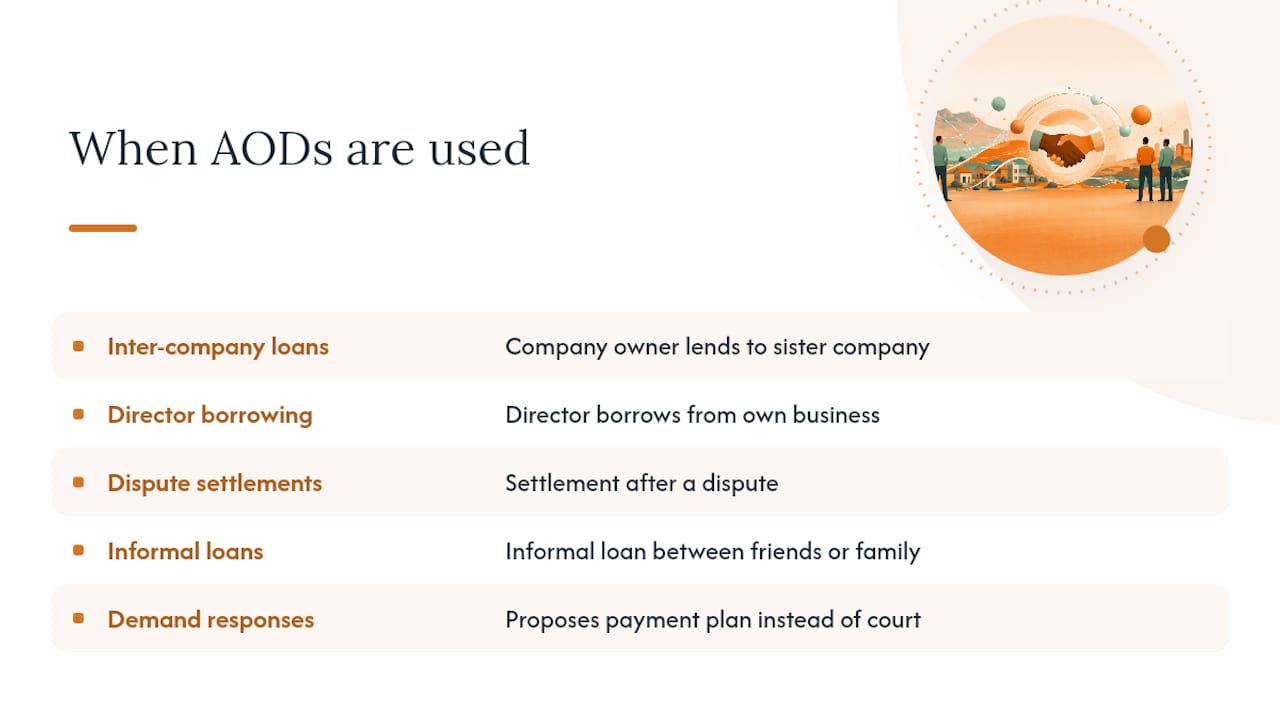
South Africans use AODs constantly outside formal lending. Common scenarios include a company owner lending money to a sister company, a director borrowing from their own business, a settlement after a dispute, an informal loan between friends or family, or a debtor responding to a letter of demand with a proposed payment plan instead of facing court action immediately.
An AOD differs from a full loan agreement in scope. A loan agreement sets out the terms of a debt from the start. An AOD usually confirms a debt that already exists and adds a repayment mechanism, which is why it tends to be shorter and less formal, but not always safer.
When does the National Credit Act apply to an AOD?
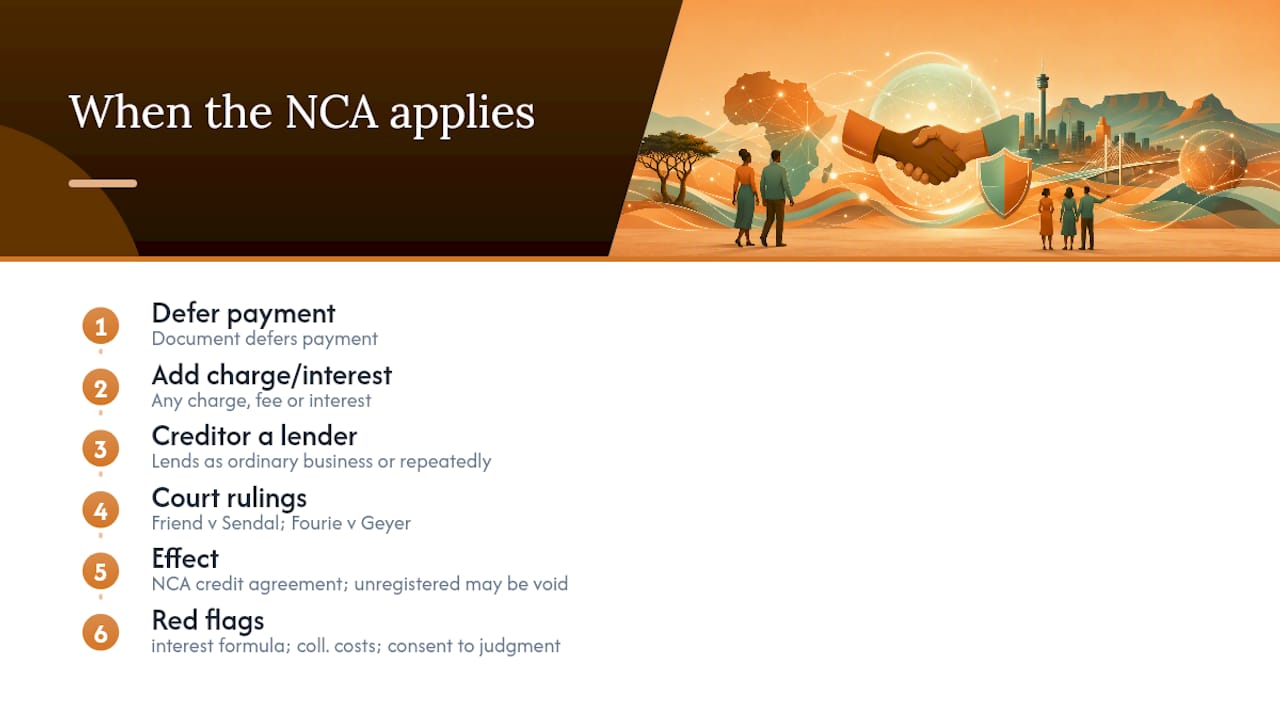
The National Credit Act applies to an AOD when the document defers payment and adds a charge, fee, or interest, and the creditor lends money as an ordinary part of their business or does so repeatedly. That combination is what converts a simple admission of debt into a regulated credit agreement.
Two cases define this test in South African law. In Friend v Sendal, the court found that even a straightforward AOD could be a credit agreement under the NCA where the creditor was shown to be in the practice of lending money, triggering the registration requirement under section 40.
Friend v Sendal matters because it shows the NCA doesn't care what you call the document. It looks at what the arrangement actually does: defer payment, add a charge, repeat the pattern, and you're in credit-agreement territory whether you meant to be or not.
Fourie v Geyer pushed this further. A commercially negotiated AOD with interest, deferred instalments, and collection fees was held to be a credit agreement under the NCA, even though it arose from an arm's length business dispute rather than a traditional loan.
If the NCA applies and the creditor never registered as a credit provider, the agreement risks being declared void. That's not a technicality. It can mean the creditor loses the ability to enforce the debt at all.
Pro Tip: Watch for these three red flags in any AOD draft: an interest calculation formula, a clause adding collection or legal costs to the balance, and consent to judgment. Any one of these should trigger a legal review before signing.
Does signing an AOD restart the prescription clock?
Yes. A signed AOD generally interrupts prescription and restarts the clock, running a fresh three-year period from the date of signature, under section 14 of the Prescription Act.
The Prescription Act treats an "express or tacit acknowledgement of liability" as an interruption event. Prescription doesn't pause. It runs afresh, as if the debt were new again.
Most debts prescribe after three years of no payment or acknowledgement. But an AOD drafted as an unconditional promise to pay a fixed sum in instalments can meet the requirements of a promissory note, extending prescription to six years, as confirmed in Cash Converters v Chalala and discussed in commentary on loans and suretyships.
This cuts both ways. A debtor who signs an AOD on an old, nearly prescribed debt can unintentionally revive a creditor's right to collect. Debt collectors know this and sometimes push for a signature specifically to reset a clock that was about to run out, a pattern consumer guidance on when debt expires in South Africa warns readers to watch for.
What clauses make an AOD enforceable?
The clauses in your AOD determine whether it survives a court challenge, whether it triggers NCA registration duties, and whether it actually interrupts prescription the way you intend.
Build the document around these essentials:
- A clear admission of the debt, stating the amount owed or exactly how to calculate it.
- Full names, ID or registration numbers, and addresses of both parties, with capacity to sign confirmed.
- A repayment schedule with specific dates and instalment amounts.
- Interest or charges stated explicitly, or a clear statement that none apply.
- A default clause setting out consequences, including acceleration of the full balance.
- Jurisdiction and, where agreed, consent to the Magistrate's Court.
- Signature blocks with dates, and witnesses where the transaction is significant.
Word the repayment promise carefully. An unconditional promise to pay fixed instalments can unintentionally create a promissory note, extending prescription to six years, which may or may not suit your situation. If NCA exposure is a real risk, consider adding affordability and disclosure language rather than skipping it. Attach supporting proof of quantum, invoices, the original letter of demand, or bank statements, so the amount isn't just asserted but backed by paper.
Pro Tip: Keep a signed, dated copy for both parties. An AOD only one side possesses is far harder to enforce or defend later.
A short acknowledgement of debt template for South Africa
This skeleton covers the parts that matter most. Treat it as a starting point, not a finished contract, and adapt each section to your facts.
- Parties: full names, ID/registration numbers, and addresses of debtor and creditor.
- Admission of debt: a clear statement of the amount owed, or the formula used to calculate it, and what it arises from.
- Repayment terms: total amount, instalment size, dates, and payment method.
- Interest or fees: state the rate if any applies, or confirm none does.
- Default clause: what happens if a payment is missed, including acceleration of the full balance.
- Jurisdiction: which court has authority, and whether the debtor consents to it.
- Signatures: both parties, dated, with witnesses if the amount is significant.
Adapt the amount, dates, and interest section to your circumstances every time. Treat any clause involving interest, added costs, or consent to judgment as a trigger for legal review before signing, since these are exactly the terms that can pull the document into NCA territory or accelerate enforcement against you.
What happens if the debtor defaults on the AOD?
If a debtor stops paying, the creditor's options depend on how the AOD was drafted. A well drafted AOD that qualifies as a liquid document can support provisional sentence, a faster court process than an ordinary trial, because the debtor's own signature already admits the debt.
- Provisional sentence: available where the AOD is a liquid document, meaning the amount and admission are clear on the face of it.
- Magistrate's Court or High Court action: standard route where the amount is disputed or the document is weaker.
- Sheriff execution and attachment: once judgment is granted, the sheriff can attach assets or garnish income to recover the debt.
Costs and timelines vary with the route and whether the debtor opposes. A straightforward provisional sentence application can resolve in weeks; a defended action can run for months or longer. Debtors facing serious financial strain should also know that sequestration is a possibility for creditors chasing a large, unsecured AOD, and that suretyships or security like a mortgage bond attached to the underlying debt survive independently of the AOD itself.
Clauses granting consent to judgment or attaching a certificate of balance can turn an ordinary AOD into a document courts treat as sufficient for provisional sentence, which is exactly why that wording deserves scrutiny before anyone signs.
When should you get a lawyer involved?
Get legal advice before signing any AOD that charges interest, creates security over an asset, or involves a significant or recurring sum. The same applies where a consent to judgment clause appears, or where the amount owed is genuinely disputed.
Other triggers worth flagging to yourself: potential NCA exposure, a commercial transaction between companies, a director facing personal liability for a company debt, or anything where the numbers don't quite add up on your own review.
Finding the right attorney starts with matching the practice area to your problem. Search for consumer debt specialists for personal debt disputes, or credit disputes attorneys where NCA registration or credit provider status is the sticking point. Before that first call, gather the amount owed, the payment history, any existing documents, and a clear idea of the outcome you want. It saves time and money once you're in front of someone qualified.
Author perspective
Creditors should document every AOD like it will end up in court, because sometimes it does. Debtors should think twice before signing anything reviving an old debt. When in doubt on NCA exposure or high-risk clauses, get it reviewed first.
Get an LPC-registered attorney to check your AOD before you sign
Justibly connects you with LPC-registered attorneys across South Africa who can draft, review, or fight an acknowledgement of debt, without you having to guess whether a firm's listing is paid promotion or genuine expertise.
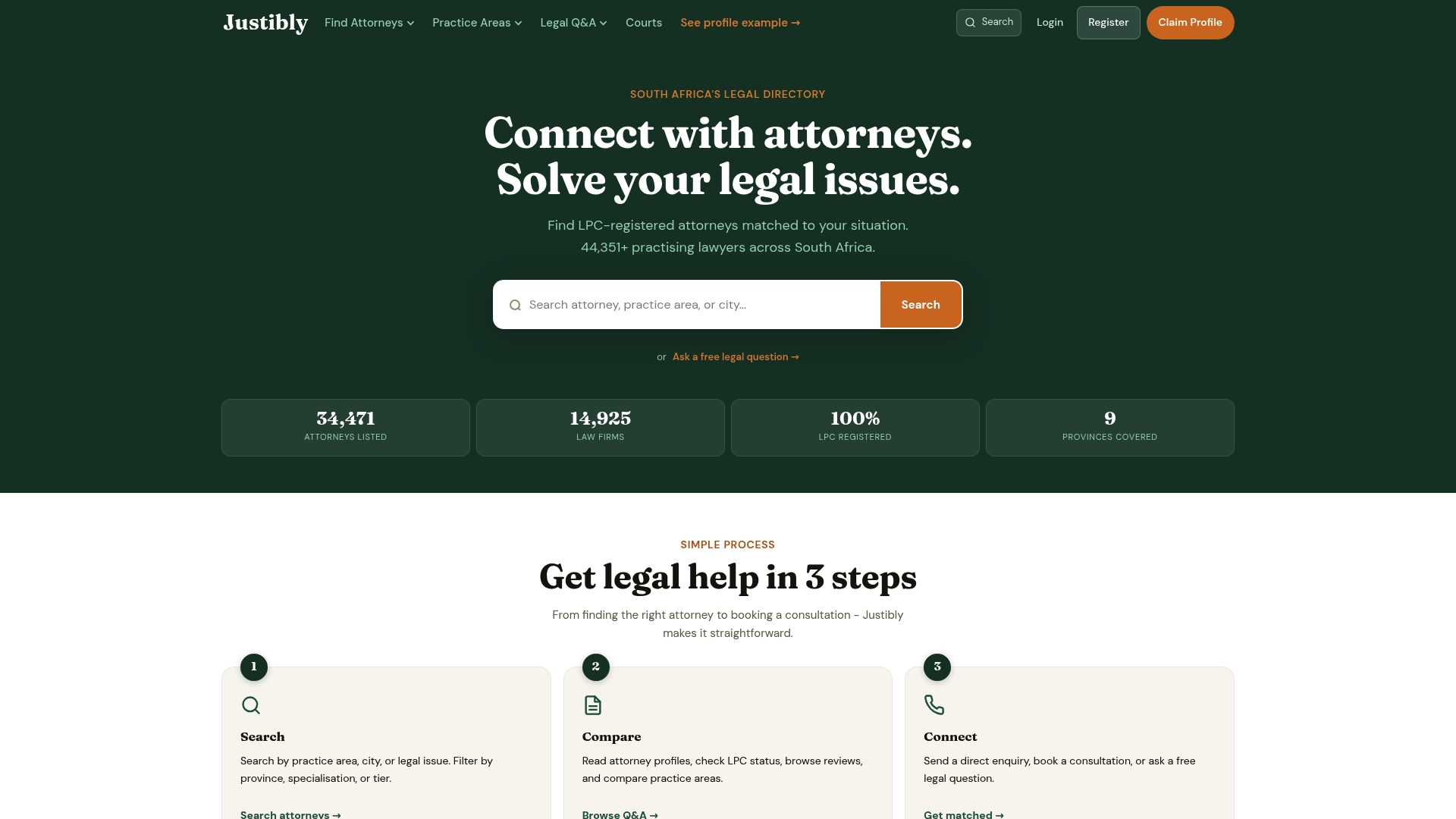
The platform's directory lets you search by practice area, so if your AOD touches NCA registration questions, credit disputes attorneys are a direct match, and consumer-facing debt problems point to consumer debt specialists. If you just need a fast sanity check before signing something, the free Q&A forum puts your question in front of a registered attorney without booking a paid consult first. When you're ready for a proper review of your specific document, start at the Justibly directory and filter by location and practice area to find someone who can look at it this week.
Sources
- Whether an AOD is regulated by the National Credit Act (academic/research source)
- Prescription of Debts — Prescription Act 68 of 1969 (consolidated text)
- Is an acknowledgment of debt regulated by the National Credit Act? (GoLegal article)
- Loans, Suretyships & Acknowledgements of Debt in South African Law 2026 | MJ Kotze Inc
This article is general information, not a substitute for advice from a qualified lawyer. Consult a qualified legal professional about your own circumstances before acting on anything here.
FAQ
Who qualifies for an acknowledgement of debt?
Anyone who owes a specific, ascertainable amount can sign one, whether an individual, a company director, or a business. It only becomes legally significant once both parties agree on the amount and sign.
What happens after three years of not paying a debt?
Under the Prescription Act, most debts prescribe after three years without payment or acknowledgement, meaning the creditor generally loses the right to enforce it in court. Signing an AOD or making a payment during that period restarts the clock.
Can you provide a sample acknowledgement of debt letter for South Africa?
A short template should include party details, a clear admission of the amount owed, repayment dates, interest terms if any, a default clause, jurisdiction, and signatures, structured as shown in the template section above. Adapt it to your facts and have significant or interest-bearing versions reviewed by an attorney found through Justibly.
What is the purpose of an acknowledgement of debt?
It confirms an existing debt in writing, creates a clear repayment plan, and interrupts prescription so the creditor's right to collect doesn't expire. It also gives the creditor a stronger enforcement position than relying on invoices or verbal agreements alone.
Recommended
By the Justibly editorial team
Published
General legal information for South Africa, checked against the Legal Practice Act, the relevant court rules and the Legal Practice Council roll. It is not legal advice and does not create an attorney-client relationship. For advice on your situation, consult an admitted attorney.
How we research and review · How the Trust Score works · Report an error