Register Your Customary Marriage in South Africa Before 31 August 2026
Register, prove and protect a customary marriage in South Africa: checklist, 31 August 2026 deadline, and LPC registered family lawyers to help.
Published

Yes, customary marriages are fully recognized in South Africa under the Recognition of Customary Marriages Act 120 of 1998. If yours was negotiated and celebrated according to customary law, involved two consenting adults, and hasn't been registered yet, your most urgent step is to register it or gather solid proof of its existence before rights around property, inheritance, or divorce come into dispute.
TL;DR:
- Customary marriages in South Africa must meet age, free consent, and customary law requirements to be legally valid after November 15, 2000, with earlier unions recognized automatically if valid.
- Registration is crucial because it provides a court-accepted proof of marriage, especially important for inheritance, estate, or property disputes, and must be completed within three months after registration opens in most cases.
- Lobola payment is not a legal requirement for validity; courts rely on evidence of mutual intent and customary processes rather than formal agreements or full payment.
- Unregistered customary marriages can still be proven with witness testimony, communication records, photographs, and community involvement, but disputes become more costly and complex without registration.
- The upcoming 2026 deadline is a rare window to regularize older, unregistered marriages before proving their existence in legal disputes becomes significantly more difficult.
Table of Contents
- What counts as a valid customary marriage in South Africa?
- How do you register a customary marriage in South Africa?
- Does lobola have to be paid in full to make a marriage legal?
- Community of property, polygamy, and what changes financially
- Proving a customary marriage that was never registered
- Getting registered or regularised: a practical checklist
- How Justibly can help you sort this out
- What rights and duties do spouses have during the marriage?
- How does a customary marriage end?
- Customary marriage versus civil marriage: what's actually different?
- What happens to inheritance rights in a customary marriage?
- Why registration matters more than most families realize
- Get help protecting your customary marriage rights
- Sources
- FAQ
What counts as a valid customary marriage in South Africa?
The law is more specific than most people assume. For a marriage entered into after the Act took effect on 15 November 2000, three conditions have to be met at the same time.
Both spouses must be 18 or older. Both must consent freely to the marriage, without coercion from family or anyone else. And the union must be negotiated, entered into, or celebrated in accordance with customary law, meaning the process your specific culture recognizes as making two people husband and wife.
- Age requirement: both parties must be 18 or older; exceptions may be made for minors with parental, guardian, or Commissioner of Child Welfare consent.
- Free consent: forced or arranged unions without genuine agreement from both parties do not meet the legal test, regardless of family pressure.
- Customary process: the marriage must follow the customs of the community involved, whether that means lobola negotiations, formal handover ceremonies, or other recognised rites.
- Existing spouse disclosure: if either party is already married under civil law, that marriage bars a customary one to someone else while it stands.
There's an important cut-off date buried in the Act that catches a lot of families off guard. Marriages entered into before 15 November 2000 were automatically recognised once the Act commenced, no registration or extra steps required, provided they were valid customary unions at the time. Marriages entered into after that date follow the newer, stricter framework, including the registration timelines discussed below. If your grandparents married customarily in the 1980s, their marriage is already legally valid. If you married last year, the rules are different and the clock is already running.
How do you register a customary marriage in South Africa?
Registration doesn't create the marriage, the customary process itself does that, but it does something almost as important: it gives you a document that courts, banks, and the Master's Office will accept without argument.
Here's the process in practice:
- Report the marriage to a Department of Home Affairs office, or in some areas, to a designated traditional leader authorised to receive these declarations.
- Bring both spouses' identity documents, along with any witnesses who were present at the negotiations or celebration, and a copy of the lobola agreement if one was written down.
- Complete the prescribed forms, generally referred to as BI-1699 and BI-1700, which capture the particulars of the marriage and the registration acknowledgement.
- Register within three months if the marriage happened after the Act commenced, this is the recommended timeframe under the RCMA's registration provisions, though missing it does not invalidate the marriage.
- Collect your registration certificate, which serves as prima facie proof of the marriage, meaning it's accepted as true unless someone actively disputes it.
If you've missed previous deadlines, there's real urgency right now. Home Affairs opened a special registration window running from 1 September 2024 to 31 August 2026, specifically to let couples with older, unregistered customary marriages regularise their status. That window closes at the end of August 2026. Once it shuts, late registration becomes a more complicated process involving affidavits and, sometimes, a formal enquiry into the existence of the marriage.
Does lobola have to be paid in full to make a marriage legal?
No. This is probably the single most misunderstood point in customary marriage law, and it trips up more people than the registration deadlines do.
Lobola is culturally central, and in many communities it's treated as proof that negotiations happened and families agreed to the union. But it is not a legal essentialia, meaning the Act doesn't require a completed or even a written lobola agreement for the marriage to be valid. Academic commentary on what actually qualifies as essential for a valid customary marriage confirms that oral evidence and other corroboration can carry just as much legal weight as a signed agreement.
Courts have backed this repeatedly. In Mbungela and Another v Mkabi and Others, the Supreme Court of Appeal found that skipping a specific ritual, in that case, the formal handover of the bride, wasn't fatal to the marriage's validity because other evidence clearly showed both families intended to create a marriage.
What actually protects you if lobola talks stalled partway through:
- Keep any written record of what was negotiated, even informal notes or messages between families.
- Retain receipts, bank transfers, or photos of livestock or goods exchanged as part of lobola.
- Ask family delegates who attended negotiations to write down what happened while memories are fresh.
- Save any communication (texts, voice notes) where either family refers to the couple as married.
Pro Tip: Don't wait for a dispute to start collecting this evidence. Ask the elders who led your lobola negotiations to write and sign a short account of what was agreed while everyone still remembers the details clearly.
Community of property, polygamy, and what changes financially
Customary marriages default to community of property unless the couple signs an antenuptial contract before the wedding to opt out. That means, in the absence of a separate agreement, both spouses' assets and debts merge into one joint estate from the moment the marriage is valid.
Polygamy adds a layer most civil marriages never touch. A man already in a customary marriage can lawfully enter a further customary marriage, but the RCMA requires him to approach a court for approval of a contract regulating the future matrimonial property system between all the wives involved. This protects the first wife's existing property rights from being diluted or absorbed without her knowledge or consent.
Key financial consequences worth knowing:
- Joint estate by default: without an antenuptial contract, both spouses share ownership and liability for debts incurred during the marriage.
- Court oversight for additional wives: a husband can't simply add a second customary wife without a court-sanctioned property arrangement protecting the first wife's share.
- Registration and the Master's Office: when a spouse dies, the Master of the High Court frequently requests proof of registration during estate administration, and an unregistered marriage can slow down or complicate that process significantly.
- Intestate succession exposure: if there's no will and no registration certificate, surviving spouses can face pushback proving their claim under intestate succession rules.
This is where unregistered marriages cause the most damage in practice, not during the marriage itself, but the moment someone dies or the relationship breaks down and there's a joint estate to divide.
Proving a customary marriage that was never registered
Registration failing doesn't mean the marriage disappears. Courts have consistently accepted a range of evidence when a customary marriage's existence is disputed, particularly in divorce or inheritance cases where one party or their family denies the union ever happened.
Accepted forms of evidence typically include witness testimony from people present at negotiations, lobola receipts or records of goods exchanged, photographs from the ceremony, evidence of families formally meeting to negotiate, and evidence that the couple lived together and held themselves out as married. Practitioner guidance on proving disputed customary marriages notes that courts accept a composite picture built from affidavits, gift records, and contemporaneous communication when formal paperwork is missing.
Judges tend to look past the absence of any single formality and focus on whether the parties genuinely intended to be married and acted on that intention. Oral evidence carries real weight, particularly from family members who attended negotiations, so the lack of a written lobola contract rarely decides a case on its own.
If your marriage's status is being challenged right now, act quickly:
- Get sworn affidavits from anyone who witnessed the lobola negotiations or ceremony.
- Preserve every document, message, and photo related to the marriage before memories fade or family relations deteriorate.
- Consult an LPC-registered family law attorney early rather than after a dispute has already escalated.
Roughly two years remain on the current special registration window, which closes 31 August 2026. Couples with older, unregistered unions have a genuinely limited opportunity to regularise their status before that deadline passes.
Getting registered or regularised: a practical checklist
Whether you're registering a recent marriage or trying to regularise an older one before the 2026 deadline, the steps are largely the same.
- Gather your documents first: both spouses' IDs, proof of residence, and a copy of any written lobola agreement, even a partial one.
- Line up your witnesses: ideally someone from each family who took part in the negotiations or ceremony, willing to confirm details if Home Affairs asks.
- Visit your local Home Affairs office, or the designated traditional leader in your area authorised to record customary marriages, and submit the relevant forms.
- Wait for your certificate: processing times vary by office, but once issued, that certificate is your prima facie proof going forward.
- If you missed earlier deadlines, ask specifically about late registration or an enquiry into the existence of the marriage, both routes exist for older, undocumented unions.
Pro Tip: Photocopy your registration certificate the day you receive it and store a copy somewhere separate from the original, family disputes and lost paperwork are the two most common reasons people struggle to prove marriages that were, in fact, properly registered.
How Justibly can help you sort this out
Working through registration paperwork or a contested marriage claim is easier with someone who knows family law inside out. Justibly's directory lists LPC-registered attorneys across all nine provinces, filterable by specialty, so you can find someone who actually handles customary marriage matters rather than a generalist. If you're in Cape Town or Johannesburg, our regional divorce attorney listings narrow that search further. Not ready to commit to an attorney yet? Post your question on free Q&A platforms to get a response from a registered legal professional.
What rights and duties do spouses have during the marriage?
Once a customary marriage is valid, whether registered or not, both spouses hold equal status and capacity in law. This overturned decades of customary practice where wives had limited legal standing, particularly around owning property or contracting independently.
Spouses owe each other a duty of support, meaning both are responsible for contributing to household needs according to their means. Neither spouse can be forced to remain in a marriage that has genuinely broken down, and either party can approach a court for a decree of divorce if the relationship has become unworkable.
Where the marriage follows the default community of property regime, both spouses have equal rights to deal with joint assets, though certain major transactions, like selling immovable property or entering large credit agreements, generally require both spouses' consent or knowledge. This mutual consent requirement exists specifically to stop one spouse from unilaterally disposing of shared assets without the other's input.
Children born during the marriage are presumed to be the legitimate children of both spouses, which matters enormously for maintenance claims, inheritance, and custody disputes down the line. Spouses also retain the right to approach the courts on maintenance, domestic violence protection, or property disputes exactly as civil-marriage spouses would, the RCMA didn't create a lesser category of marriage, it created an equal one with a different formation process.
How does a customary marriage end?
Customary marriages end the same way civil marriages do in South Africa today: only through a court order. This is a deliberate design choice in the RCMA, meant to stop spouses (usually wives) from being informally cast aside without any legal protection or say in how joint assets get divided.
A spouse seeking to end the marriage must approach the High Court or a Regional Court with divorce jurisdiction and show the marriage has broken down irretrievably, the same standard applied to civil divorces. Simply returning lobola, or a family declaring the union over, has no legal effect on the marriage's status, no matter how customary that practice might feel within a particular community.
Once a decree of divorce is granted, the court also deals with the practical fallout: division of the joint estate if the couple married in community of property, maintenance for a spouse who needs it, and custody or care arrangements for children. If the marriage was polygamous, the court factors in the property arrangements approved for each wife when working out how assets get split.
Death also ends a customary marriage, and this is where registration status becomes critical. A surviving spouse with a registration certificate faces a straightforward process proving their claim to the deceased's estate. A surviving spouse without one may need to prove the marriage existed at all before an executor or the Master's Office will recognise any claim, adding delay and cost to an already difficult moment.
Customary marriage versus civil marriage: what's actually different?
Both marriage types carry equal legal weight in South Africa today, but the paths to get there, and some of the default rules, diverge in ways that catch people off guard.
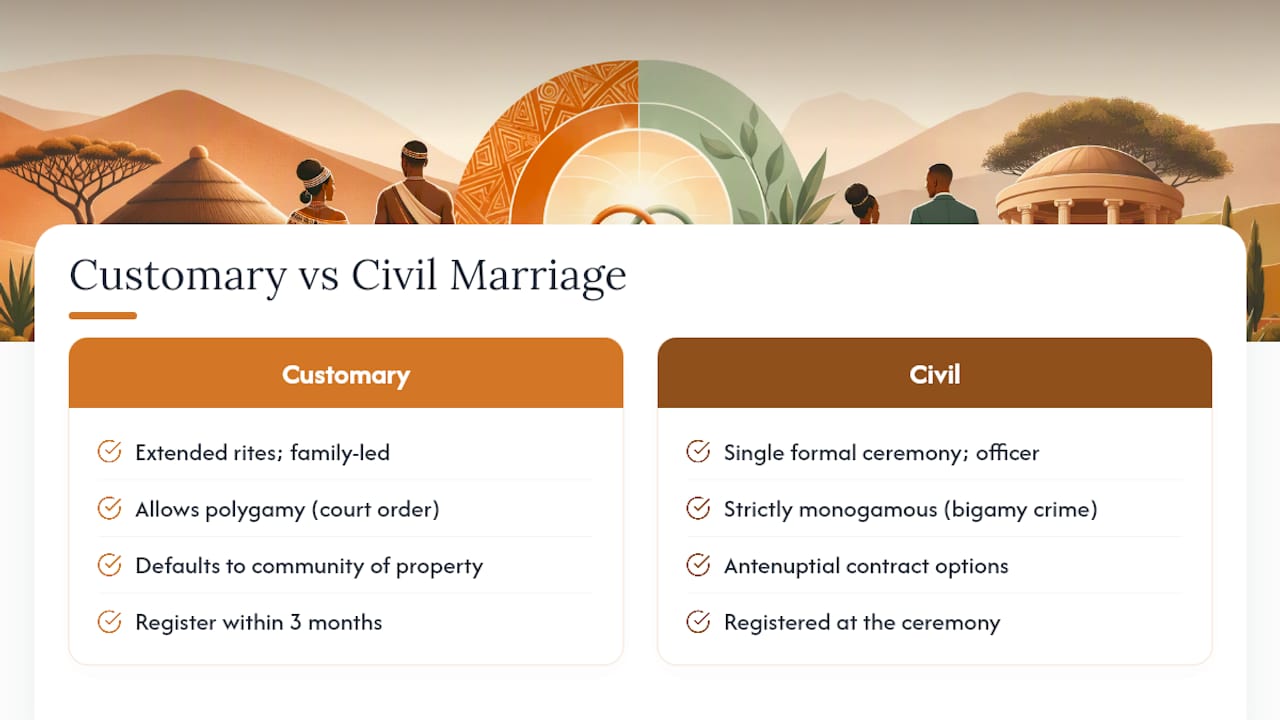
Civil marriages under the Marriage Act require a civil marriage officer and happen at a single formal ceremony with witnesses. Customary marriages instead recognise a process, negotiations, family involvement, and customary rites, that can unfold over weeks or months rather than one event. There's no equivalent to a marriage officer standing at the front of a room; the marriage becomes valid once the customary requirements are actually met.
Polygamy is the starkest difference. Civil marriage is strictly monogamous, a second civil marriage while the first still stands is bigamy and a criminal offence. Customary marriage permits polygamy, provided the husband secures court approval for a property arrangement covering all wives before or after taking an additional wife.
Property defaults also differ slightly in flavor even though both use community of property as the starting point. Civil marriages allow couples to choose community of property, out of community without accrual, or out of community with accrual, via an antenuptial contract signed before marriage. Customary marriages follow the same logic, defaulting to community of property absent a contract, but the polygamy question adds a layer of court-supervised complexity civil marriages never encounter.
Registration timing differs too. Civil marriages are registered at the ceremony itself, there's no separate step. Customary marriages are meant to be registered within three months after the fact, which is exactly the gap that leaves so many unregistered and vulnerable years later.
What happens to inheritance rights in a customary marriage?
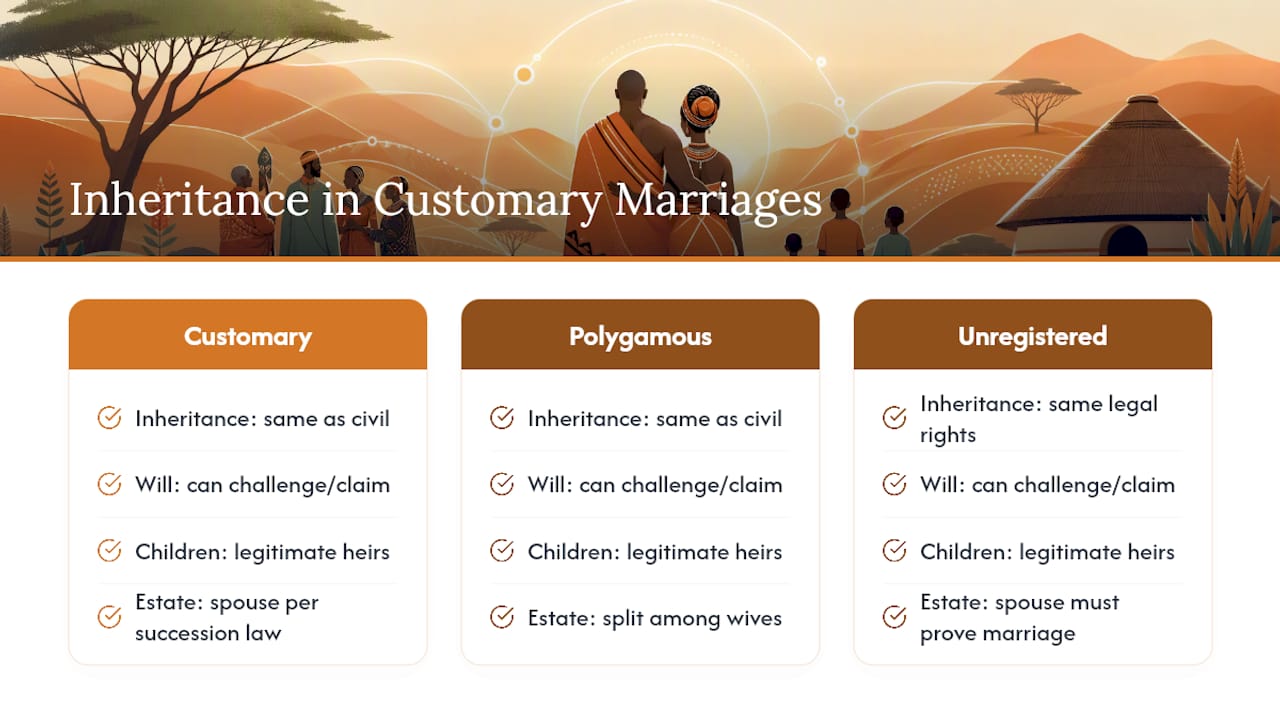
Surviving spouses in a valid customary marriage inherit under the same intestate succession rules that apply to civil marriages, provided there's no valid will directing otherwise. This wasn't always the case, but the RCMA and subsequent case law closed the gap that once left customary wives with far weaker inheritance claims than civil wives.
Where a will exists, a customary spouse has the same right to challenge or claim against the estate as any other legally recognised spouse would, including claims for maintenance from the estate if they were financially dependent on the deceased.
Polygamous marriages complicate the math without changing the underlying principle. When a husband dies leaving multiple customary wives, each wife shares in the intestate estate according to the formula set out in succession legislation, rather than one wife inheriting everything and the others being excluded. Children from each marriage also inherit as legitimate heirs regardless of which wife is their mother.
Here's where registration status decides how smoothly any of this actually plays out. An executor or the Master's Office handling a deceased estate will typically ask for a marriage certificate as the simplest way to confirm a claimant's status. Without one, a surviving spouse may need affidavits, witness statements, and sometimes a court finding just to establish that the marriage existed before their inheritance claim can even be assessed. That delay can stretch an estate process from months into years, particularly when other family members have reason to dispute the marriage's validity.
Why registration matters more than most families realize
The conventional advice on customary marriages tends to stop at "it's legally recognised, don't worry." That's technically true and practically useless. A marriage that exists in law but can't be proven in a specific moment, at a bank, in a divorce court, at the Master's Office, functions exactly like no marriage at all until someone establishes otherwise.
What gets underestimated is how often that proof gets demanded at the worst possible time: after a death, mid-divorce, or when family members with competing financial interests suddenly develop convenient amnesia about a lobola agreement everyone acknowledged for years. Courts like Mbungela show real flexibility toward oral evidence and incomplete rituals, but flexibility isn't certainty, and litigation to establish a marriage's existence costs money and time a grieving or separating spouse rarely has to spare.
The 2026 registration deadline isn't bureaucratic housekeeping. It's a genuinely rare window to fix decades of undocumented marriages before proving them becomes a court fight instead of a form. If there's one thing worth prioritizing over everything else in this article, it's this: stop treating registration as optional paperwork and start treating it as the only thing standing between your family and a legal argument nobody wins cleanly.
— Nkosi
Get help protecting your customary marriage rights
Sorting out registration, lobola disputes, or estate claims tied to a customary marriage isn't something to handle alone when the outcome affects your property, your children, or your inheritance. There are services that connect users directly with LPC-registered attorneys who practice family law, verified against Legal Practice Council data rather than a paid ranking system.
If you need representation now, search our family law attorney directory for someone in your province who handles customary marriage matters specifically. Not sure where to start, or just need a quick answer before committing to a consultation? Post your question on our free legal Q&A and get a response from a registered attorney at no cost.
Sources
Verify the details above directly through the Department of Justice's guidance on customary marriage, the RCMA's full statutory text on SAFLII, and the SCA judgment in Mbungela v Mkabi.
This article is general information, not a substitute for advice from a qualified lawyer. Consult a qualified legal professional about your own circumstances before acting on anything here.
- Getting married under customary law — Department of Justice (South Africa)
- Recognition of Customary Marriages Act 120 of 1998 (consolidated text) — SAFLII
- Home Affairs reminds public of deadline for registration of customary marriages — GovZA (16 Jul 2026)
- Register your customary marriage to make it legal — Vuk'uzenzele
FAQ
What are the requirements for a customary marriage in South Africa?
Both spouses must be 18 or older, consent freely, and the marriage must be negotiated and celebrated according to customary law, with neither party already married under civil law to someone else.
Does paying half lobola mean you are married?
Not automatically. Lobola isn't a legal requirement for validity, so partial payment isn't decisive either way. Courts look at whether both families' conduct shows a genuine intention to create a marriage, alongside other evidence like witness accounts and communication between the families.
Can a man marry two wives in a customary marriage?
Yes, but he must first get a court order approving a contract that regulates the matrimonial property arrangements between all his wives, protecting each wife's existing property rights before or alongside the new marriage.
What are the requirements for a customary marriage in August 2026?
The core legal requirements remain unchanged, but August 2026 carries extra weight because it's the deadline for the special Home Affairs registration window that closes 31 August 2026, after which late registration becomes considerably harder.
Do I need an attorney to register or prove a customary marriage?
It's not legally required, but an LPC-registered family law attorney becomes essential the moment a marriage's existence is disputed or a divorce and property division are involved.
Recommended
By the Justibly editorial team
Published
General legal information for South Africa, checked against the Legal Practice Act, the relevant court rules and the Legal Practice Council roll. It is not legal advice and does not create an attorney-client relationship. For advice on your situation, consult an admitted attorney.
How we research and review · How the Trust Score works · Report an error