Living will South Africa: how to create one that works
Learn how to create a living will in South Africa that ensures your medical wishes are honored, giving you peace of mind and clarity.
Published

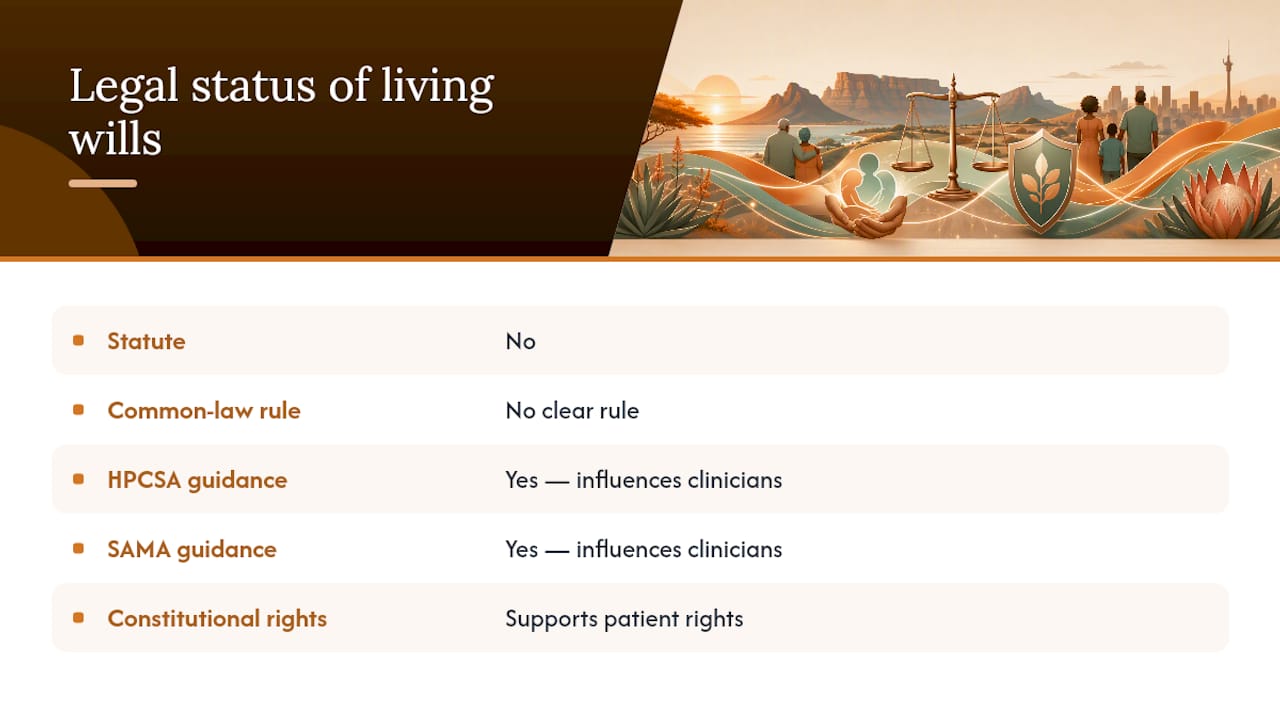
A living will is not automatically enforceable under South African law right now. No statute governs it, and no court has laid down a general rule that doctors must follow one. But it still carries real weight: the HPCSA and the SAMA both expect clinicians to respect a clear, properly signed advance directive, and the National Health Act reinforces a patient's right to informed consent.
So the practical move is this:
- Write a clear, dated, signed directive stating exactly what treatment you refuse and under what conditions.
- Name a consult person (a spouse, adult child, or close friend) who knows your wishes and can speak for you.
- Put copies where they'll actually be seen: your GP's file, your hospital file if you're admitted, and a card in your wallet.
Key Takeaways
A living will carries strong ethical and evidentiary weight in South Africa even though no statute currently makes it automatically enforceable.
| Point | Details |
|---|---|
| Legal status | No South African law or clear common-law rule makes living wills automatically enforceable, though HPCSA and SAMA guidance carries real influence. |
| Validity conditions | Being 18 or older, mentally capable, giving informed consent, and showing no later change of mind are the four practical requirements. |
| Combine directive and proxy | Pairing a written directive with a named consult person covers gaps that a document alone can't anticipate. |
| Distribution matters most | Give copies to your GP, hospital, and family, and carry a wallet card, since an unfound directive can't be followed. |
| Get it reviewed properly | Justibly connects readers with LPC-registered attorneys and offers a free Q&A forum to clarify legal questions before drafting. |
This article is general information, not a substitute for advice from a qualified lawyer. Consult a qualified legal professional about your own circumstances before acting on anything here.
Table of Contents
- What counts as a living will in South Africa?
- Is a living will legally binding in South Africa?
- Who can make a valid living will, and what makes it credible?
- Living will or medical power of attorney: which do you need?
- How do you actually draft a living will that clinicians will trust?
- How do you make sure it's found and honoured in an emergency?
- What do HPCSA and SAMA actually tell doctors to do?
- What can you do if clinicians or family disagree?
- Where can you get reliable templates and help in South Africa?
- What does it cost, and how long does it take?
- Your checklist to create or update a living will today
- Why a directive alone isn't enough
- Get help from a South African attorney who knows this area
- Sources
- FAQ
What counts as a living will in South Africa?
A living will, also called an advance directive or advance healthcare directive, is a written statement of what medical treatment you want or refuse if you lose the ability to decide for yourself. It only activates when you can no longer communicate your wishes, whether from unconsciousness, dementia, or a medical crisis.
It does two separate jobs. One is refusing specific interventions, such as CPR, mechanical ventilation, or artificial feeding. The other is stating your broader values, like prioritising comfort over prolonging life at all costs.
Two situations show the difference clearly:
- Permanent vegetative state. You've suffered irreversible brain damage with no realistic chance of recovery, and your directive says you don't want to be kept alive on machines.
- Terminal, incurable illness. You're in the final stage of a disease like advanced cancer, and doctors are weighing whether to start aggressive life-prolonging treatment you'd already ruled out.
Is a living will legally binding in South Africa?
Not yet, and that gap matters more than most templates admit. There's no legislation currently governing living wills in South Africa, and earlier proposals such as the National Health Amendment Bill have never been enacted. That leaves the country in a strange middle ground: a directive isn't worthless, but it isn't a guaranteed instruction either.
Legal commentary points out that constitutional rights, particularly dignity and bodily integrity, together with the informed consent framework in the National Health Act, can support a living will in practice even without dedicated legislation. Courts have also engaged with related questions before. In Clarke v Hurst, the court allowed the withdrawal of artificial feeding from a man in a persistent vegetative state, based on substituted judgment about what he would have wanted. It's not a living-will case in the strict sense, but it shows South African courts are willing to weigh a patient's prior wishes heavily.
Academic analysis identifies four recurring obstacles to enforcement: a lapsed or absent proxy, unsettled law on end of life decisions, doctors' fear of criminal or civil liability, and directives that simply never reach the treating clinician.
What that means at the bedside:
- A clear, specific directive is usually followed where the medical situation matches it closely.
- In doubt or dispute, doctors often default to treating and preserving life until the picture is unambiguous.
- Court applications remain rare and are reserved for genuinely contested cases, not routine ones.
Who can make a valid living will, and what makes it credible?
There's no dedicated law, so validity comes down to ethical practice that both attorneys and clinicians recognise. Guidance from medical-legal bodies sets four practical conditions: you must be 18 or older, mentally capable when you sign, given informed consent about what you're refusing, and there must be no evidence you later changed your mind.
- Be specific. "No heroic measures" means little to a doctor; "no CPR or ventilation if I'm in an irreversible coma" means everything.
- Date and sign it, and destroy old copies the moment you update it. A living will from 2019 contradicting one from 2026 creates exactly the ambiguity clinicians fear most.
- Use two independent witnesses, ideally people with no financial interest in your estate, even though the law doesn't formally require this.
Pro Tip: Have your GP read the draft before you sign it. A doctor will spot vague clinical language an attorney might miss, like a "terminal illness" clause that doesn't specify a timeframe or prognosis.
Living will or medical power of attorney: which do you need?
A living will is a written instruction. A medical proxy, sometimes loosely called a durable power of attorney for health decisions, is a named person empowered to make choices for you in real time.
- A written directive covers scenarios you anticipated when you wrote it.
- A proxy can respond to situations you never wrote down, using judgment instead of a script.
- South African law doesn't yet formalise enduring powers of attorney for healthcare the way some other countries do, which limits how much weight a proxy's authority carries on its own.
Given that legal gap, combining a specific written directive with a named consult person is usually the strongest approach available in South Africa today.
How do you actually draft a living will that clinicians will trust?
A clinically useful directive isn't a paragraph of good intentions. It's a document a doctor can act on in under a minute.
- Start with identifying details: full name, ID number, date of birth.
- Define your triggers precisely, such as permanent vegetative state or terminal, incurable illness with no reasonable hope of recovery.
- List specific refusals: CPR, mechanical ventilation, artificial nutrition or hydration.
- Add a comfort care clause confirming you still want pain relief and dignity, even while refusing life-prolonging treatment.
- Sign and date it, with two witnesses present.
Avoid blanket phrases like "do everything possible" or "let nature take its course." They sound decisive but leave a doctor guessing. Ambiguity about reversible versus irreversible conditions is where most disputes start.
Pro Tip: Before finalising anything, read your draft aloud to a GP or palliative-care clinician. If they hesitate on any sentence, that's the sentence to rewrite.
How do you make sure it's found and honoured in an emergency?
The best-written directive is useless in a drawer no one checks. Distribution matters as much as drafting.
- Give signed copies to your GP, any specialist treating a chronic condition, and your next of kin.
- Ask your hospital or clinic to file a copy directly in your medical notes.
- Carry a wallet card summarising your key wishes and where the full document is kept.
- Upload a copy to your electronic health record if your provider supports one.
Talk to your family and your named consult person directly, not just about the document's existence but about what you actually want. Organisations like DignitySA and health department guidance both stress routine review and multiple stored copies as the difference between a directive that gets followed and one that gets missed entirely.
What do HPCSA and SAMA actually tell doctors to do?
Professional guidance shapes clinical behaviour more directly than any statute right now. The core principle both bodies apply is respect for patient autonomy, balanced against a duty to confirm capacity and consent were genuine.
Guidance instructs clinicians to provide necessary emergency treatment until a directive is produced or verified, rather than delaying care while searching for paperwork.
- Doctors are expected to honour a clear, verified directive where it applies to the exact clinical situation in front of them.
- Where a directive is vague, outdated, or contested, doctors typically treat first and seek clarity second.
- When in doubt, clinicians are advised to consult a colleague, their medical defence body, or legal counsel rather than act unilaterally.
What can you do if clinicians or family disagree?
Disputes are rare but they do happen, usually when family members disagree with a patient's stated wishes or a directive seems unclear to the treating team.
- Ask to speak directly with the treating clinician and present the original signed document.
- Request a second opinion from another doctor if the first refuses to act on it.
- Ask the hospital's ethics or legal committee to review the case.
- If the impasse continues, urgent court guidance may be necessary, though this remains uncommon.
Keep a scanned copy accessible on your phone and know your hospital's patient advocate contact in advance. If things escalate, an attorney sourced through Justibly can advise quickly on next steps.
Where can you get reliable templates and help in South Africa?
Skip generic overseas templates. American and British advance directive forms reference legal frameworks and treatment refusals that don't map onto South African clinical or legal practice, and a mismatched document can create more confusion than none at all.
- HPCSA and SAMA publish ethical guidance clinicians actually reference, useful reading before you draft.
- University research, including work from the University of Pretoria, gives a grounded picture of where the law genuinely stands.
- For anything beyond a straightforward case, a South African attorney sourced through Justibly's legal guides can review or draft your directive properly.
What does it cost, and how long does it take?
Costs vary widely depending on complexity. A free NGO template from DignitySA costs nothing and suits straightforward cases. A basic attorney review typically sits at the lower end of legal fees, since it's a short document rather than a full estate plan. Bespoke drafting involving complex medical conditions or family disputes costs more, priced as a standard hourly consultation.
Timing is refreshingly quick. You can draft a directive in an afternoon, get it clinically reviewed within days to a couple of weeks, and distribute copies to your GP and family the same day you sign. If you're unsure about a legal point before committing to a paid consultation, Justibly's free Q&A forum is a fast way to get clarity from a registered attorney first.
Your checklist to create or update a living will today
- Decide your values and specific triggers, such as irreversible coma or terminal illness.
- Draft the document yourself or start from a trusted South African template.
- Sign it in front of two independent witnesses.
- Give copies to your GP, hospital, and family, and name your consult person.
- Carry a summary wallet card.
- Schedule a review every two to three years, or sooner after any major health change.
Set aside one afternoon to draft it and the following week to distribute copies and talk it through with your consult person.
Why a directive alone isn't enough
Legal uncertainty is exactly why relying on a written document by itself is risky. A named consult person who understands your wishes fills the gaps no template can anticipate, especially when a clinical situation doesn't match your wording precisely. If you're serious about this, draft the directive, then sit down with a GP and, where the situation is complex, an attorney, so both the medical and legal sides of your wishes are covered.

Get help from a South African attorney who knows this area
Justibly's directory cuts out the guesswork of finding someone qualified. Every attorney listing reflects real LPC data, not a pay-to-rank spot, so when you search for a professional to review your living will, you're seeing who's actually registered to practise, not who paid for placement.
If you're not ready to commit to a consultation, ask your question first through Justibly's free legal Q&A, where registered attorneys answer directly. When you're ready for a proper review or drafting session, search Justibly's legal guides for the process, then find an attorney in your area, whether that's Johannesburg, Cape Town, or Pretoria, and book a consultation to get your living will drafted properly.
Sources
- Enforceability of living wills in South Africa (University repository item)
- Living wills/Advance directives (Medical Protection factsheet)
- Advance directive planning guide 2024 (DignitySA / health knowledge hub PDF)
- The legal status and enforceability of living wills in South Africa (Ackermann Attorneys article)
- Enforcing living wills in South Africa (Juta Journals)
FAQ
Is a living will legally binding in South Africa?
Not automatically. No statute or clear common-law rule enforces it, but HPCSA and SAMA guidance, along with constitutional rights, give it strong practical weight with clinicians.
Which banks do free wills?
Several major South African banks offer free will drafting for clients with qualifying investment or banking products, though this typically applies to standard estate wills, not medical living wills, which are best drafted with an attorney or NGO template.
Who is disqualified from inheriting under a will?
Under South African law, a person who unlawfully causes or contributes to the deceased's death is generally disqualified from inheriting, along with witnesses to the will and their spouses in most circumstances.
How much does a will cost in South Africa?
Costs range from free NGO templates for a basic living will to attorney fees charged at standard hourly consultation rates for more complex drafting; Justibly's Q&A forum is a good first stop to clarify what you actually need before paying for a consultation.
Recommended
By the Justibly editorial team
Published
General legal information for South Africa, checked against the Legal Practice Act, the relevant court rules and the Legal Practice Council roll. It is not legal advice and does not create an attorney-client relationship. For advice on your situation, consult an admitted attorney.
How we research and review · How the Trust Score works · Report an error