Intestate succession in South Africa: what heirs need to know
Learn how intestate succession works in South Africa, including share calculations and estate management tips for families without a will.
Published
When someone dies without a valid will in South Africa, the Intestate Succession Act 81 of 1987 decides who inherits, not the family's own preferences. A surviving spouse and children take first priority: the spouse gets a child's share or R250,000, whichever is greater, and the children split what's left. That single rule resolves most estates, but the details around calculating shares, qualifying as a "spouse," and handling the paperwork trip up a lot of families.
This guide walks through:
- How to calculate a child's share when there's a spouse and children
- What the Master of the High Court actually requires opening the estate
- When you genuinely need an attorney versus when you can manage alone
Key Takeaways
Intestate succession in South Africa follows a fixed statutory order, and the surviving spouse always receives a child's share or R250,000, whichever is greater, before descendants split the remainder.
| Point | Details |
|---|---|
| Statutory order governs everything | The Intestate Succession Act 81 of 1987 fixes the heir order; family agreement cannot override it. |
| Spouse gets the greater amount | A surviving spouse takes a child's share or R250,000, whichever is larger, when descendants also survive. |
| Life partners must prove the relationship | Post-2023 amendments recognize permanent life partners as spouses, but evidence of mutual support is required. |
| The Master's Office runs the process | Executors report deaths within 14 days and must advertise for creditors before distributing assets. |
| A valid will avoids the whole process | Justibly's directory connects readers with wills and estates attorneys to draft one or resolve disputed intestate claims. |
This article is general information, not a substitute for advice from a qualified lawyer. Consult a qualified legal professional about your own circumstances before acting on anything here.
Table of Contents
- What is intestate succession under South African law?
- Who inherits when a spouse and children survive?
- Does a customary marriage or life partner count as a spouse?
- What happens if there's no spouse or children?
- How does the Master of the High Court handle an intestate estate?
- How do you avoid intestate succession altogether?
- When should you consult an estates attorney?
- Get matched with a wills and estates attorney
- Sources
- FAQ
What is intestate succession under South African law?
Intestate succession is the legal process that distributes a deceased person's assets when no valid will exists. South African law doesn't leave this to chance or family consensus. It follows a fixed statutory order laid out in the Intestate Succession Act 81 of 1987, backed by the Administration of Estates Act 66 of 1965 for the practical mechanics of winding up the estate.
Several other statutes shape who counts as an heir. The Recognition of Customary Marriages Act 120 of 1998 brought customary marriages into the same legal standing as civil marriages for inheritance purposes. The Reform of Customary Law of Succession and Regulation of Related Matters Act 11 of 2009 abolished the old rule of male primogeniture, which had automatically excluded women and younger sons from customary estates. The Judicial Matters Amendment Act 15 of 2023 more recently expanded the legal definition of "spouse" to include qualifying permanent life partners.
The Constitutional Court's Bhe ruling struck down customary law's automatic exclusion of women and extramarital children from inheriting, forcing Parliament to rewrite the rules that had governed millions of South African estates for decades.
That 2004 Bhe decision remains the single most consequential moment in modern South African succession law. If you want the primary legal text rather than a summary, the Department of Justice's Master's Office page and Gov are the two most reliable starting points.
Who inherits when a spouse and children survive?
Where a deceased person leaves behind both a spouse and descendants, the surviving spouse inherits a child's share or R250,000, whichever amount is greater, and the descendants split whatever remains of the estate.
The child's share formula is straightforward once you see it worked through:
- Add up the total value of the intestate estate after debts are settled.
- Count the number of surviving children plus the number of surviving spouses.
- Divide the estate value by that total number. That figure is one "child's share."
- Compare the child's share to R250,000. The spouse receives whichever is larger.
- The remaining balance splits equally among the children.
Say an estate is worth R900,000, with one spouse and two children. Three shares total, so a child's share equals R300,000. Since R300,000 exceeds the R250,000 statutory minimum, the spouse takes R300,000, and each child takes R300,000.
Now shrink the estate to R450,000 with the same family structure. A child's share here works out to R150,000, which falls below R250,000. The spouse instead takes the fixed R250,000, leaving R200,000 to split between the two children at R100,000 each.
Polygynous marriages, recognized under customary law, complicate the math slightly but follow the same principle:
- Each surviving spouse in a valid polygynous marriage counts toward the total number of "shares" when calculating a child's portion.
- All surviving spouses together still cannot receive less than what the formula and minimum guarantee allows.
- Where only spouses survive with no children, they inherit the estate in equal shares between them.
Pro Tip: If you're unsure whether an estate's value clears the R250,000 threshold for the surviving spouse, get a proper asset valuation before assuming the standard child's-share split applies. Property values and outstanding bonds shift this calculation more than people expect.
Does a customary marriage or life partner count as a spouse?
Yes, but the proof required varies a lot depending on the relationship type. South African law now recognizes several categories of relationship for intestate inheritance purposes:
- Civil marriages under the Marriage Act, including same sex marriages recognized under the Civil Union Act
- Customary marriages registered or provable under the Recognition of Customary Marriages Act, including polygynous unions
- Permanent life partners, where the surviving partner can show a relationship akin to marriage with reciprocal duties of support, following the Judicial Matters Amendment Act 15 of 2023 and the Constitutional Court's Bwanya ruling
Children inherit regardless of whether their parents were married, and adopted children carry the same rights as biological children. Where a child predeceases the parent but leaves their own children, those grandchildren inherit their parent's share by representation, a principle known as per stirpes.
Pro Tip: Life partners face a real evidentiary hurdle. Bank statements, joint leases, insurance nominations, and affidavits from people who knew the couple all help establish the "reciprocal duty of support" that courts require before recognizing a partner as a spouse for inheritance purposes.
What happens if there's no spouse or children?
The Act moves down a fixed ladder of relatives when the deceased leaves no spouse and no descendants:
- Both parents survive: they split the estate equally between them.
- One parent survives: that parent takes half, and the deceased's siblings split the other half.
- No parents survive: siblings inherit everything, or their children by representation if a sibling has also died.
- No close family exists at all: the estate goes to the nearest blood relatives, tracing separately through the maternal and paternal lines.
- No relatives can be traced within the statutory period: the estate escheats to the state as a last resort.
Picture an unmarried, childless person whose parents both died first, survived only by one full sibling and two children of a deceased half sibling. The full sibling would take a larger portion, while the half sibling's children split their parent's share between them, since siblings related through only one parent traditionally inherit a reduced portion relative to full siblings.
How does the Master of the High Court handle an intestate estate?
The Master of the High Court oversees every deceased estate in South Africa, intestate or not, and appoints an executor (called an "administrator" in intestate matters where no executor was nominated) to manage the process.
The administration generally follows this sequence:
- Report the death to the Master's Office within 14 days, using the prescribed forms.
- The Master issues Letters of Executorship (or Letters of Authority for smaller estates under R250,000).
- The executor advertises for creditors under section 29 of the Administration of Estates Act, giving a 30-day window for claims.
- The executor draws up a liquidation and distribution account covering assets, debts, and proposed heir allocations.
- Once the Master approves the account and no objections arrive, the executor distributes the assets to heirs.
Expect to gather a death certificate, ID documents, a marriage certificate or proof of customary marriage, birth certificates for children, bank statements, and asset valuations before the Master's Office will move the file forward. Estates under R250,000 qualify for a simplified process that often finishes in a few months. Larger or contested estates, particularly those involving disputed heirs or property in multiple provinces, commonly take a year or longer to finalize. Costs typically include executor's fees (capped by regulation at a percentage of the estate value), Master's fees, and any conveyancing or valuation costs tied to specific assets.
Debts always come out before heirs see a cent. An executor must settle bonds, credit accounts, funeral costs, and tax liabilities from the estate before calculating what's left to distribute, which is why an estate that looks substantial on paper sometimes leaves heirs with far less than expected.

How do you avoid intestate succession altogether?
Writing a valid will sidesteps this entire statutory process and lets you decide who inherits what. South African law requires the will to be in writing, signed by the testator in the presence of two competent witnesses over 14 years old, with every page initialed.
- Draft the will with clear, unambiguous language naming specific heirs and assets.
- Nominate an executor you trust, ideally someone familiar with your affairs.
- Store the signed original somewhere secure, such as with your attorney or the Master's Office, and tell a trusted family member where to find it.
- Review and update the will after marriage, divorce, a new child, or a major asset purchase.
Pro Tip: Revisit your will every three to five years even without a major life event. Asset values shift, relationships change, and an outdated will can create the exact disputes it was meant to prevent.
When should you consult an estates attorney?
Some intestate matters genuinely need professional guidance rather than a DIY approach through the Master's Office:
- A life partner or customary spouse's status is disputed by other family members
- The estate includes property or investments held outside South Africa
- Heirs disagree about the child's share calculation or asset valuations
- Someone is challenging the validity of a will that does exist
- A dependent needs to pursue an urgent maintenance claim against the estate
An estates attorney advises on the strength of a claim, prepares and lodges the required documents with the Master, negotiates between disputing family members, and represents heirs in court where necessary. A searchable attorney directory makes it easier to find someone who specializes in deceased estates rather than general practice.
Finding your way through the paperwork
I once helped a relative track down a deceased estate file after a parent passed without a will. Between locating the marriage certificate, working out the Master's requirements, and understanding why the child's share formula gave an unexpected number, the process felt confusing at first. Getting proper guidance on the calculation made the outcome far clearer than muddling through alone.
Get matched with a wills and estates attorney
Working out an intestate estate on your own is legal, but the Master's Office moves at its own pace, and one missing document or misclassified relationship can stall a file for months. Justibly is a searchable directory of LPC-registered attorneys across all nine provinces, built specifically so you can filter by practice area and location instead of cold-calling law firms.
If your situation is straightforward, start with Justibly's free Q&A forum, where registered attorneys answer quick questions about heirship, documentation, or the child's share calculation at no cost. If you need someone to actually open the file with the Master or fight a disputed claim, search the wills and estates directory to compare verified attorney profiles by location and book a consultation directly.
Sources
- DO&JCD: Master/Intestate Succession
- What happens if I die without a will (intestate succession)? | South African Government
- Intestate Succession Act, 1987 – LawLibrary (AKN)
- ZAGPJHC 2024/321 — court judgment (SAFLII)
FAQ
What is the order of priority in intestacy?
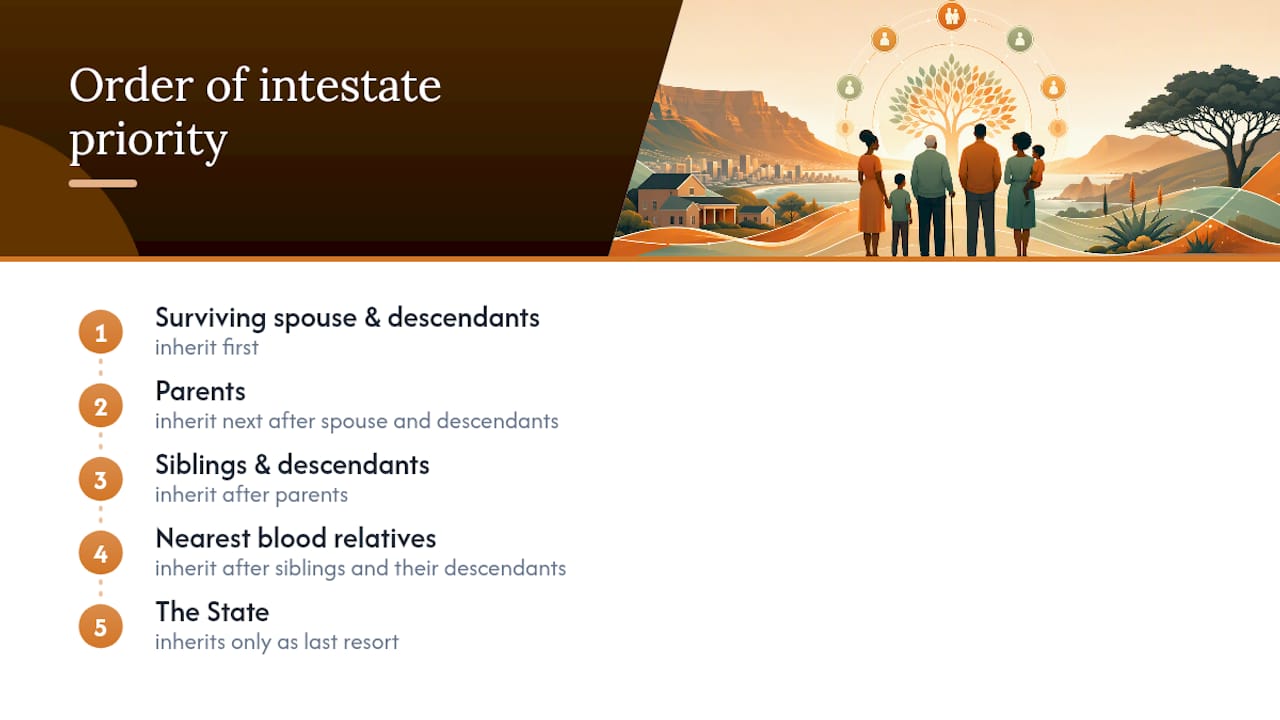
Spouse and descendants inherit first, followed by parents, then siblings and their descendants, then nearest blood relatives, with the state inheriting only as a last resort.
How do you calculate intestate succession in South Africa?
Divide the estate's value by the number of children plus surviving spouses to get a child's share; the spouse receives that amount or R250,000, whichever is greater, and children split the balance.
Who is disqualified from inheriting intestate?
Someone who unlawfully caused the deceased's death, or a divorced spouse whose marriage ended before death, is generally barred from inheriting under the intestate rules.
How is an intestate estate divided?
The Master of the High Court appoints an executor who settles debts first, then distributes the remaining assets according to the statutory order set out in the Intestate Succession Act.
Can a life partner inherit without being married?
Yes, if the surviving partner can prove a permanent relationship with reciprocal duties of support, following the 2023 amendment that expanded the legal definition of "spouse."
Recommended
By the Justibly editorial team
Published
General legal information for South Africa, checked against the Legal Practice Act, the relevant court rules and the Legal Practice Council roll. It is not legal advice and does not create an attorney-client relationship. For advice on your situation, consult an admitted attorney.
How we research and review · How the Trust Score works · Report an error