Attorney-Client Confidentiality in South Africa Explained
What your attorney must keep confidential in South Africa, how legal professional privilege differs, what 'without prejudice' means, and when protection ends.
Published

What you tell your attorney in South Africa is protected in two ways. The first is a professional duty of confidentiality, which binds your attorney. The second is legal professional privilege, which belongs to you and stops qualifying communications from being forced into evidence. The two overlap but are not the same, and neither is absolute. This guide explains how each works, what "without prejudice" means, and when protection falls away.
TL;DR
- Confidentiality is your attorney's broad duty to protect information about your affairs. Privilege is the narrower protection that keeps legal-advice communications out of proceedings, and only you can waive it.
- Privilege covers confidential communications with a legal adviser acting professionally, made to get or give legal advice. It does not cover communications meant to further a crime or fraud.
- "Without prejudice" settlement talks are generally inadmissible, with limited exceptions such as interrupting prescription.
- The Legal Practice Council (LPC) Code of Conduct binds every practitioner to protect client information, and your attorney cannot waive your privilege for you.
- If you think an attorney has breached your confidence, you can complain to the LPC.
Table of Contents
- Confidentiality and privilege: two different protections
- Where the duty comes from
- What legal professional privilege protects
- When privilege or confidentiality can end
- What "without prejudice" means
- Perspective: how we see it
- Practical steps to protect yourself
- If your attorney breaches your confidence
- For attorneys: show clients you take confidentiality seriously
- FAQ
- Sources
Confidentiality and privilege: two different protections
People use the words interchangeably, but South African law treats them separately. De Rebus, the attorneys' professional journal, explains the distinction this way: confidentiality is the attorney's wider duty to preserve information about a client's affairs, while legal professional privilege is the narrower common-law protection that stops qualifying communications from being disclosed or used as evidence.
The practical differences matter:
| Confidentiality | Legal professional privilege | |
|---|---|---|
| Whose protection is it? | A duty the attorney owes you | A right that belongs to you |
| How wide is it? | Any information about your affairs | Only qualifying legal communications |
| Who can waive it? | Governed by the Code and the law | Only you, the client |
| Does it survive the end of the mandate? | Ordinarily yes, including after your death | Persists unless you waive it or an exception applies |
| Where does it bite? | In everyday practice: what your attorney may tell others | In disputes, investigations and court: what can be demanded or admitted |
A simple example: your attorney knows your salary, your health condition and the name of your business partner. All of that is confidential. But a SARS officer, a litigant or a court might still ask for it. Whether they can get it depends on whether privilege applies, or whether a statute or court order overrides the duty.
Courts explain the reason for the rule plainly. In A Company and Others v Commissioner for the South African Revenue Service (2014), the court described privilege as supporting full and frank communication between client and lawyer, which in turn supports a properly functioning adversarial justice system. It is not there to shield lawyers for their own sake.
Where the duty comes from
The duty is not only a matter of good manners. The LPC lists the Legal Practice Act 28 of 2014, the LPC Rules and the Code of Conduct as the framework governing practitioners. Within the Code of Conduct, three clauses matter most to clients:
- Clause 3.6 requires practitioners to maintain legal professional privilege and confidentiality about the affairs of present or former clients or employers, according to law.
- Clause 57.2 requires them to preserve personal and confidential client information, unless it is not privileged and disclosure is required by law.
- Clause 57.3 says a practitioner may not waive, or purport to waive, privilege over privileged information.
The last point is worth stressing. If an opposing party, a regulator or a colleague asks your attorney to hand over privileged material, the decision is yours, not your attorney's.
For criminal matters, section 201 of the Criminal Procedure Act adds a related protection. As described in Savoi and Others v National Prosecuting Authority (2021), a legal practitioner cannot be compelled to testify about matters learned through professional employment or consultation without the client's consent. There is a statutory exception for facts connected with an offence that the practitioner learned before being consulted for the defence.
What legal professional privilege protects
Not everything you say to a lawyer is privileged. The courts look for specific requirements. Drawing on the A Company judgment and De Rebus, a communication is protected when:
- The legal adviser was acting in a professional capacity.
- You consulted the adviser in confidence.
- The communication was made to obtain or give legal advice.
- The advice was not meant to facilitate a crime or fraud.
- Privilege is claimed by you, the client.
Legal advice privilege
This covers confidential communications made to seek or give legal advice. It is not limited to litigation. Advice on a contract, a retrenchment, a will or a property purchase can qualify. In the A Company case, the court applied the principle to attorneys' fee notes in a SARS tax investigation.
Litigation privilege
Litigation privilege is wider in one respect: it can cover communications with third parties, such as experts, when they were created for the dominant purpose of pending or contemplated litigation. Baker McKenzie's South Africa guide identifies Ibex RSA Holdco v Tiso Blackstar as adopting that dominant-purpose test. So a valuation report your attorney commissions to prepare for a court case may be protected, while a report you ordered for ordinary business reasons probably is not.
Who and what is covered
Privilege attaches to the communication, not to the physical document. According to the same guide's section on scope, copies you hold remain protected, and the protection can extend to interpreters, articled clerks, secretaries and other firm employees, where the communication stays within the privileged legal-advice or litigation context.
That means you can forward your attorney's advice to your own spouse or colleague with some care, but you should think first. Sharing it widely, particularly outside a need-to-know circle, risks undermining the claim that it was kept confidential.
What is not protected
- Facts that exist independently of the consultation. Telling your attorney about a car accident does not make the accident privileged.
- Pre-existing documents. Handing a contract to your lawyer does not turn it into a privileged document.
- Communications made to further a crime or fraud.
- General business or fact-finding discussions where no legal advice is sought.
The last point comes up often in workplace investigations. Baker McKenzie's investigations chapter notes that notes of employee interviews conducted by lawyers to gather facts for legal advice can be privileged, but not when the interview is a general fact-finding exercise.
When privilege or confidentiality can end
The law treats privilege as fundamental but not automatic. In Savoi v NPA, the court stressed that courts must vigilantly protect privilege and look critically at state access to attorneys' files, while also applying it strictly according to its conditions.
You waive it
Only you can waive privilege. You might do so deliberately, for example by relying on your attorney's advice as part of your defence, or by accident, by circulating the advice to outsiders. Ask your attorney before you share anything that comes from them.
Crime and fraud
Privilege does not protect communications made to facilitate a crime or fraud. This is the crime-fraud exception. Asking an attorney how to comply with the law is protected. Asking an attorney to help you hide assets from creditors by a sham transaction is not.
Statute or court order
Some laws require disclosure despite confidentiality. One example noted by Bisset Boehmke McBlain is section 46 of the Promotion of Access to Information Act 2 of 2000, which can require a public body to disclose information despite privilege where disclosure would reveal substantial legal non-compliance or an imminent serious safety or environmental threat, and the public interest clearly outweighs the harm.
The interests of justice
The Code of Conduct allows disclosure of privileged information where the interests of justice require it, but only after the practitioner seeks permission from the instructing attorney, where applicable, and from the client. This process sits in clause 57.6 of the Code. It is not a licence for your attorney to disclose when they think best.
What "without prejudice" means
Many readers arrive here because a letter says "without prejudice" and they want to know what that does. In South Africa, it marks a communication as part of genuine settlement negotiations. The general rule is that such communications cannot be used as evidence against the person who made them. The purpose is to let parties speak openly about compromise without fear that an offer will be treated as an admission.
The label alone does not do the work. What counts is whether the communication was truly an attempt to settle a dispute. Marking a demand letter "without prejudice" does not automatically stop it being used.

The prescription exception
In KLD Residential CC v Empire Earth Investments (2017), the Supreme Court of Appeal recognised an exception. An acknowledgment of liability made without prejudice can be used solely to interrupt prescription under section 14 of the Prescription Act 68 of 1969. It remains protected when someone tries to use it to prove that the debt exists or how much it is.
If you are a debtor, this means a "without prejudice" acknowledgment may still restart the clock on a debt that was about to expire. Take advice before you write one.
Settlement offers and admissions
A 2024 decision of the South Gauteng High Court held that a without-prejudice settlement offer by the Road Accident Fund did not in itself amount to an admission of liability, where the Fund had not waived privilege and had not clearly conceded liability elsewhere. If you are negotiating an RAF claim, treat an offer as an offer, not as proof that the Fund accepts fault.
Perspective: how we see it

At Justibly we see the same misunderstanding repeatedly: people hold back facts from their attorney because they fear the information will leak, or they share too freely with friends and lose protection without realising. Both are avoidable.
Our view is simple. Be fully honest with a registered attorney, because the duty of confidentiality and the privilege rules exist to make that safe. Keep legal advice inside a small circle. Never ask a lawyer to help you do something unlawful, because that is where protection stops. And check that the person advising you is actually registered, because the Code of Conduct binds LPC-registered practitioners. That is why our directory lists attorneys on the basis of verified LPC data and why only LPC-registered lawyers answer questions in our free Q&A forum. Our listings are not ranked by payment.
— Nkosi
Practical steps to protect yourself
- Confirm registration first. Before you share sensitive details, check that the attorney is LPC-registered. Our guide to 12 questions to ask a lawyer includes the LPC checks.
- Say it is confidential. You do not need magic words, but making clear you are seeking legal advice helps show the purpose of the communication.
- Use your own channels carefully. Do not send advice to a work email on a shared or employer-monitored account, and avoid forwarding it to people who do not need it.
- Ask before you disclose. If a third party, such as a bank, an insurer or an investigator, asks for your attorney's advice, ask your attorney whether handing it over could waive privilege.
- Label settlement talks properly. If you are genuinely negotiating, say so in writing, and understand the prescription exception before you acknowledge a debt.
- Keep records of the mandate. A written engagement letter makes the scope of the relationship clearer.
Free sources of help exist too. If cost is the worry, see our pages on where to get free legal advice and how to get a pro bono lawyer. The same confidentiality duties apply to a pro bono client as to a paying one, as they flow from the attorney's professional status and not from the fee.
If your attorney breaches your confidence
If you think an attorney has disclosed your information improperly, keep a record of what was disclosed, to whom and when. Then raise it with the practitioner or firm in writing. If that does not resolve the matter, you can complain to the Legal Practice Council. Our guide on where to report lawyers in South Africa walks through the route. A breach of the Code is a professional conduct issue, and you may also have other remedies, so consider speaking to a different registered attorney about your options.
For attorneys: show clients you take confidentiality seriously
Clients choose attorneys they can trust with sensitive information. If you practise in South Africa, a verified Justibly profile puts your LPC registration in front of people searching by area and practice. Our Professional plan costs R499 per month and Premium costs R999 per month, and the Firm Professional plan costs R1499 per month. See all options on our pricing page.
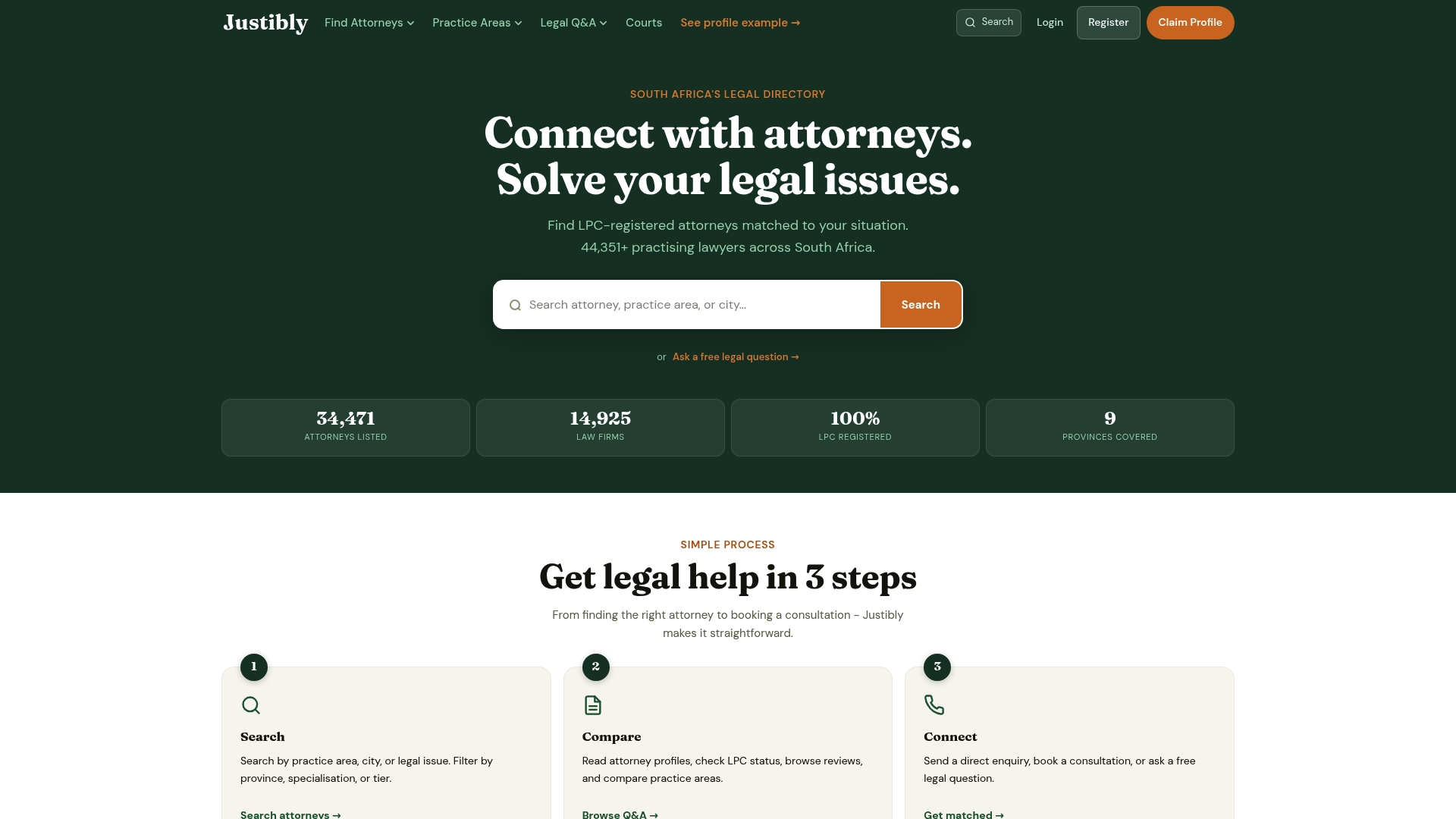
Members of the public can search the directory for free, and ask the Q&A forum a question without paying.
FAQ
Is attorney-client confidentiality the same as legal professional privilege?
No. Confidentiality is your attorney's broad duty to protect information about your affairs. Privilege is a narrower protection that belongs to you and keeps qualifying legal-advice communications out of proceedings. Information can be confidential without being privileged.
Can my attorney disclose what I told them?
Generally not. The LPC Code requires practitioners to preserve confidential client information, unless it is not privileged and the law requires disclosure. Your attorney also cannot waive your privilege on your behalf. Limited exceptions apply, such as a court order, a statute, or the interests-of-justice process in the Code.
Does confidentiality continue after I stop using the attorney?
Ordinarily yes. According to De Rebus, the confidentiality duty usually survives the end of the mandate and even the client's death. Privilege likewise continues unless you waive it or an exception applies.
Does "without prejudice" mean I can say anything in a settlement letter?
No. Settlement communications are generally inadmissible, but exceptions exist. For example, a without-prejudice acknowledgment of a debt can be used to interrupt prescription. Get advice before you write anything that admits liability.
Is an attorney the same as a lawyer?
In everyday speech people use the words loosely. "Lawyer" is the general term, and attorneys are one category of legal practitioner. What matters for confidentiality is that the person is a registered legal practitioner bound by the LPC Code of Conduct.
Sources
- De Rebus: The difference between legal professional privilege and confidentiality
- A Company and Others v Commissioner for the South African Revenue Service (2014), SAFLII
- Savoi and Others v National Prosecuting Authority (2021), SAFLII
- KLD Residential CC v Empire Earth Investments (2017), SAFLII
- South Gauteng High Court decision on a without-prejudice RAF offer (2024), SAFLII
- LPC Code of Conduct
- LPC Rules and Regulations
- Baker McKenzie: types of privilege in South Africa
- Baker McKenzie: scope of privilege in South Africa
- Bisset Boehmke McBlain: confidentiality and legal professional privilege
Recommended
By the Justibly editorial team
Published
General legal information for South Africa, checked against the Legal Practice Act, the relevant court rules and the Legal Practice Council roll. It is not legal advice and does not create an attorney-client relationship. For advice on your situation, consult an admitted attorney.
How we research and review · How the Trust Score works · Report an error