Public Liability in South Africa: Cover, Limits and Claims
What public liability means in South Africa: when a business is legally liable, what insurance covers, common exclusions, how much cover to buy and how claims work.
Published

Public liability is a business's legal responsibility for injury to a third party or damage to their property. Public liability insurance pays when you are held legally liable for that harm, including compensation and defence costs up to your policy limit. It is not legally compulsory for every South African business, but leases, tenders, venues and client contracts often demand it. Below we explain how liability arises, what a policy covers and excludes, how to choose a limit, and what to do when a claim lands.
TL;DR
- Public liability insurance covers your legal liability for third-party bodily injury or property damage linked to your premises or work, plus legal defence costs, subject to the policy wording.
- It does not pay just because someone was hurt on your premises. The claimant must still prove negligence and the other elements of a delictual claim.
- It is not a blanket legal requirement, but contracts, leases, permits and some events make it effectively compulsory.
- Employee injuries, fines, faulty workmanship and property in your care are typically excluded or handled separately.
- Report any claim or incident to your insurer in writing as soon as reasonably practicable, and do not settle on your own.
Table of Contents
- What public liability means in South Africa
- Liability is not automatic
- What a public liability policy usually covers
- What is commonly excluded
- Who needs it
- Is it legally required?
- How much cover do you need?
- How a claim generally works
- Practical steps to keep your risk low
- Perspective
- Find an LPC-registered attorney for contracts and claims
- FAQ
- Sources
What public liability means in South Africa
Two things share the same name, and it helps to separate them.
The first is the legal exposure. If your business, your staff or your premises cause a member of the public to suffer injury, illness or property damage, that person may sue you for damages. The second is the insurance that sits behind that exposure.
Public liability insurance responds when the insured is legally liable to pay damages for third-party bodily injury or property damage arising from business operations or premises, together with legal defence costs, subject to the policy wording, exclusions and terms. In plain terms, it protects your balance sheet from other people's claims. It is different from first-party cover, which protects your own stock, equipment or building.
The typical triggers are everyday. Visitors slipping on wet floors, technicians damaging a client's property, or injury from falling signage are the kind of incidents insurers describe. A shop, a salon, a restaurant and a building contractor all face versions of the same risk.
Liability is not automatic
Many owners assume that an injury on their premises means they pay. South African law does not work that way, and neither does the insurance.
In a delictual claim, the claimant ordinarily has to establish wrongfulness, fault (negligence or intention), factual and legal causation, and loss. Public liability insurance is not a general accident fund and does not pay merely because an injury occurred on business premises.
This matters in practice for two reasons:
- Your conduct is the issue. Whether you took reasonable steps, such as warning signs, maintenance records, trained staff and incident logs, often decides whether negligence can be shown.
- Defence costs count. Even a weak claim costs money to answer. That is one reason the legal-fee element of a policy is valuable.
If the harm involves an animal rather than a business, the same delict principles apply in a different setting. Our guide to a dog bite claim in South Africa shows how liability is assessed when an owner's responsibility is in question.
What a public liability policy usually covers
Policies differ, but the core is consistent across the market. Cover generally responds to bodily injury or property damage suffered by third parties for which a business is legally liable, because of negligence in premises safety, employees' care at third-party premises, product safety or the standard of work performed.
One published broadform wording indemnifies accidental death, bodily injury or illness of a person, and accidental loss of or damage to tangible property not belonging to the insured, when it occurs in connection with the business.
In everyday terms, a policy can pay for:
- Compensation when a member of the public is injured on your premises or by your products or services.
- Third-party property damage, for example a contractor damaging a client's flooring.
- Legal fees and expenses incurred defending claims, as one major insurer describes it.
Some policies add items such as nuisance or trespass-related interference, fire spreading from the insured property and cross-liability, depending on the wording you select. Read the schedule, not just the brochure.
What is commonly excluded
Exclusions are where most disappointment happens. Check the wording for these:
| Exclusion or limit | What it means for you |
|---|---|
| Employee injuries | These fall under COIDA, not public liability, as one broker guide explains. |
| Professional advice | Negligent advice is normally a separate professional indemnity matter. |
| Faulty workmanship | The cost of redoing defective work is usually not covered. |
| Intentional acts | Deliberate harm is not insured. |
| Property in your care, custody or control | Goods you hold for others often need a separate extension. |
| Fines and penalties | Standard wordings exclude fines, penalties and punitive damages. |
| Pollution, vehicles, products | Excluded or treated separately in the broadform wording. |
The practical step: ask your broker which of these you can buy back as extensions, and get the answer in writing. If your business sells or manufactures goods, ask specifically about product liability, since it is often separate from the main public liability section.
Who needs it
Anyone who deals with the public or works on other people's property has some exposure. Insurers point to artisans and tradesmen, retailers, service providers, manufacturers and distributors, professional offices, and hospitality and food-service businesses as typical buyers.
You do not need to be a registered company. Sole traders can obtain public liability insurance, and typical users include home-based businesses receiving clients, beauty and wellness operators, contractors and market or pop-up traders.
Size is not protection. Even a small business can face compensation and defence costs that threaten its survival, so cover should reflect your real risk profile rather than your turnover.
Is it legally required?
Generally, no. There is no single law making public liability insurance compulsory for every South African business. But that is not the end of the story.
Events. The Safety at Sports and Recreational Events Act makes insurance a requirement for particular events. The Act itself is published on gov.za, and event organisers should read it alongside the guidance of the relevant authority.
Municipal permits. Local rules can require it. Nelson Mandela Bay's Outdoor Dining Policy requires a restaurant owner seeking outdoor dining rights to take out public risk insurance before those rights take effect. Check your own municipality's permit conditions.
Contracts. This is where the requirement bites most often. Commercial leases, subcontractor and construction agreements, government tenders, venue terms and client contracts often ask for proof of cover, and construction subcontractors are often asked to hold R5 million or R10 million limits.
Trade bodies. Some associations make it a membership condition. The South African Pest Control Association, for example, makes public liability insurance compulsory for membership with a minimum cover of R5,000,000 for pest control companies, according to its bulletin.

Before you sign anything that mentions insurance, read the clause carefully: the required limit, whether the other party must be named on your policy, and what evidence you must supply. A contract clause is a legal document, and having an attorney review it before signing is cheap compared with a dispute later. If you are weighing up lawyers, our free legal advice guide explains the options, and the pro bono guide covers those who cannot afford a fee.
How much cover do you need?
There is no universal number. The sensible method is to start with the worst realistic incident and work back.
Think about what a serious injury to a customer would cost: medical treatment, long-term rehabilitation and future loss of earnings. Limits often start at R1 million, but they should be aligned with your industry and with any minimum written into client or venue contracts.
The factors that move the number:
- Premises and operations. A salon with two chairs and a building site with cranes are very different risks.
- Foot traffic. More visitors means more chances of an incident.
- Contract minimums. If a tender or lease demands R5 million, that is your floor.
- Extensions. Products, care, custody and control, tenants' liability, defective workmanship, pollution and employers' liability may each need separate treatment.
A useful exercise: write down your three most likely incidents and the three worst ones. Ask your broker to explain, for each, which section of the policy would respond and what the excess would be.
How a claim generally works
The sequence is similar across policies, though your wording governs.
- Secure the scene. Help the injured person first. Photograph the area, note witnesses and keep the objects involved.
- Notify in writing. Policies generally require written notice to the insurer as soon as reasonably practicable of a claim or of a circumstance that may give rise to one.
- Forward documents. Any letter of demand, summons or correspondence goes to the insurer straight away, along with the information and assistance it asks for.
- Let the insurer run the defence. The insurer may take over the defence or settlement, subject to the policy terms. Admitting fault or agreeing a payment yourself can jeopardise cover.
- Keep records. Maintenance logs, incident reports and signed acknowledgements help establish what happened. Dated, signed documentation matters here, and it is worth understanding digital signature validity if you store inspection or incident records electronically.
If a claim becomes a court matter, the forum depends on the amount. Smaller disputes may fit the small claims court, while larger ones go to the higher courts, which you can read about on our courts page. If you are the injured person rather than the business, ask any lawyer how fees are structured. Our guide to contingency fees in South Africa explains what the Act allows.
Practical steps to keep your risk low
Insurance is the backstop. Your own habits are the first line of defence, and they also strengthen your position if a claim is made.
- Inspect floors, stairs, signage and equipment on a schedule, and log each check.
- Use warning signs for wet floors, uneven surfaces and works in progress.
- Train staff on what to do after an incident, including who to call and what not to say.
- Keep contractor agreements in writing, with clear insurance clauses.
- Review your policy every year, and whenever you move premises, add services or take on a larger contract.
Perspective
Most small business owners we hear from only think about liability after a letter of demand arrives. By then the useful decisions, such as which contract to sign and which clause to negotiate, have already been made.
Our view is that liability is a legal question first and an insurance question second. Insurance answers "who pays", but the lease, the subcontract and the terms on your customer's form decide "who is responsible". That is why we built Justibly around verified Legal Practice Council data: you should be able to find an attorney who is actually registered, in your province, in the practice area you need, without paying for a position in the list.
If you are unsure about an indemnity clause or a demand you have received, our free Q&A forum lets you put the question to LPC-registered attorneys before you commit to anything.
Nkosi
Find an LPC-registered attorney for contracts and claims
If a lease, tender or subcontract asks you to carry public liability cover, or a claim has been made against you, speak to a registered attorney before you sign or respond. On Justibly you can search LPC-registered attorneys by practice area and location in all nine provinces. Listings reflect real LPC data and are not ranked by payment, and you can ask a free question in our Q&A forum first.
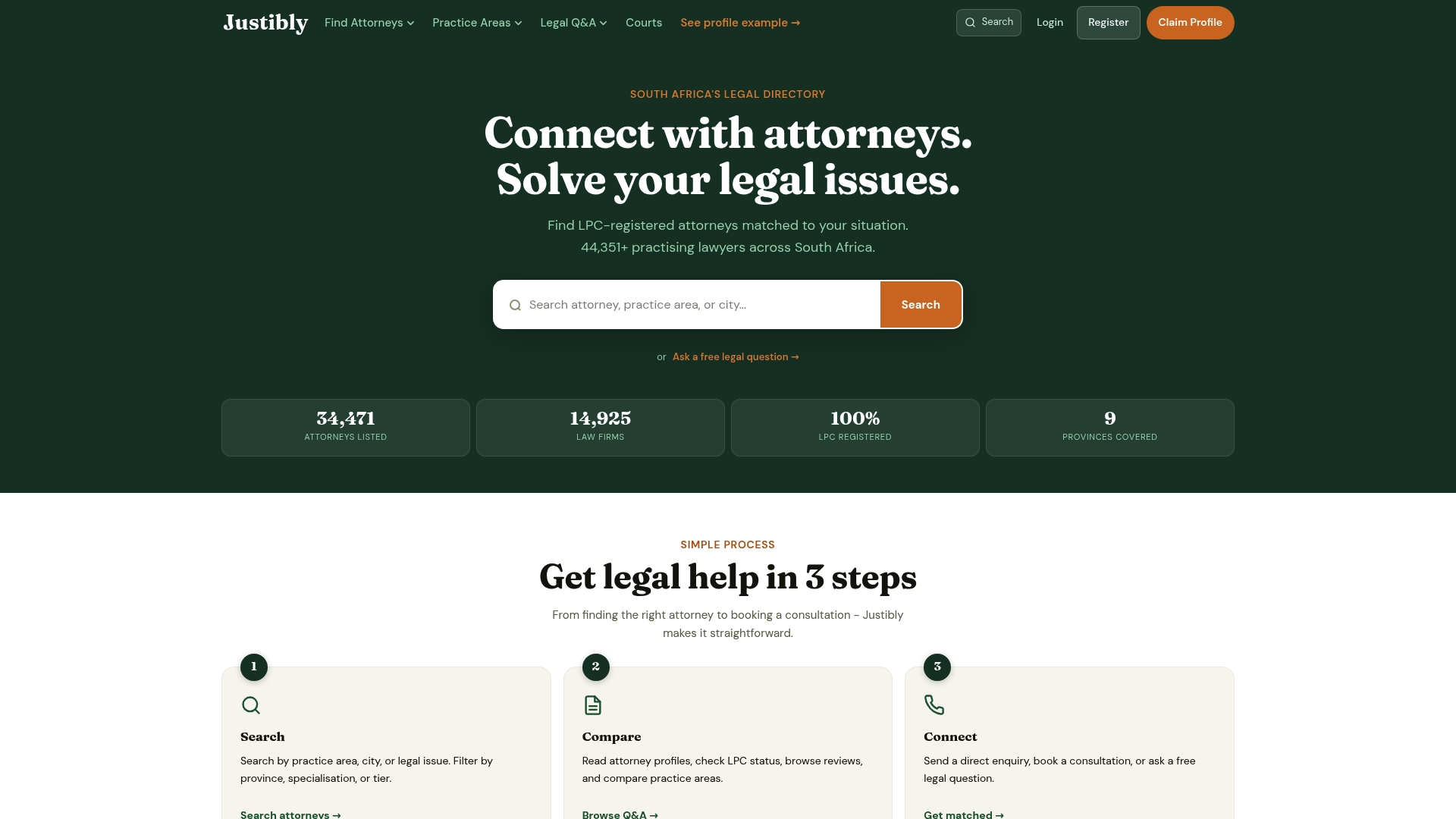
Start on the Justibly directory to find a lawyer near you. Attorneys who want to be found by clients can compare profile plans, such as Professional at R499 per month and Premium at R999 per month, on our pricing page.
If you ever need to complain about a lawyer's conduct, see where to report lawyers in South Africa.
FAQ
Do I really need public liability insurance?
Not by general law, but often by contract. If you receive customers, work on other people's property or sell products, one claim could exceed your savings. Leases, tenders and venue terms frequently demand proof of cover, so check your agreements first.
How much public liability insurance do I need?
Start with the worst realistic incident: medical costs, rehabilitation and lost earnings for the injured person. Limits often start at R1 million, but your contracts may require more, such as R5 million for some construction work. Your broker can match the limit to your operations.
Does public liability cover my employees?
No. Injuries to your own employees are normally excluded and fall under the COIDA system. Public liability is aimed at third parties such as customers, visitors and suppliers.
Who is responsible for product liability?
Responsibility depends on the facts and on who in the chain was at fault. For insurance, product liability is often a separate section or extension, so confirm whether your policy includes it if you make, import or sell goods.
Sources
- Public liability insurance in South Africa: cover and cost (Mont Blanc Financial Services)
- Public Liability Insurance South Africa | Cover Guide
- Public Liability Insurance | Third-Party Damage Cover
- Broadform Liability / Public Liability Insurance wording
- Public Liability Insurance for Businesses (Hollard)
- Public Liability Insurance | Bi-me
- Public Liability Insurance Cover for Small Businesses in SA
- Public Liability Wording, May 2023
- Safety at Sports and Recreational Events Act
- Nelson Mandela Bay Outdoor Dining Policy
- Public Liability Insurance South Africa | Graham Silva
- SAPCA bulletin: Public Liability for pest control companies
- Digital signature validity
Recommended
By the Justibly editorial team
Published
General legal information for South Africa, checked against the Legal Practice Act, the relevant court rules and the Legal Practice Council roll. It is not legal advice and does not create an attorney-client relationship. For advice on your situation, consult an admitted attorney.
How we research and review · How the Trust Score works · Report an error