Pro bono lawyers in South Africa: how to get free legal help
Discover how to access free legal help in South Africa with pro bono lawyers. Get fast assistance through Legal Aid and other resources.
Published

If you can't afford a lawyer, three routes work fastest: call Legal Aid South Africa if your income falls under their means test, request a pro bono referral through the Legal Practice Council if you need a private attorney to act for free, or search Justibly's directory and free Q&A to find an LPC-registered attorney and get guidance today.
TL;DR:
- Legal Aid South Africa is the fastest route for those with low income facing criminal or civil cases, especially when public-interest issues are involved.
- The Legal Practice Council coordinates referrals from private attorneys who are required to donate pro bono hours, but waiting times and disbursement costs may delay case progress.
- Qualification depends on current means test thresholds, but public-interest cases, eviction, or domestic violence matters may qualify even if income exceeds standard limits.
- Pro bono services usually cover lawyer advice and time but not court fees, disbursements, or expert costs, which remain the client's responsibility.
- While waiting for official referrals, using Justibly's directory and free Q&A forum can provide quick guidance from registered attorneys to expedite your case.
Table of Contents
- Where to get pro bono lawyers in South Africa
- Who qualifies for free legal assistance in South Africa?
- What pro bono legal help covers, and what it doesn't
- Alternatives when pro bono legal help isn't available
- How to apply for pro bono legal help: step-by-step
- How Justibly helps you find LPC-registered attorneys fast
- What the official routes get right, and where they fall short
- Get faster answers while you wait for a referral
- Sources
- FAQ
Where to get pro bono lawyers in South Africa
Four channels handle most requests for free legal help, and knowing which one fits your problem saves weeks of running around.
Legal Aid South Africa is the government-funded starting point for anyone facing criminal charges or a civil dispute who cannot pay a private attorney. It has offices in every province and is usually the fastest route if you qualify financially.
The Legal Practice Council (LPC) doesn't employ lawyers itself, but it coordinates pro bono referrals from private attorneys who are required to donate hours each year. The LPC publishes provincial application forms that you complete and submit to your regional office, and staff there match your case to an available volunteer.
University law clinics and community legal centres run walk-in or appointment-based clinics that typically handle:
- Family law matters (maintenance, divorce, custody disputes)
- Housing and eviction disputes
- Labour disputes and unfair dismissal claims
- Wills and small estate administration
- Refugee and immigration law
- Selected public-interest or impact litigation cases
Clinics often prioritise family, labour, housing, and refugee matters, and most require you to book an appointment rather than simply walk in.
Which one should you contact first? Criminal matters go to Legal Aid immediately, since constitutional rights to representation apply there. Civil disputes (divorce, debt, unfair dismissal) suit either Legal Aid or a clinic, depending on your income. Administrative issues, like disputing a decision by a government department, often fit better with a clinic or an LPC referral because Legal Aid's civil capacity is stretched thin in most regions.
Who qualifies for free legal assistance in South Africa?
Qualification comes down to two things: what you earn, and whether your case has enough merit to justify a volunteer's time.
Legal Aid SA revised its means test in April 2024, widening income and asset thresholds so more applicants qualify than under the previous scale. The exact figures depend on household size and whether the matter is criminal or civil, so it's worth checking the current thresholds directly with your nearest office before assuming you're excluded.
Pro Tip: Don't self-reject. Public-interest cases, like matters affecting a group of vulnerable people, can qualify for pro bono help even when the applicant's income sits above the standard threshold.
Before you apply anywhere, gather:
- Your ID document
- Recent payslips or proof of income (or an affidavit if you're unemployed)
- Bank statements from the last three months
- Any court documents, letters, or notices related to your case
Clinics and LPC referrals also weigh merit and public interest alongside income. A case tied to eviction, domestic violence, or a labour dispute affecting several workers often gets priority even under a strict financial cut off.
What pro bono legal help covers, and what it doesn't
A volunteer attorney donating their time is not the same as a free legal process from start to finish, and this is where a lot of applicants get caught out.
Pro bono representation usually covers the attorney's own time and advice. It typically does not cover disbursements: sheriff's fees for serving documents, expert witness costs, or court filing fees, which remain the client's responsibility even when the lawyer works for free. Ask the clinic upfront whether any limited disbursement assistance exists, because some do offer small amounts.
A few other realities worth planning around:
- Clinics run on appointments, and demand usually exceeds capacity, so expect a wait of days to a few weeks depending on your area.
- Advocates (barristers who argue in higher courts) generally won't take a pro bono brief directly from a member of the public. They need a referring attorney to submit the matter to a Bar pro bono committee first, which adds a step for complex litigation.
- Attorneys must log a minimum number of community service hours annually, and pro bono work counts toward that, which is part of why supply exists at all.
Alternatives when pro bono legal help isn't available
If you don't qualify for Legal Aid or a clinic can't take your case, you still have workable paths.
Legal Aid remains the right choice for criminal defence and most civil matters where you meet the means test, since it's a structured, funded service rather than a volunteer favour.
Contingency fee arrangements ("no win, no fee") suit civil claims like personal injury, medical negligence, or motor vehicle accident claims, where attorneys accept a percentage of any award instead of upfront fees, under the Contingency Fees Act. This isn't available for most family, criminal, or administrative matters.
Limited-scope help works when you just need document review or a letter drafted, not full representation:
- Paralegal advice offices in many townships and rural areas
- Community-based organisations that assist with specific issues like UIF claims or ID document disputes
- A single consultation with a private attorney, paid at an hourly rate, rather than a full retainer
How to apply for pro bono legal help: step-by-step
- Identify the right channel first. Criminal matter: contact Legal Aid SA directly. Civil dispute where you meet the means test: also Legal Aid. Need a private attorney to donate time: request an LPC referral. Family, labour, or housing issue: check your nearest law clinic's intake days.
- Collect your documents before you call anyone. ID, income proof, bank statements, and any letters or notices tied to the case.
- Write a one-page summary of your case. State what happened, when, who's involved, and what outcome you want. A short and structured summary speeds up screening significantly compared to a rambling phone call.
- Submit the correct form. Download your province's pro bono application form from the LPC site, or complete Legal Aid's own application at your local office. For clinics, call ahead to confirm intake days and required paperwork.
- Follow up with specifics, not vague check-ins. When you call back, quote your reference number and ask directly: "Has my file been allocated to an attorney yet?" rather than "any updates?"
Pro Tip: Keep a printed or saved copy of everything you submit. Offices handling hundreds of applications occasionally lose paperwork, and having your own record means you don't start from zero.
How Justibly helps you find LPC-registered attorneys fast
Justibly is an online directory built for exactly this moment: when you need to find a legitimate, LPC-registered attorney without guessing who's real and who isn't. Every listing reflects actual LPC registration data rather than paid placement, and the directory covers all nine provinces.

If you're waiting on a Legal Aid appointment or an LPC referral, Justibly's free Q&A forum lets you post your question and get a response from a registered attorney while your formal application sits in a queue. You can also search by practice area, like family or labour law, to see who handles cases like yours near you.
What the official routes get right, and where they fall short
Legal Aid SA and the LPC's pro bono system do the heavy lifting in South Africa's access-to-justice picture, and no directory or Q&A forum replaces that. But the conventional advice, "just contact Legal Aid or find a clinic", assumes readers already know which form to download, which office covers their area, and how long to wait before following up. That's the gap most guides skip.
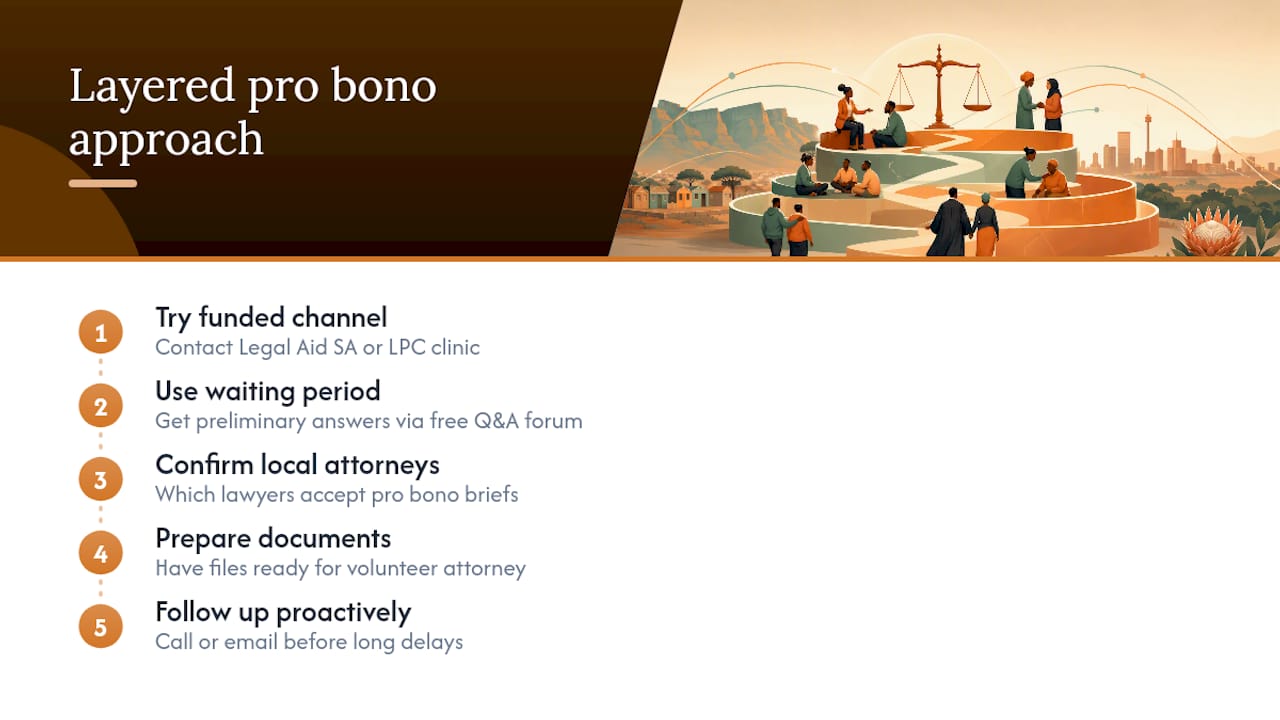
What the research actually supports is a layered approach: try the funded or mandated channel first, because it's free in the fullest sense, but don't sit passively while your file moves through a queue. Use the waiting period productively. Get a preliminary answer through a free Q&A forum, confirm which attorneys in your area actually take pro bono briefs, and have your documents ready so that when a volunteer attorney does pick up your case, you're not the reason for further delay.
The biggest mistake I see in how this topic gets discussed is treating pro bono as a single door you either get through or don't. It's a system with several entry points, and readers who understand that move faster than readers who wait for one office to call back.
— Nkosi
Get faster answers while you wait for a referral
Justibly is a practical companion to Legal Aid and LPC referrals, not a replacement for them. While your application works through official channels, you can search Justibly's directory for LPC-registered attorneys by province and practice area to see who's realistically available near you, and how they're rated.
If your question is urgent, like a maintenance dispute, an eviction notice, or a labour issue, post it on the free Q&A forum and get a response from a registered attorney without waiting for a formal intake process. Justibly's legal guides also walk you through preparing documents for debt review, divorce, and other common matters, so you arrive at any consultation already organised. Search the attorney directory now to find someone in your area, or browse by practice area if you already know what kind of help you need.
This article is general information, not a substitute for advice from a qualified lawyer. Consult a qualified legal professional about your own circumstances before acting on anything here.
Sources
- Members of the Public - Legal Practice Council
- LEGAL AID SA AMENDS MEANS TEST, WIDENING ACCESS TO LEGAL SERVICES
- Regulations regarding community service and pro bono references (government gazette)
- Cape Bar pro bono guidance
FAQ
How do I get a pro bono lawyer in South Africa?
Contact Legal Aid SA if you meet their means test, or apply through your provincial Legal Practice Council office for a pro bono referral to a private attorney. You can also search Justibly's directory for LPC-registered attorneys or post a question on its free Q&A forum while you wait.
What are the disadvantages of pro bono legal help?
Pro bono typically doesn't cover disbursements like sheriff's fees, expert costs, or filing fees, and clinics often have long waiting periods due to high demand. Advocates also generally require an attorney referral first, which can slow complex cases.
How does pro bono work in South Africa?
Attorneys are required to log a minimum number of community service hours each year, and pro bono work counts toward that obligation. The LPC coordinates referrals between applicants and available volunteer attorneys based on need and merit.
What if I can't afford a lawyer in South Africa?
Start with Legal Aid SA if your income falls under their means test, or request a pro bono referral through the LPC if you need a private attorney to act for free. Contingency fee arrangements are also an option for civil claims like personal injury, and Justibly's Q&A forum can give you quick guidance in the meantime.
Recommended
By the Justibly editorial team
Published
General legal information for South Africa, checked against the Legal Practice Act, the relevant court rules and the Legal Practice Council roll. It is not legal advice and does not create an attorney-client relationship. For advice on your situation, consult an admitted attorney.
How we research and review · How the Trust Score works · Report an error