Free Help and Verified Human Rights Lawyers in South Africa
Get free NGO or clinic advice and fast paid representation for rights violations in South Africa. Use SAHRC routes or verify an LPC‑registered attorney...
Published

A human rights lawyer is an attorney who handles constitutional and rights-based claims, from unlawful detention to discrimination and access to housing or healthcare. If you need urgent help, contact an NGO like Lawyers for Human Rights for free advice, or search Justibly's directory for an LPC-registered attorney if you can afford private representation. Both routes can lead to individual relief or broader systemic change.
TL;DR:
- Most human rights lawyers focus on discrimination, detention, police misconduct, refugee rights, and socio-economic issues rather than handling broad or complex constitutional claims.
- NGOs like Lawyers for Human Rights provide free advice and run law clinics for urgent or low-income cases, but they do not conduct litigation or systemic advocacy directly.
- Private lawyers are best for fast, dedicated representation, but verifying LPC registration and setting clear fee arrangements are essential before engagement.
- Human rights cases often take months to years, especially impact litigation, and outcomes cannot be guaranteed, which limits expectations about quick results.
- Many people overlook that most day-to-day rights work is accessible through NGOs and statutory bodies; private practitioners tend to be less involved in systemic change efforts.
Table of Contents
- What human rights lawyers do: services, cases and impact litigation
- Where to get help: NGOs, SAHRC, law clinics, pro bono teams and private attorneys
- How to choose and vet a human rights lawyer: criteria, questions and red flags
- Costs, fees and remuneration context
- How to become a human rights lawyer: qualifications and career steps
- How to prepare for your first consultation
- How long human rights cases typically take
- What human rights lawyers cannot do
- What happens after you hire a human rights lawyer
- Why I think South Africans undersell how much help is actually available
- Find and verify a human rights lawyer through Justibly
- Sources
- FAQ
What human rights lawyers do: services, cases and impact litigation
Most human rights lawyers spend their days on a narrower set of problems than the job title suggests. The bulk of the work clusters around discrimination, unlawful arrest and detention, police misconduct, refugee and migrant rights, and socio economic rights claims involving housing, healthcare access, or social grants.
The service itself varies a lot depending on who is doing it. A single consultation might produce a letter of demand. A bigger case might run for years and end up shaping how a law gets applied nationally.
- One-off legal advice for an individual dispute
- Courtroom representation in a specific case
- Strategic or impact litigation aimed at setting precedent
- Policy advocacy directed at government departments
- Community education and rights awareness programmes
NGOs and statutory bodies tend to prioritize the last three. Lawyers for Human Rights runs programmes across six areas of rights law specifically because individual cases, on their own, rarely fix a systemic problem. A private attorney taking on a rights-adjacent matter, by contrast, is usually solving one client's problem rather than trying to change the system that created it. Neither approach is wrong. They just answer different questions.
Where to get help: NGOs, SAHRC, law clinics, pro bono teams and private attorneys
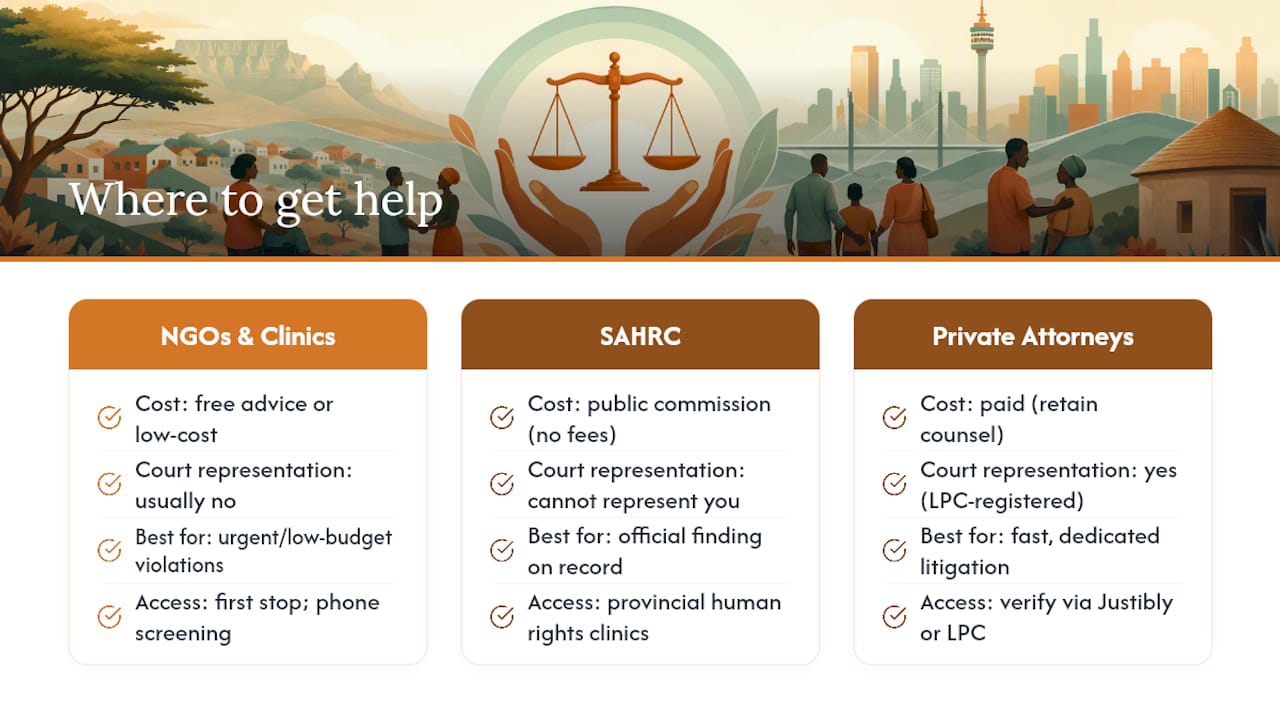
Your entry point depends on urgency, budget, and how systemic the issue is. NGOs like Lawyers for Human Rights are built for exactly this: they run law clinics offering free advice and are often the first stop for people with no money for a private attorney but a genuine rights violation.
The South African Human Rights Commission is a different kind of resource. It investigates complaints, issues recommendations, and runs provincial human rights clinics, but it is not a law firm and cannot represent you in court the way a retained attorney can. It fits best when you want an official finding on record, not necessarily a courtroom outcome.
University law clinics and firm-run pro bono teams sit in between. Several major firms maintain dedicated pro bono and human rights practices that partner with universities and NGOs on both advice and litigation. These suit matters that are serious but not necessarily urgent, where a supervised law student or junior associate can build a case under experienced oversight.
Private LPC-registered attorneys make sense when you need dedicated, fast-moving representation and can pay for it, or when your matter does not fit an NGO's intake criteria. Before retaining anyone, verify their registration through Justibly's directory of attorneys or the Legal Practice Council itself.
Pro Tip: Call the NGO or clinic before you assume you cannot afford help. Many screen for eligibility over the phone in minutes, and rejection at one clinic does not mean rejection everywhere.
How to choose and vet a human rights lawyer: criteria, questions and red flags
Credentials matter, but they are not the whole picture. An attorney can be perfectly admitted and still have zero relevant experience with rights litigation, which is a very different skill set from conveyancing or commercial contracts.
Start with these checks before you commit to anyone:
- Confirm Legal Practice Council admission and ask specifically about human rights case history, not general litigation experience.
- Request examples of similar matters or programmes they have worked on, even if names are confidential.
- Ask directly about the fee model. Free? Contingency? Hourly? Get it in writing.
- Ask how they define success: an individual remedy, a systemic change, or both.
- Ask how often you will get updates and through what channel.
Attorney remuneration in South Africa varies enormously by practice area and city, according to market remuneration analysis, and that gap partly explains why fee transparency at the outset matters so much. If someone promises a guaranteed outcome, that is a red flag on its own. Litigation outcomes are never guaranteed, and an attorney who says otherwise is either inexperienced or not being straight with you.
Evasiveness about registration status or fee structure is the other major warning sign. A legitimate attorney will not hesitate to confirm their LPC number.
Costs, fees and remuneration context
Funding shapes who take your case as much as merit does. Pro bono work through NGOs and law clinics costs nothing but is not unlimited. Legal aid exists for qualifying criminal and some civil matters. Contingency arrangements, where a lawyer is paid only on a successful outcome, remain limited in South African practice and are far from guaranteed in rights cases. Private attorneys typically charge fees based on hourly rates or retainers.
On earnings, Payscale data puts average attorney pay in South Africa in the mid hundreds of thousands of rand annually, with wide swings depending on specialization and location. Commercial practice areas generally out earn public interest work, which is a big part of why specialist human rights lawyers cluster in NGOs, academic clinics, or advocacy roles rather than high-billing private firms.
That earnings gap has a knock-on effect on availability. Recent market analysis points to a broader shift toward gig and technology-enabled legal models, warning that firms slow to adopt legal technology risk losing ground. For rights work specifically, that shift matters because tighter NGO funding combined with fewer commercially incentivized firms entering the space can mean longer waits for free or reduced-cost representation.
How to become a human rights lawyer: qualifications and career steps
The regulated path is fixed, whatever specialty you eventually choose. Admission requirements run through the Legal Practice Act, and there is no shortcut around them.
- Complete an LLB or equivalent recognized law degree.
- Complete a Practical Vocational Training Contract, the supervised training period required before admission.
- Pass the Legal Practice Council competency examination and apply for admission to the High Court.
- Choose a career track: NGO litigator, statutory body investigator, law clinic supervisor, private practitioner doing pro bono work, in-house counsel, or academic.
Beyond the formal steps, volunteering at a law clinic during your degree, taking a targeted LLM or short course in constitutional or administrative law, and building relationships with rights organizations early tend to matter more for landing this kind of work than grades alone.
How to prepare for your first consultation
Walking in organized saves time and often money, especially if you are paying hourly. Gather any documents connected to the incident: official letters, notices, medical records if relevant, police case numbers, or correspondence with a government department.
Write a short timeline before the meeting. Dates matter enormously in rights cases, particularly where statutory deadlines apply to lodging a complaint or launching litigation. A one-page chronology, even a rough one, helps a lawyer assess your case faster than a verbal retelling under pressure.

Bring identifying documents, including your ID and proof of address if the matter involves a government agency or a specific jurisdiction. If you have already approached another body, such as the SAHRC or a police station, bring reference numbers and copies of anything you submitted.
Think through what outcome you actually want. Do you want compensation, a policy change, a formal apology, or simply for the conduct to stop? Lawyers can plan more effectively when they know your priority upfront rather than guessing at it mid case.
Finally, prepare a short, honest account of your budget and expectations around fees, and be ready to ask the questions covered earlier about registration, experience, and communication. Consulting Justibly's legal guides beforehand can help you understand terminology you might otherwise stumble over in the room.
How long human rights cases typically take
Timelines swing wildly depending on the route you take. A straightforward advisory consultation at a law clinic can be resolved in a single sitting or a few follow-up calls. An SAHRC complaint involving investigation and a formal recommendation commonly takes several months, since the Commission has to gather evidence and give the other side a chance to respond.
Strategic or impact litigation is the slowest category by design. Cases aimed at setting a legal precedent often move through multiple court levels, sometimes stretching past a year or more, particularly if the matter is contested at each stage or appealed. NGOs pursuing this kind of case usually tell clients upfront that the goal is systemic change over time, not a quick resolution.
Private representation sits somewhere in the middle, largely because a paid attorney has more capacity to push a matter forward without waiting on NGO caseloads. Even so, court backlogs and the other party's conduct will affect the schedule regardless of who represents you.
Ask your lawyer for a realistic estimate at the first meeting, and ask what could extend it. A vague "it depends" answer without any elaboration is worth pushing back on.
What human rights lawyers cannot do
Scope matters here, and expectations often outrun reality. Human rights lawyers cannot guarantee a specific outcome, cannot fast-track a court's schedule, and generally cannot take on a matter that has no arguable constitutional or rights dimension, even if it feels deeply unfair to you personally.
NGOs and statutory bodies also have intake limits. Lawyers for Human Rights and similar organizations focus on the areas their programmes cover, and a matter outside those categories may get referred elsewhere rather than accepted. The SAHRC can investigate and recommend, but it does not litigate on your behalf in the way a retained attorney would.
Purely commercial or contractual disputes without a rights angle usually fall outside this specialty entirely, no matter how strongly you feel wronged. And because most rights work in South Africa runs through NGOs, statutory bodies, and university clinics rather than commercially focused private firms, a for-profit firm may simply decline a case that lacks a paying angle, even when the underlying issue is genuine. Knowing this upfront saves a lot of frustrated phone calls.
What happens after you hire a human rights lawyer
The relationship usually starts with an intake meeting where your lawyer confirms the facts, checks for any urgent deadlines, and outlines a strategy. Expect a written engagement letter or mandate setting out fees, scope, and what they will and will not handle.
From there, most cases move through evidence gathering: statements, documents, expert input if needed, and correspondence with the opposing party or relevant department. Your lawyer should give you a sense of milestones, even loosely, so you are not left wondering what is happening for months at a stretch.
If litigation is necessary, expect formal pleadings, possible settlement discussions, and court dates that can shift due to backlogs outside anyone's control. Throughout, a competent lawyer should keep you updated at agreed intervals rather than going silent, and should flag early if the strategy needs to change.
Why I think South Africans undersell how much help is actually available
The biggest misconception readers bring to this topic is that a "human rights lawyer" is a rare, expensive specialist you can only access if your case is dramatic enough. That is backwards. Most day-to-day rights work in this country runs through NGOs, statutory complaint routes, and university clinics, not boutique private firms billing by the hour.
The harder truth is that the private market genuinely underpays this specialty relative to commercial law, which pushes talented rights-focused lawyers toward NGOs and academia rather than firms. That is not a flaw in the system so much as an honest reflection of where the money is. If you are searching for a private attorney and expecting them to behave like an NGO litigator chasing systemic change, you will be disappointed. If you want that kind of impact work, go to the people who are funded and mandated to do it.
Where I do think the system fails people is verification. Too many people hire based on a confident phone manner rather than checking Legal Practice Council admission, and that single step would filter out a meaningful share of disappointing experiences before they start.
— Nkosi
Find and verify a human rights lawyer through Justibly
An online legal directory can help you find a verified attorney faster than cold-calling firms or scrolling search results hoping a listing is current. Profiles often reflect Legal Practice Council data, and some directories avoid pay-to-rank placement skewing the results, so what you see is what is actually registered.
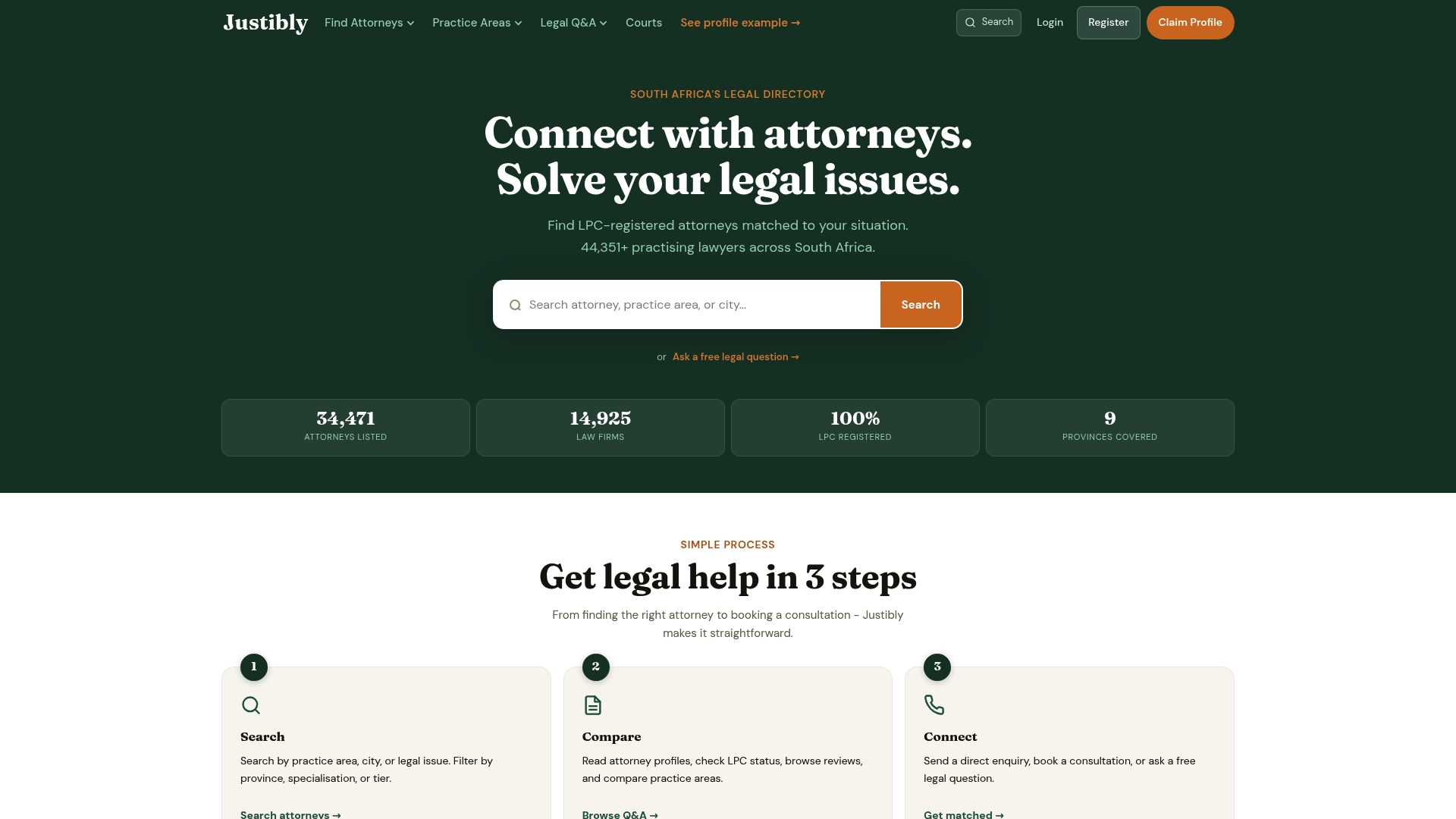
If your situation needs a quick read before you commit to anyone, post it in the free Legal Q&A forum and get a response from an LPC-registered attorney without booking a paid consultation first. If you already know you want representation, search the directory by practice area and location, or browse the legal guides to understand your situation before that first call. Either way, start with the directory search today rather than guessing at a firm's credentials from its website alone.
This article is general information, not a substitute for advice from a qualified lawyer. Consult a qualified legal professional about your own circumstances before acting on anything here.
Sources
- About Us – Lawyers for Human Rights
- What we do — SAHRC
- Becoming a legal practitioner — LSSA
- South African Legal Market Remuneration Report 2026-2027
- Attorney / Lawyer salary in South Africa — Payscale
FAQ
What do human rights lawyers do?
They provide legal advice, courtroom representation, and strategic litigation on constitutional and rights-based matters like discrimination, unlawful detention, and access to housing or healthcare.
How much do human rights lawyers earn in South Africa?
Attorney pay averages in the mid hundreds of thousands of rand annually according to Payscale, though human rights specialists in NGOs or clinics often earn less than commercial practitioners.
What is the highest paid type of lawyer in South Africa?
Commercial and corporate lawyers in high-demand practice areas and major cities typically out earn public interest specialists, based on market remuneration data.
How do I become a human rights lawyer in South Africa?
Complete an LLB, finish a Practical Vocational Training Contract, and pass the Legal Practice Council's competency exam before seeking admission and choosing an NGO, statutory, or private career path.
How do I find a human rights lawyer near me?
Search Justibly's attorney directory by location and practice area, or contact an NGO clinic like Lawyers for Human Rights for free initial advice.
Recommended
By the Justibly editorial team
Published
General legal information for South Africa, checked against the Legal Practice Act, the relevant court rules and the Legal Practice Council roll. It is not legal advice and does not create an attorney-client relationship. For advice on your situation, consult an admitted attorney.
How we research and review · How the Trust Score works · Report an error