Avoid Delays When Applying for Expungement in South Africa
Complete Form J744 and a current police clearance, follow the Department of Justice steps, and use tips from lawyers to avoid delays. Expect about 60...
Published

If you were convicted more than 10 years ago, never received direct imprisonment during that decade, and aren't on the sex offenders or child protection registers, you likely qualify to expunge your record under section 271B. The process is free. Your next step: request a recent police clearance certificate from SAPS and complete Form J744 (Form A) for submission to the Department of Justice, which estimates 60 working days to finalize a complete application.
TL;DR:
- Expungement is possible for convictions over 10 years old without direct imprisonment, but not if the person is listed on sex or child protection registers.
- Using a recent Police Clearance Certificate and correctly completing Form J744 are crucial, as errors or outdated PCCs cause delays or rejection.
- The process generally takes around 60 working days to finalize once all documents are submitted, but SAPS updates can extend the timeline.
- Applications must be carefully assembled and submitted in order, avoiding unnecessary follow-ups during the processing period to prevent delays.
- Reapplication is allowed if the initial application is denied due to incomplete documents or errors, and legal assistance can be valuable for disputes or complex cases.
Table of Contents
- Eligibility under section 271B: the 10-year rule and exclusions
- What documents you need and how to complete Form J744
- How to apply, step by step
- How long expungement takes and what happens along the way
- Common reasons applications get rejected or delayed
- What expungement actually changes and how to confirm it worked
- Legal rights and limitations after expungement
- How to appeal or reapply if your expungement is denied
- What I'd tell a friend before they apply
- Find an attorney who handles expungement cases properly
- Sources
- FAQ
Eligibility under section 271B: the 10-year rule and exclusions
The clock starts on your conviction date, not your sentencing date or the date you finished serving a sentence. You need a full 10 years to pass, and during that entire window you cannot have received a sentence of direct, unsuspended imprisonment for any new offence. A single slip during year nine resets nothing about the old conviction, but it does mean you don't meet the clean-record requirement the Department of Justice looks for.
Several sentence types still qualify you, even though they sound serious on paper:
- Fines of R20,000 or less
- Wholly suspended sentences of imprisonment
- Imprisonment with the option of a fine, where the fine did not exceed R20,000
- Correctional supervision
- Periodical imprisonment
- Postponed sentences, including a caution and discharge
- Historical sentences of corporal punishment
Direct imprisonment, served without suspension, is the main disqualifier and it's permanent for that conviction. There's also a hard line for sexual offences against children or mentally disabled persons: if your name sits on the National Register for Sex Offenders or the National Child Protection Register, you're excluded from standard expungement unless you can prove your name has been removed.
Worth knowing: section 271C creates a separate, largely automatic route for certain pre 1994 convictions tied to apartheid era race based laws. If that applies to you, the process looks different from the standard section 271B application described here.
What documents you need and how to complete Form J744
Form J744, also referred to as Form A, is the official application document, and getting it right the first time saves months. Here's what to assemble:
- A completed Form J744 with all personal and case details filled in accurately
- A certified copy of your identity document
- A recent Police Clearance Certificate from the SAPS Criminal Record Centre
- Certified copies of any court documents relevant to your sentence, if your case history is unclear
- Proof of removal from the sex offender or child protection register, if you were ever listed
The PCC needs to be current. Departments processing these applications want a clearance that reflects your record as it stands now, not one issued years ago before circumstances changed. You can request a PCC directly from any SAPS Criminal Record Centre, and certified copies of your ID and supporting documents can usually be done at a police station or by a commissioner of oaths.
Pro Tip: Order your police clearance certificate before you touch Form J744. If the PCC comes back showing something you didn't expect, like a conviction you thought had already fallen away, you'll want to sort that out before you submit anything, not after.
How to apply, step by step
The sequence matters more than most applicants realize, mostly because skipping ahead creates paperwork that has to be redone. Work through it in this order:
- Self-assess against section 271B: confirm 10 years have passed and there's no direct imprisonment on your record since
- Request your Police Clearance Certificate from SAPS
- Complete Form J744, checking every field against your ID and court records
- Assemble certified copies of every supporting document, including register removal proof if it applies to you
- Post or hand deliver the full application to the Directorate Legal Process in Pretoria
The Department of Justice's guidance points applicants to the Directorate Legal Process, and it's worth double checking the current postal and hand delivery addresses on the Department's own page before you send anything, since government contact details shift occasionally. Label your envelope clearly, include a short cover letter stating your ID number and the conviction date you're applying against, and keep copies of everything you send.
Here's the part almost every guide underplays: the Department explicitly warns that contacting them before the processing period has elapsed causes what it calls a tremendous delaying effect. Staff have to stop, pull your file, respond to the enquiry, and then pick the case back up. That's not a minor inconvenience. It genuinely pushes your application further back in the queue. Submit your documents, note the date, and resist the urge to follow up until the estimated window has fully passed.
How long expungement takes and what happens along the way
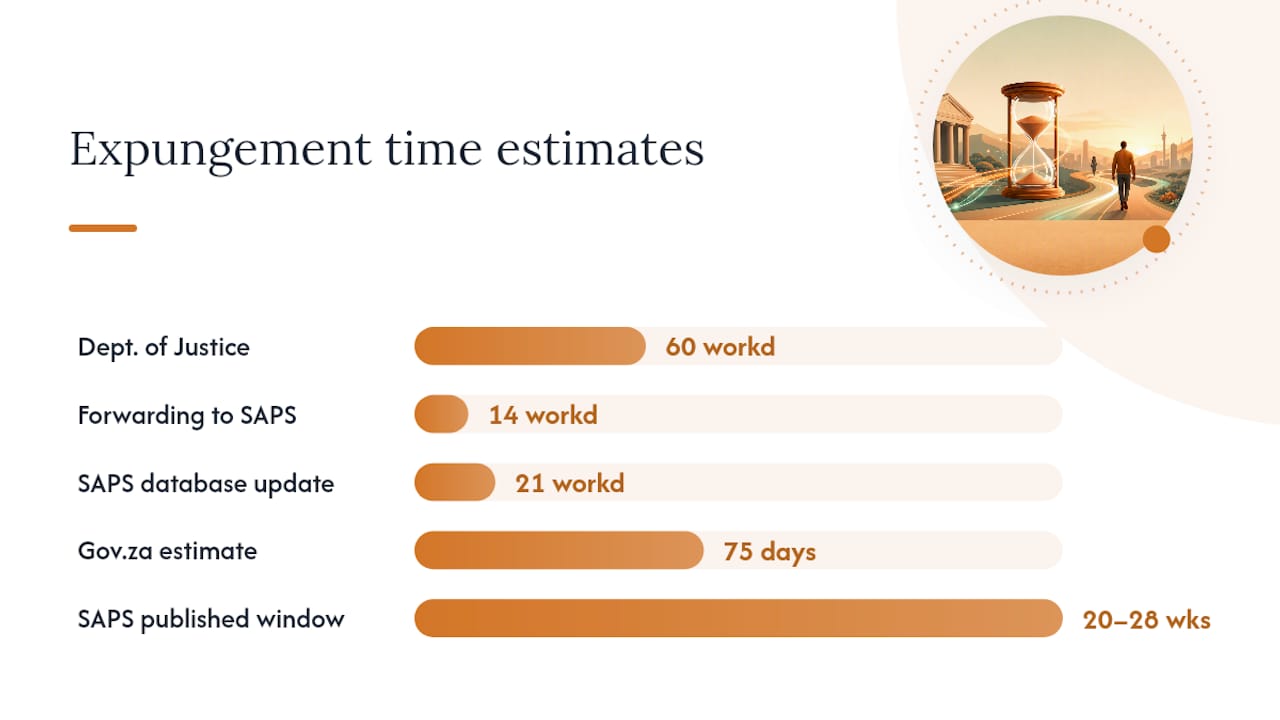
The Department of Justice states that a complete application takes 60 working days to finalize once every required document has been received. Treat that as your baseline expectation, because it's the most current figure the Department itself publishes.
Behind that headline number sit a few sub-steps that explain where the time actually goes. Once your application clears the Directorate Legal Process, the confirmation of expungement is typically forwarded to the SAPS Criminal Record Centre within 14 working days, and SAPS then takes roughly 21 working days to update its own database and confirm the deletion.
You'll notice other figures floating around online. Gov.za's own FAQ page references a 75 day estimate, and SAPS materials have cited windows as long as 20 to 28 weeks in some published guidance. Legal commentary on these discrepancies recommends leading with the Department's 60 working day figure since it's the most recently dated, while still disclosing that other official sources quote longer windows. Plan around 60 working days, but don't be alarmed if SAPS-side confirmation takes a little longer to fully settle.
Common reasons applications get rejected or delayed
Most delays trace back to a handful of avoidable mistakes:
- An outdated or expired Police Clearance Certificate
- Uncertified copies where certified ones were required
- Confusion about sentence type, especially when a court record doesn't clearly state whether imprisonment was suspended
- Missing proof of removal from the sex offender or child protection register when it applies
If your sentencing history is murky, request a certified extract from the court that handled your case rather than guessing. And if you're paying someone to handle the paperwork for you, know that the Department gives no processing priority to applications submitted through paid agents.
Pro Tip: Read your PCC line by line before you submit anything. A single unclear entry, like an old charge that was withdrawn but never formally cleared from the database, is enough to trigger a rejection months later.
What expungement actually changes and how to confirm it worked
A successful application produces a certificate of expungement, and SAPS removes the conviction from its criminal record database once it processes that confirmation. Section 271DA allows the Department to revoke an expungement later if it turns out you didn't actually meet the criteria, so accuracy on your original application matters. Note the distinction between section 271A, which lets certain convictions fall away for sentencing purposes without deleting the record, and section 271B, which physically removes the entry. If a cleared conviction still shows up on a later background check, request a fresh PCC and raise the discrepancy with SAPS directly.
Legal rights and limitations after expungement
Once your record is expunged, you generally don't have to disclose that conviction to employers, landlords, or most institutions asking about your criminal history. A background check run after successful expungement should return a clean result for that specific offence.
There are real limits, though. Expungement under section 271B applies to that particular conviction, not your entire history. If you have multiple convictions, each one needs to independently meet the 10 year rule and sentence criteria. Some professional licensing bodies and immigration authorities in other countries may still ask whether you've ever been convicted, regardless of a South African expungement, so the legal protection doesn't necessarily travel across every context.
Expungement also doesn't erase the historical fact that a court case happened. Media reports, civil litigation records, and court archives outside the criminal record database may still reference the case. What changes is your criminal record as SAPS holds it, which is the record that shows up on standard police clearance checks used by employers and licensing bodies.
If you're unsure whether a specific institution or process still requires disclosure after expungement, that's a question worth putting to a practicing attorney rather than guessing, particularly if the stakes involve employment, adoption, or firearm licensing.
How to appeal or reapply if your expungement is denied
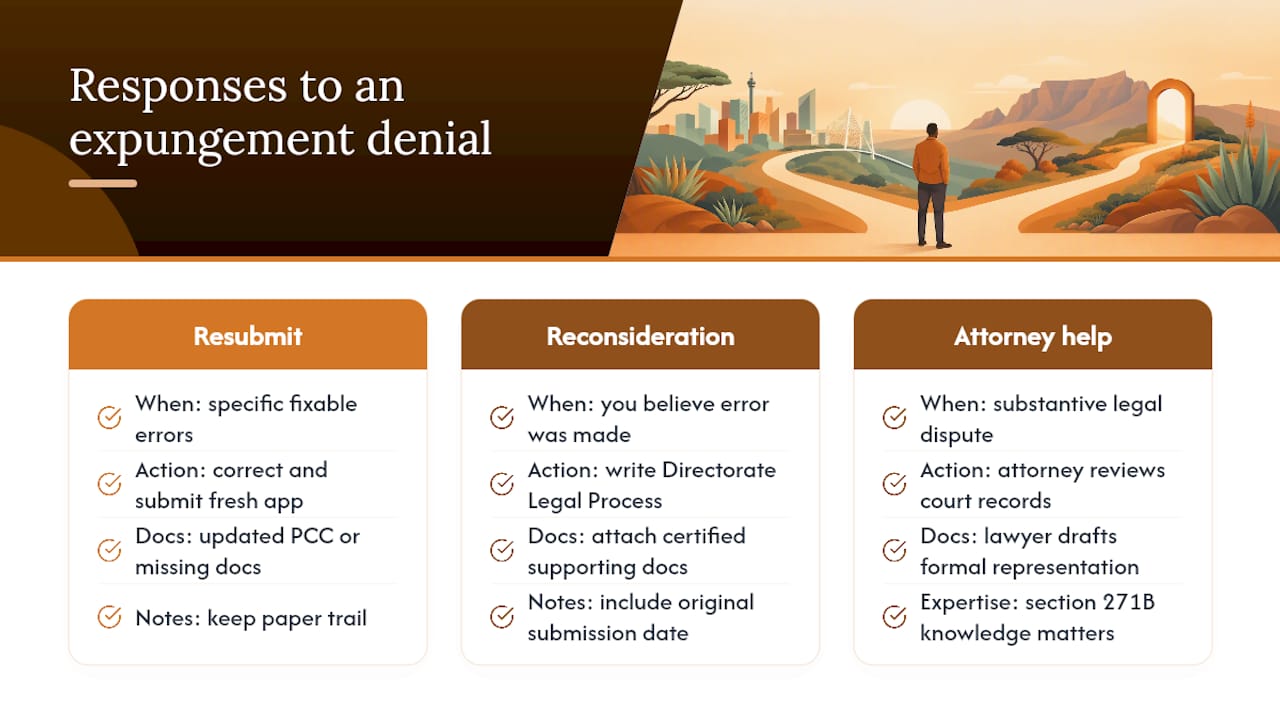
A denial usually comes with a stated reason, and that reason tells you exactly what to fix. If it's an incomplete document set or an outdated PCC, the straightforward move is to correct the specific problem and resubmit a fresh application rather than treating the denial as final.
If you believe the denial was made in error, for example if the Department misclassified your sentence type or missed evidence of register removal, you can write to the Directorate Legal Process requesting reconsideration, attaching the certified documents that support your position. Keep a paper trail of everything, including the original submission date and any correspondence you received.
Where the disagreement is more substantive, such as a dispute over whether your sentence counted as direct imprisonment, a NH Criminal Record Annulment Attorney can review your court records and draft a formal representation on your grounds. That's not overkill; sentencing records from older cases are sometimes ambiguous, and a lawyer familiar with section 271B can spot distinctions that matter far more than they appear to on the page.
Reapplication carries no penalty, and there's no cap on how many times you can apply once you've addressed the issue that caused the original refusal.
What I'd tell a friend before they apply
Patience and paperwork decide most outcomes here, not luck. Get your documents certified and current before you touch the form, and don't call the Department to check progress before your 60 working days are up. If your sentencing history is genuinely unclear, or you're disputing a register listing, that's the moment to bring in an attorney rather than guessing your way through a resubmission. Justibly's directory exists for exactly that moment.
— Nkosi
Find an attorney who handles expungement cases properly
Most expungement applications are straightforward enough to handle yourself, but the ones involving disputed sentence records, register removal disputes, or a revoked expungement under section 271DA are a different animal entirely, and that's where Justibly earns its place. There are searchable directories of LPC registered attorneys across South Africa that allow filtering by practice area and province to help find law firms handling criminal record work.
If your case touches criminal law specifically, or you want to see attorneys who list expungement as a focus area, Justibly's criminal record expungement listings let you compare qualified professionals before you commit to one. Not ready to hire someone yet? Post your question on Justibly's free Q&A forum and get a response from a registered attorney without paying a consultation fee first. If your submission is headed to Pretoria along with the rest of the Directorate Legal Process paperwork, it's worth browsing law firms in Pretoria in case you'd rather have someone local double check your file before you post it.
This article is general information, not a substitute for advice from a qualified lawyer. Consult a qualified legal professional about your own circumstances before acting on anything here.
Sources
- Expungement — Department of Justice and Constitutional Development
- Gov
- Expungement of a criminal record — SAPS
- Criminal record expungement in South Africa — Recording Law
FAQ
What crimes can be expunged in South Africa?
Most convictions qualify once 10 years have passed and you received no direct imprisonment, including fines, suspended sentences, correctional supervision, and periodical imprisonment. Sexual offences tied to a register listing are excluded unless you prove the listing was removed.
How much does expungement cost in South Africa?
The application itself is free through the Department of Justice. You may still pay for a police clearance certificate, certified copies, or an attorney's fee if you hire one for a complicated case.
How long does an expungement take in South Africa?
The Department of Justice estimates 60 working days to finalize a complete application, though SAPS record updates can add extra time on top of that. Other official pages cite longer windows, so treat 60 working days as the baseline and expect some variation.
Can I apply for expungement online?
No online application currently exists. You complete Form J744 on paper and submit it by post or hand delivery to the Directorate Legal Process in Pretoria, alongside your certified supporting documents.
Recommended
By the Justibly editorial team
Published
General legal information for South Africa, checked against the Legal Practice Act, the relevant court rules and the Legal Practice Council roll. It is not legal advice and does not create an attorney-client relationship. For advice on your situation, consult an admitted attorney.
How we research and review · How the Trust Score works · Report an error