Divorce Attorney Consultation: What to Bring and Ask
Book a divorce attorney consultation in South Africa with confidence: what to bring, what to ask, what it costs to enquire, and what happens next.
Published

A divorce attorney consultation is a first meeting, in person, by phone or online, where a registered attorney hears your situation and explains your options, the likely steps and the costs. To get real value from it, confirm the attorney is registered, bring your marriage and financial papers, and arrive with a written list of questions. This guide shows you how, step by step, for South Africa.
TL;DR
- Check that the attorney is on the Legal Practice Council (LPC) roll before you book, and ask upfront whether the consultation is paid and what the fee is.
- Bring your marriage certificate, any antenuptial contract, your children's birth certificates, and recent financial records. Bring any court papers you have received.
- Ask which matrimonial property system applies, what is urgent, what the stages and costs are, and what you can agree on versus dispute.
- Unopposed divorces can be finalised in roughly three to four months from issue of summons, according to Chambers Practice Guides. Contested ones take longer.
- If you cannot afford a private attorney, the Department of Justice names Legal Aid South Africa as a first port of call.
Table of Contents
- What a first divorce consultation is for
- Choosing the right attorney to consult
- How to prepare before you go
- Questions to ask in the consultation
- What an attorney can and cannot do for you
- Jurisdiction, timing and what happens after
- If money is tight
- Our perspective
- Find a registered family attorney on Justibly
- FAQ
- Sources
What a first divorce consultation is for
The consultation is not the divorce. It is where you learn where you stand. The attorney listens, asks about the marriage, the children, the assets and debts, then explains what the process would look like for you and what it would cost.
The Department of Justice describes the first formal step as approaching Legal Aid South Africa or a private attorney for a consultation. The appointed practitioner then drafts the summons and related documents, has the summons issued by the Registrar, and sends it to the Sheriff to serve on the other spouse. A statistics form is included only if children were born during the marriage.
So what you want from the first meeting is clarity on four things:
- Whether your matter is likely to be uncontested or contested.
- What needs attention immediately (safety, deadlines, money, children).
- What the process will cost and how you will be billed.
- Whether this attorney is the right person for you.
If you are still working out whether you want to divorce at all, say so. A good attorney can explain your position without pushing you to issue summons.
Choosing the right attorney to consult
Divorce sits within family law, so look for an attorney who works in that field regularly. Our family law attorneys directory lets you browse by location, and if you are in a major city you can go straight to divorce attorneys in Johannesburg or the listings for Durban, Cape Town and Pretoria.
Confirm registration first
Under the Legal Practice Act, 2014, attorneys are registered on the practising roll at the Legal Practice Council. The LSSA explains that you can contact the relevant LPC regional office to confirm an attorney is on the roll and holds a Fidelity Fund Certificate. It is a two-minute check that protects your money.
On Justibly, listings reflect verified LPC data and are not ranked by payment, so the registration status you see has been validated.
Practical things to compare
- Location and format: Many consultations can be done by phone or video, which helps if the best specialist is in another city. Court matters, however, are tied to a court area, so ask where the attorney practises.
- Experience with your kind of case: Divorce with a family business, a pension, a property or contested custody calls for different experience from a simple uncontested divorce.
- Communication: Ask how quickly they respond and who will handle your file day to day.
- Language: You will share personal details. Choose someone you can speak to comfortably.
How to prepare before you go
You do not need a perfect file. A broad outline is enough for a first enquiry, and the attorney will tell you what else is needed. But a little preparation saves time, and time is what you may be paying for.
Write a one-page summary
Set out:
- The date of marriage and, if relevant, the date you separated.
- Where each of you lives and works.
- Your children's names and ages and where they currently live.
- What you have already agreed with your spouse and what is still uncertain.
- The three or four issues you most need advice on.
Keep it factual. Dates and amounts are more useful than descriptions of who did what.
Gather your documents
Use this checklist and bring copies, keeping originals safe.
| Category | What to bring |
|---|---|
| Identity | ID or passport, contact details, proof of address |
| Marriage | Marriage certificate (or civil-union certificate), antenuptial contract, any later court order changing the property system |
| Children | Birth certificates, any parenting plan or maintenance order |
| Papers received | Summons, notices, protection orders, settlement proposals, letters or emails, each with the date you received it |
| Income | Recent payslips, employment details, tax returns and assessments |
| Accounts | Bank, investment, credit-card, loan and bond statements |
| Property | Ownership documents, valuations or purchase papers, outstanding bond balances |
| Retirement | Pension, provident or retirement annuity statements |
| Summary | A list of assets, debts and your monthly expenses |
Only collect financial records you can lawfully access. Do not take documents from your spouse's private accounts, devices or email. If something is missing, tell the attorney and they will advise how it can be obtained formally.
If you have a parenting arrangement in mind, our guide to drafting and registering a parenting plan explains what it should cover.
Flag anything urgent
Tell the attorney at the start of the meeting, not at the end, if:
- You have already been served with a summons or any court document with a deadline.
- You or your children are in danger. In that case seek help immediately, from the police or a protection-order process, before worrying about the consultation.
- Your spouse is selling, hiding or transferring assets.
- There is an upcoming court date.
Questions to ask in the consultation
Take a written list. Clear, considered questions help the attorney understand your needs faster, which can keep the meeting shorter and the bill lower. These are the ones that matter most.
About your case
- Which matrimonial property system applies to us (in community of property, out of community with or without accrual), and what else do you need from me to confirm it?
- Is anything urgent, including deadlines in documents already served on me?
- What can I realistically expect on the division of assets, maintenance and the children's arrangements?
- Which issues are likely to be agreed and which will probably be disputed?
On financial disputes, note that in some courts, for example in Gauteng, comprehensive financial disclosure forms must be filed after pleadings close where maintenance or proprietary issues are in dispute. Ask your attorney how this applies to you.
About the process
- What are the likely stages from start to finish, and roughly how long will each take?
- Could this be settled through mediation, and when would court be unavoidable?
- What do I need to do, and not do, between now and the next step?
- Where will the matter be heard?
About fees and scope
- Is the consultation itself charged, and if so, how much and how long does it run?
- Is a deposit payable if I instruct you?
- Do you bill an hourly rate or fixed fee, and which costs fall outside it, such as court fees, the Sheriff's fees or experts?
- How often will I receive an account?
Tell the attorney exactly what help you need and the outcome you want. That fixes the scope of the instruction so both of you are clear on what is being done. For a general overview of expected spend, see how much divorce costs in South Africa.
What an attorney can and cannot do for you
An attorney can explain your rights, draft and serve court papers, negotiate a settlement with your spouse's side, and represent you in court. Many divorces settle, and the settlement can become a court order.
Mediation and settlement
The Department of Justice explains that a mediator facilitates discussions, helps the parties identify issues and explore compromise, and then helps draft a settlement agreement. That agreement is enforceable as a contract and can be made an order of court. If mediation fails, the parties can still litigate. The mediator does not judge or decide the outcome for you.

Your attorney can tell you whether mediation suits your situation and prepare you for it.
Children and the Family Advocate
Where children are involved and parents disagree, the Family Advocate helps parties reach agreement on care, contact and guardianship. If they cannot agree, the Family Advocate evaluates the circumstances in light of the best interests of the child and makes a recommendation to the court. That recommendation is not enforceable unless the court incorporates it in an order. The office has more than 25 offices and 90 family advocates countrywide, according to the government publication Vuk'uzenzele. Our guide to free Family Advocate help explains how to use it, and the one on who gets custody covers the principles.
Maintenance
For maintenance disputes, the Department of Justice says a Maintenance Officer issues a directive for the parties to meet, conducts mediation, and if agreement is reached makes it an order of court. If not, the matter goes to a formal enquiry in court.
Jurisdiction, timing and what happens after
Under section 2(1) of the Divorce Act, a court has jurisdiction if one or both parties are domiciled in its area on the date the action starts, or are ordinarily resident there and have lived in South Africa for at least one year before filing, as summarised by Chambers. Your attorney will confirm which court is right for you.
The same source notes that unopposed divorces can be finalised within three to four months of issue of summons. Contested divorces take longer and cost more, because every disputed issue needs to be dealt with. Read more in how long a divorce takes and how to apply for divorce. For the full process, see our complete divorce application guide.
After the consultation, you normally decide whether to instruct the attorney. You are not obliged to. Take the fee details and next steps in writing, think it over, and only then sign a mandate.
If money is tight
A private attorney is not the only route. The Department of Justice lists Legal Aid South Africa alongside private attorneys as a first step, and our guide on getting a free divorce explains what is available. For a general question, you can also read where to get free legal advice.
Our perspective
Most people reach us at a hard moment, and they often do not know what to ask. We think the first consultation should leave you steadier than it found you: you should know your next step, what it will cost and who is responsible for what.
That is why we list attorneys by verified LPC data and do not sell ranking positions. When you search for a family lawyer, the information should reflect who is actually registered, not who paid for prominence.
Our free Q&A forum exists for the earlier question: you are not sure whether you need an attorney yet. Registered attorneys answer there, so you get a view from someone accountable to the profession before you commit to a formal consultation. Then use the checklist above, book with a specialist, and arrive prepared.
Nkosi
Find a registered family attorney on Justibly
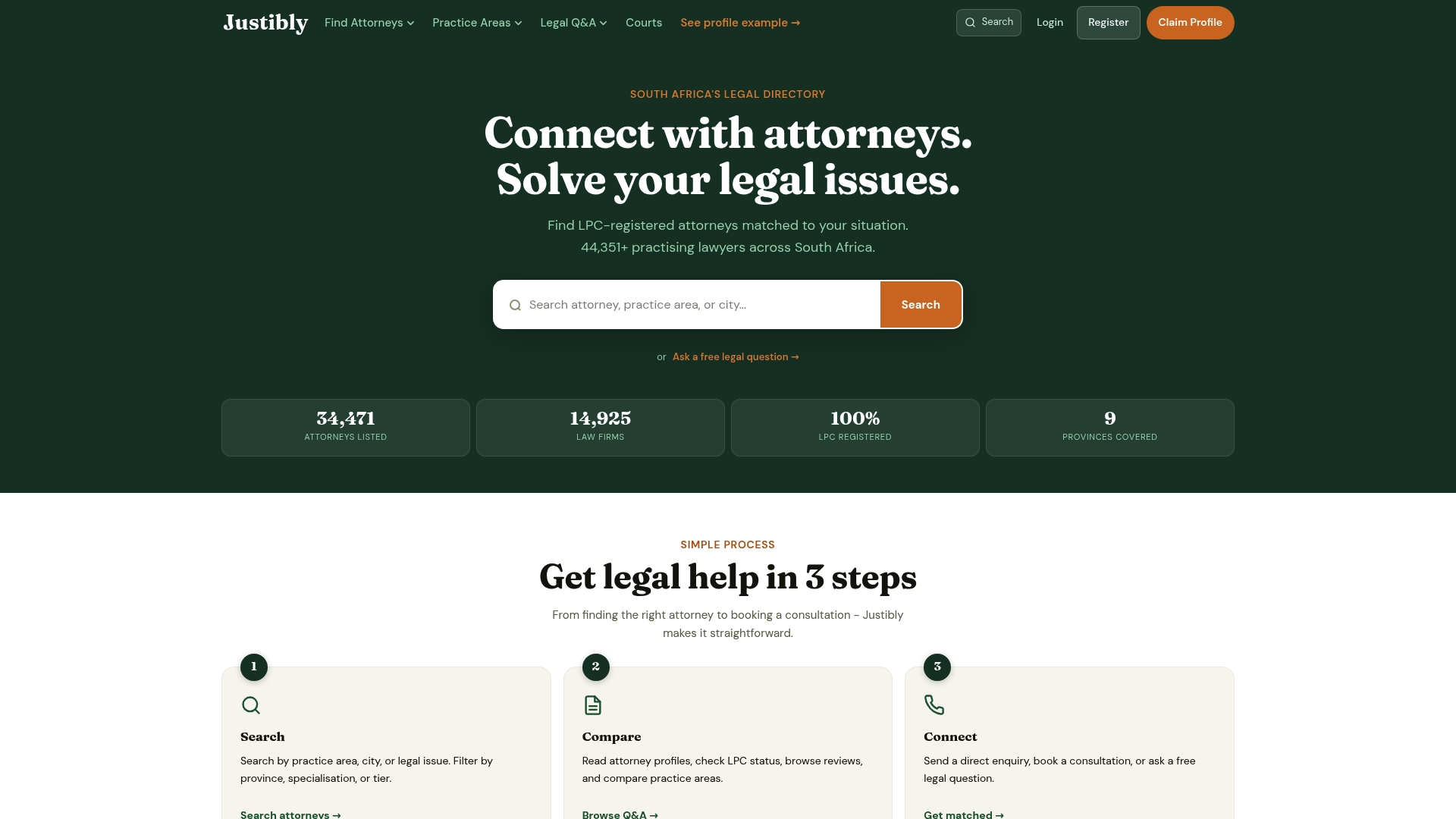
If you are ready to book, search our directory of LPC-registered attorneys by practice area and location, then match with a family law attorney for an appointment. Using the directory is free for you.
Not ready for a meeting? Post your question on our free legal Q&A and have it answered by a registered attorney. If you are an attorney who wants to reach people looking for divorce advice, see our profile plans.
FAQ
Is a divorce attorney consultation free in South Africa?
It depends on the attorney. Some offer a free or reduced first meeting and others charge for their time. Ask before you book whether a fee is payable, what it is and how long it covers. Legal Aid South Africa may help if you cannot afford a private attorney.
How do I prepare for my first divorce consultation?
Write a one-page timeline of the marriage and separation, list your income and expenses, and bring your marriage certificate, antenuptial contract, children's birth certificates and financial statements. Add any court papers you have received, with the dates. Finish with a list of your questions.
Can I consult a divorce lawyer before deciding to divorce?
Yes. A consultation is for advice, not commitment. You can learn about your rights, the property system that applies and the likely process before you decide anything. You only start a divorce when summons is issued.
How do I know an attorney is registered?
Attorneys must be on the practising roll of the Legal Practice Council. You can confirm this with the LPC regional office, as the LSSA explains, or use our directory, where listings reflect verified LPC data.
What if my spouse and I agree on everything?
An agreed divorce is usually quicker and cheaper, because there is less to dispute. An attorney still needs to draft the settlement properly so it can be made an order of court, and to protect your interests on property, maintenance and the children.
Sources
- Chambers Practice Guides: Family Law 2026, South Africa
- Department of Justice: Divorce information sheet
- Department of Justice: Mediation
- Department of Justice: Family Advocate
- Department of Justice: Maintenance FAQ
- Vuk'uzenzele: Office of Family Advocate puts children first
- LSSA: Check whether a legal practitioner is registered
Recommended
By the Justibly editorial team
Published
General legal information for South Africa, checked against the Legal Practice Act, the relevant court rules and the Legal Practice Council roll. It is not legal advice and does not create an attorney-client relationship. For advice on your situation, consult an admitted attorney.
How we research and review · How the Trust Score works · Report an error