What is a deed of sale, and why does signing one bind you?
Discover the crucial role of a deed of sale in South African property transactions and how it legally binds buyers and sellers.
Published

A deed of sale, in South African practice, is the signed written contract, usually a countersigned Offer to Purchase, that creates a legally binding obligation to buy and sell a property. The moment both parties sign, obligations attach: the seller must deliver, the buyer must pay. But signing is not transfer. Ownership only passes once the deed is lodged and registered at the Deeds Office. Under the Alienation of Land Act, the agreement must be in writing and signed by both parties, or their authorised agents, and it must be in wet ink. No exceptions for a quick email confirmation.
- The signed OTP is usually the deed of sale itself, not a separate document
- Registration at the Deeds Office, not signature, is what legally transfers ownership
- Wet-ink signatures are required by law; a scanned or typed signature will not hold up
Key Takeaways
The deed of sale binds both parties on signature under the Alienation of Land Act, but ownership only transfers once the Deeds Office registers the deed, a process that typically takes six to twelve weeks depending on financing.
| Point | Details |
|---|---|
| Signature creates obligation | Both parties are bound once the OTP is signed in wet ink, but ownership only passes at registration. |
| FICA delays are avoidable | Certified ID, recent proof of address, and source-of-funds documents prevent the most common early stall. |
| Suspensive conditions need written notice | Most deeds require formal notice of non-fulfilment, not silent lapse, to actually end the deal. |
| Bond cancellation needs early notice | Sellers should notify their bank of intent to cancel as soon as the OTP is signed, since cancellation runs on its own timeline. |
| Costs split beyond transfer duty | Sellers usually cover rates clearance and bond cancellation fees; buyers cover transfer duty and conveyancer costs. |
Table of Contents
- What is a deed of sale and how does the offer to purchase fit in?
- What clauses actually matter in a deed of sale?
- What are the steps in the property transfer process?
- What legal formalities can invalidate a sale agreement?
- How long does transfer take and what does it cost?
- What common mistakes delay or derail a property sale?
- How should buyers and sellers prepare before signing?
- Where can you find a registered conveyancer and verify the rules yourself?
- What happens if one party breaches the deed of sale?
- How does the deposit and balance payment actually work?
- Who pays for what: buyer and seller responsibilities beyond transfer duty
- How does bond cancellation affect the timeline?
- What legal protections exist for buyers against defects or title problems?
- The gap between contract templates and real transactions
- Sources
- FAQ
What is a deed of sale and how does the offer to purchase fit in?
Most South African property sales never see a separate "deed of sale" document. The Offer to Purchase signed by the buyer and countersigned by the seller becomes the binding sale agreement, provided it meets the writing and signature requirements of section 2(1) of the Alienation of Land Act. Once both signatures are on it, you have a legal sale contract, not a mere offer.
Some transactions use a bespoke sale agreement instead, typically for complex deals: off-plan developments, deceased estates, or sales involving trusts or companies with unusual conditions. Either format works legally, provided it satisfies the same statutory formalities.
- An OTP becomes binding the moment the seller signs it back to the buyer
- Bespoke agreements suit complex ownership structures or off-plan sales
- Section 29 cooling-off rights apply only to certain sales under a set price threshold, not to the general market
Most residential resales fall outside the cooling-off window entirely, which is a common misconception among first-time buyers who assume they have days to reconsider.
What clauses actually matter in a deed of sale?
Every deed of sale contains the same skeleton, but the details inside each clause decide who carries the risk. Read these in order before you sign anything.
- Parties and signatures. Full names, ID numbers, and marital status matter. If either party is married in community of property, both spouses usually need to sign.
- Property description. Cross-check the erf or unit number, title deed reference, and extent against the actual title deed, not just the listing.
- Price and payment terms. This covers deposit amount, when it's payable, and whether the balance depends on a bank guarantee or bond approval.
- Suspensive conditions. Bond approval deadlines, sale of another property, or subdivision approval. If the condition isn't met by the stated date, the deal usually falls away automatically.
- Occupation date and risk. Occupation can happen before registration, which shifts practical risk (and sometimes rates) onto the buyer earlier than expected.
- Voetstoots clause. This transfers risk for patent defects to the buyer but does not excuse the seller from disclosing known latent defects.
Pro Tip: Never assume a suspensive condition "just expires quietly." Most deeds require written notice of non-fulfilment, and missing that step can leave you contractually bound when you thought the deal was dead.
What are the steps in the property transfer process?
Transfer is not one event. It's a sequence run mostly by your conveyancer, with SARS, the bank, and the municipality all holding pieces of the puzzle.
- Instruction. The seller's agent (or the parties directly) instructs a conveyancer once the OTP is signed and suspensive conditions look likely to be met.
- FICA and document collection. The conveyancer, as an accountable institution under FICA, must verify both parties' identity, address, and source of funds. Missing paperwork here is the single most common reason files stall in week one.
- Bond and cancellation coordination. If the buyer needs finance, a bond attorney registers the new bond; if the seller has an existing bond, a cancellation attorney is appointed too. All three conveyancers must align lodgement dates.
- Municipal clearance application. The conveyancer requests rates clearance figures; the transfer process depends heavily on municipal turnaround, which varies widely by council.
- Transfer duty payment. The buyer's conveyancer pays transfer duty via SARS eFiling and obtains a receipt, required before lodgement.
- Lodgement. All documents, transfer, bond, and cancellation, go to the Deeds Office together.
- Registration. The Registrar signs the deeds into the record. That signature is the legal moment ownership changes hands, under the Deeds Registries Act.
Typical bonded transfers run eight to twelve weeks from signature to registration, sometimes longer if bank approval or municipal clearance drags. Cash deals move faster because there's no bond registration to coordinate.
What legal formalities can invalidate a sale agreement?
South African law treats certain formalities as non-negotiable. Miss one, and the whole agreement can be void, not just voidable.
- The agreement must be in writing and signed by both parties or duly authorised agents under the Alienation of Land Act
- If signing through an agent, that agent's authority must itself be in writing
- Spouses married in community of property generally both need to sign, or the transaction risks being challenged later
- Electronic signatures do not satisfy the Act for immovable property sales
Attempts to close a deal by email confirmation or a digital signature platform, however convenient, risk leaving the entire sale unenforceable. ECTA specifically excludes agreements for the alienation of land from its electronic-signature provisions, so the wet-ink rule survives even in an increasingly digital market.
Your conveyancer's FICA checks, trust account handling, and lodgement duties exist precisely to protect both sides from these formal traps.
How long does transfer take and what does it cost?
Budget for both time and money before you sign, not after.
- Transfer duty is paid by the buyer, calculated on a sliding scale; check current brackets directly with SARS before finalising your budget, since thresholds shift periodically.
- Conveyancer fees cover the transfer attorney's charges plus disbursements: Deeds Office fees, FICA verification costs, and postage or courier charges for documents.
- Municipal clearance certificates typically take a few working days to a few weeks depending on the municipality's backlog.
- Bond registration attorney fees apply separately if you're financing the purchase, on top of the transfer conveyancer's account.
A cash purchase often completes in six to eight weeks since there's no bond registration to synchronize. A bonded purchase, involving three coordinated firms, commonly stretches to ten or twelve weeks. Watch for extra costs like outstanding levies on sectional title units or unpaid rates that surface only once the clearance figures come back.
What common mistakes delay or derail a property sale?
Most transfer delays trace back to a handful of repeat offenders.
- Changing terms after signature. If one party alters a clause after signing but before the other counterparts it, that alteration is legally a counter-offer, not acceptance. Re-sign properly or risk an unenforceable deal.
- Missing FICA documents. Proof of address that's six months old, or an ID copy that isn't certified, sends the file back to square one.
- Outstanding municipal debt. Unpaid rates on the property block the clearance certificate, and clearance won't issue until the account is settled.
- Undisclosed latent defects. A voetstoots clause covers defects a reasonable inspection would miss discovering, but it doesn't protect a seller who knew about a leaking roof and said nothing.
Pro Tip: If a suspensive condition deadline is approaching and the bank hasn't confirmed your bond, get your conveyancer to request an extension in writing before the deadline passes. Once a condition lapses unmet, the contract can automatically fall away, no negotiation required.
Remedies for breach include specific performance (forcing the other party to complete), cancellation with a demand for damages, or, where the contract includes one, a penalty clause.
How should buyers and sellers prepare before signing?
Walk into your first meeting with the conveyancer with these ready, and you'll shave weeks off the process.
- FICA pack. Certified ID copy, proof of residential address no older than three months, and source-of-funds documentation for larger deposits.
- Title deed copy and rates account. Sellers should have both on hand; buyers should request a copy to confirm the property description matches the OTP.
- Bond pre-approval or proof of funds. This speeds suspensive condition fulfilment and reassures the seller's side.
- Deposit and guarantee instructions. Know whether your deposit goes into the conveyancer's trust account or is covered by a bank guarantee instead.
- A short list of questions for your conveyancer: who handles the bond cancellation, what the expected lodgement date is, and what happens if clearance figures come back higher than budgeted.
Where can you find a registered conveyancer and verify the rules yourself?
Justibly's conveyancing attorney directory lists LPC-registered practitioners by location, so you can confirm a conveyancer's standing before handing over your deposit. The property law practice page breaks down what conveyancing actually involves if you want more detail before instructing anyone.
For primary sources, check the Deeds Office directly on transfer procedure, SARS for current transfer duty brackets, and the Financial Intelligence Centre for FICA requirements. Cross-referencing directory search with these official sources means you're never relying on secondhand advice for figures that change over time.
What happens if one party breaches the deed of sale?
Breach doesn't automatically mean the deal collapses. South African law gives the innocent party a choice, and the deed of sale itself usually narrows that choice further through its own clauses.
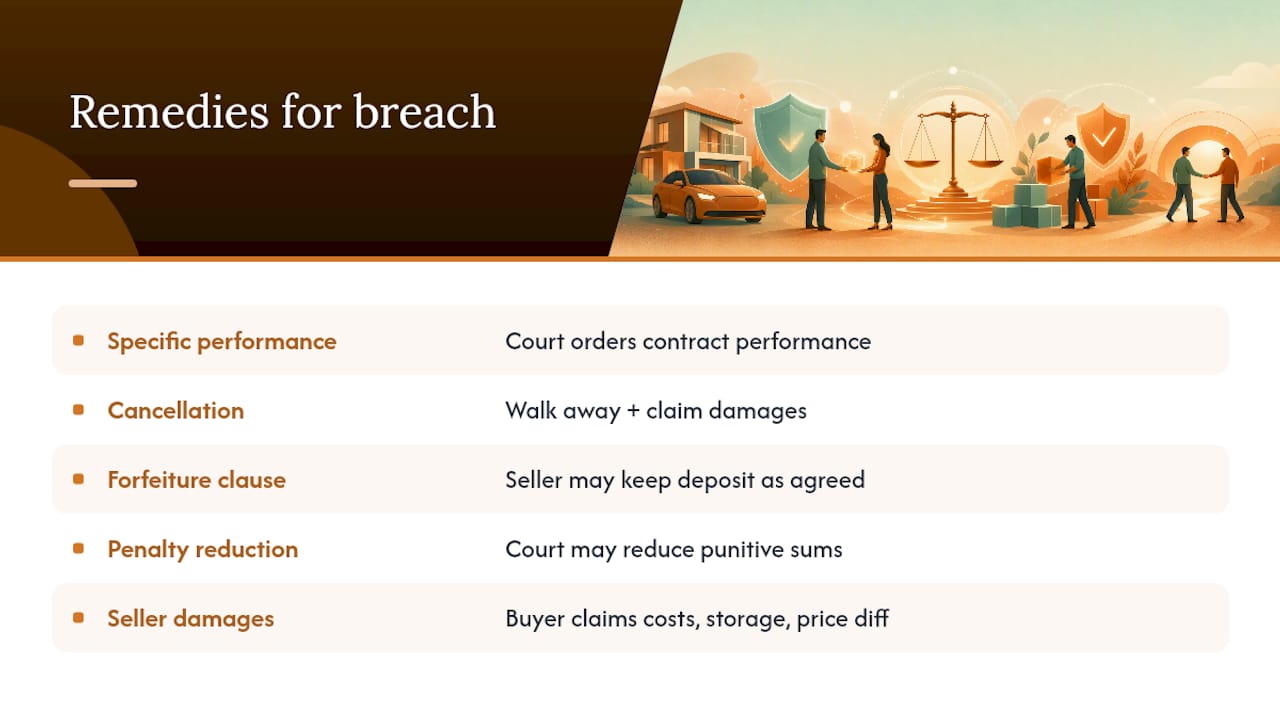
The two textbook remedies are specific performance and cancellation. Specific performance means asking a court to force the breaching party to carry out the contract, useful when a seller gets cold feet after signing and simply refuses to proceed. Cancellation lets the innocent party walk away and claim damages for actual financial loss suffered, provided the contract or common law entitles them to cancel rather than merely sue for performance.
But most deeds of sale go further than those two default remedies. A penalty clause or forfeiture clause is common: if the buyer breaches by failing to secure finance or pay the deposit on time, the deed may allow the seller to cancel and keep the deposit (or a portion of it) as pre-agreed compensation, without having to prove actual loss in court. Courts can still reduce an unreasonably punitive penalty under the Conventional Penalties Act, so an inflated forfeiture clause isn't automatically enforceable at face value.
Sellers who breach, missing the transfer date without a valid suspensive condition excuse, expose themselves to a damages claim for costs the buyer incurred, storage fees, temporary accommodation, or the price difference if the buyer has to purchase elsewhere at a higher cost. Read your specific breach clause before you sign; it decides your options long before any dispute happens.
How does the deposit and balance payment actually work?
The deposit, typically a percentage of the purchase price agreed in the OTP, doesn't go straight to the seller. It sits in the conveyancer's trust account, protected by the same accountable-institution rules that govern FICA compliance, until registration actually happens.
That distinction catches people off guard. Sellers sometimes assume they'll receive deposit funds immediately after signing; in practice, the conveyancer holds the money in trust and only disburses it once transfer registers, or occasionally on occupation if the deed specifically allows an earlier release. Buyers should ask their conveyancer, in writing, exactly when the deposit becomes releasable and under what conditions.
The balance of the purchase price, whether from a bond payout or cash, comes through separately and later in the process. For bonded buyers, the bank only releases bond funds once the bond is registered simultaneously with the transfer, which is why the three conveyancing firms, transferring attorney, bond attorney, and cancellation attorney if applicable, must coordinate lodgement dates precisely. For cash buyers, the conveyancer will usually request the full balance shortly before the anticipated lodgement date, again held in trust until registration.
Interest earned on trust account deposits typically belongs to the Legal Practitioners' Fidelity Fund or is directed per the specific trust arrangement, not to either party, unless the deed of sale states otherwise. Ask your conveyancer to clarify this upfront rather than assuming.
Who pays for what: buyer and seller responsibilities beyond transfer duty
Transfer duty gets most of the attention, but it's far from the only cost either side carries. The deed of sale should spell out who pays what; if it doesn't, disputes tend to surface at the worst possible time.
Sellers typically cover: the municipal rates clearance certificate costs, any outstanding rates or levies owed on the property up to the clearance date, the bond cancellation attorney's fees if there's an existing mortgage, and, in most standard deals, the estate agent's commission.
Buyers typically cover: transfer duty (paid to SARS), the transferring conveyancer's fees and disbursements, and, if financing the purchase, the bond registration attorney's fees on top of the transfer costs.
Sectional title properties add another layer: levy clearance certificates from the body corporate or managing agent, confirming no outstanding levies, are required before transfer can proceed, and the cost of obtaining that certificate usually falls to the seller. Justibly's sectional title practice page covers scheme-specific issues like this in more depth if your sale involves a unit rather than a freehold property.
Neither party should assume the other absorbs an unlisted cost. If your OTP is silent on who pays for a particular clearance or certificate, raise it with your conveyancer before signing, not after the invoice arrives.
How does bond cancellation affect the timeline?
If the seller has an existing mortgage, that bond must be cancelled as part of the transfer, and this single step is one of the most underappreciated sources of delay in the entire process.
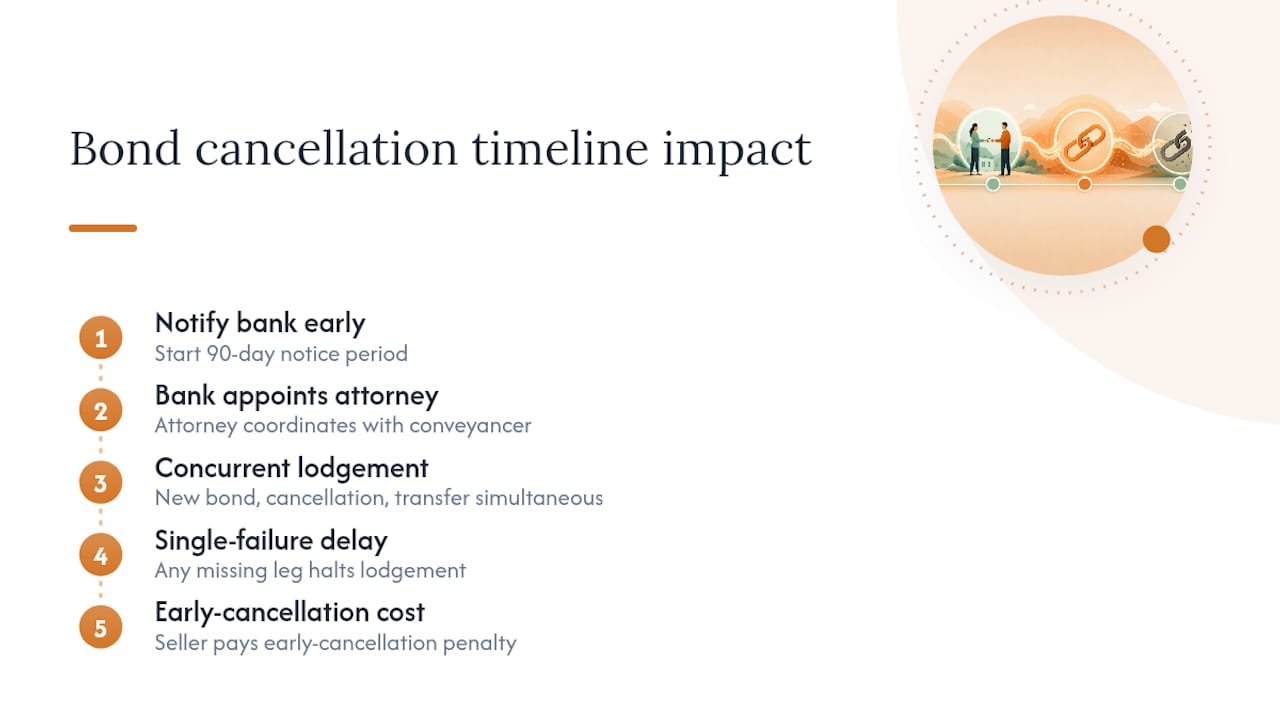
Cancelling a bond isn't instant. The seller's bank requires written notice, typically around 90 days, and if that notice period hasn't run its course by the time everything else is ready, the whole transfer waits on the bank, not the conveyancer. Sellers who anticipate a sale should notify their bank of intent to cancel as early as possible, ideally the moment an OTP is signed, to start that clock running in parallel with everything else.
A separate cancellation attorney, appointed by the seller's bank, has to coordinate directly with the transferring conveyancer and, where applicable, the buyer's bond registration attorney. All three need to lodge on the same day at the Deeds Office, since registration of the new bond, cancellation of the old one, and transfer of ownership happen simultaneously. If any one leg isn't ready, none of them proceed. This is precisely why effective coordination by the transferring attorney reduces failed lodgements: a single missing signature or unpaid settlement figure on the old bond can push the entire transaction back by weeks.
Sellers should also expect an early settlement or cancellation penalty from their bank if they cancel before a fixed-rate term ends. That cost sits with the seller, not the buyer, and is separate from anything the deed of sale itself addresses.
What legal protections exist for buyers against defects or title problems?
The voetstoots clause, present in most South African deeds of sale, transfers risk for defects the seller didn't know about and a reasonable inspection wouldn't reveal. It does not protect a seller who knowingly concealed a defect, such as a known structural crack patched over before viewings. Fraudulent non-disclosure can void the voetstoots protection entirely, and a buyer who later discovers this has grounds to claim damages or, in serious cases, cancel the sale.
The Consumer Protection Act adds another layer, though its reach is narrower than many buyers assume. It generally applies to sales by a seller acting "in the course of business," such as a property developer or an estate selling multiple units, rather than a private individual selling their own home. Buyers dealing with a developer get stronger implied warranties against defects than buyers dealing with an ordinary private seller.
Title problems get caught earlier in the process, largely because the conveyancer runs a Deeds Office search before transfer to confirm the seller actually holds clean title and that there are no unresolved liens, caveats, or competing claims. Buyers should still request their own copy of the title deed against the OTP's property description before signing, since a mismatch here (wrong erf number, incorrect extent) is far easier to fix before signature than after.
Many deeds of sale also include a specific defects disclosure annexure, where sellers list known issues in writing. Buyers should insist on this rather than relying on verbal assurances during a viewing; a written disclosure becomes part of the contract and strengthens any later claim if something was omitted deliberately.
The gap between contract templates and real transactions
Most guidance on deeds of sale treats the document as a formality, sign here, transfer happens. That framing undersells how much of the real risk sits in the details most templates gloss over: the suspensive condition notice requirement, the trust account timing on deposits, and who actually pays for a sectional title levy clearance. None of these are exotic legal issues. They're routine, and they're exactly where deals stall or turn into disputes.
The conventional advice to "get a good conveyancer" is correct but incomplete. A conveyancer manages the legal mechanics competently in the vast majority of cases; that's not where buyers and sellers usually go wrong. They go wrong earlier, at the OTP stage, by signing before checking the title deed, glossing over a penalty clause they don't fully understand, or assuming a verbal assurance about a leaking roof carries the same weight as a written disclosure.
If there's one priority worth acting on before anything else, it's this: read every clause in the OTP as though it's the only document that will ever govern your rights, because in practice, it usually is. Everything downstream, the conveyancer's diligence, the Deeds Office process, SARS compliance, operates within the boundaries that first signature sets.
This article is general information, not a substitute for advice from a qualified lawyer. Consult a qualified legal professional about your own circumstances before acting on anything here.
Sources
- Deeds Office FAQs
- Property transfer process (ooba)
- Property transfer process (MJ Kotze Inc)
- FICA — Financial Intelligence Centre guidance
- Dlrrd
FAQ
How do I get a deed of sale in South Africa?
You don't apply for one separately; it's created when you and the other party sign an Offer to Purchase or bespoke sale agreement that meets the Alienation of Land Act's writing and signature requirements, usually drafted by an estate agent or attorney.
Can a house be sold without a title deed?
Yes, provided the seller has clear title recorded at the Deeds Office and a copy or duplicate can be obtained; the conveyancer verifies ownership through a Deeds Office search rather than relying on the physical document alone.
How do I get my title deed online?
Title deed information can be searched through the Deeds Office system, though a certified copy typically requires a formal request through a conveyancer or directly with the Deeds Office rather than an instant online download.
How much does it cost to get a copy of a title deed?
Costs vary by request method and whether you use a conveyancer to obtain it; check current Deeds Office fee schedules directly, since specific published figures were not available for this article.
Who pays transfer duty, the buyer or the seller?
The buyer pays transfer duty to SARS as part of the transfer process, separate from the conveyancer's own fees and disbursements.
Recommended
By the Justibly editorial team
Published
General legal information for South Africa, checked against the Legal Practice Act, the relevant court rules and the Legal Practice Council roll. It is not legal advice and does not create an attorney-client relationship. For advice on your situation, consult an admitted attorney.
How we research and review · How the Trust Score works · Report an error