LLB to LPC in 6 years: Corporate law careers in South Africa
A practice focused corporate law guide for South Africa: Companies Act 71, company formation, director duties, and the LLB to LPC route.
Published

Corporate law governs how companies form, operate, transact, and dissolve, and in South Africa the controlling statute is the Companies Act 71 of 2008, administered by the Companies and Intellectual Property Commission (CIPC). Anyone practising in the field must also register with the Legal Practice Council (LPC). This guide walks through the Act's core provisions, the different company types, director duties, transactional practice, and the exact education path from LLB to admission.
TL;DR:
- Directors face personal liability if they approve distributions without ensuring the company's assets exceed liabilities and can pay debts as they fall due.
- Private companies are the most common structure for small and medium businesses, while public companies face stricter governance and disclosure obligations.
- The Companies Act emphasizes the importance of insolvency and fiduciary duties, with key sections that protect minority shareholders and address company distress through business rescue.
- Practical corporate law practice involves thorough due diligence in mergers and acquisitions, with remedies like oppression relief or derivative claims available for minority shareholders.
- Becoming a corporate lawyer requires completing an LLB, two years of articles, passing LPC exams, and proper registration, with real-world experience being crucial for specialization.
Table of Contents
- What does corporate law actually cover?
- What does the Companies Act 71 of 2008 actually require?
- What types of companies exist under South African law?
- How do director duties and corporate governance actually work?
- How do you register a company and set up its governing documents?
- What happens in mergers, takeovers, and shareholder disputes?
- How long does it take to become a corporate lawyer in South Africa?
- How do you find a reliable corporate lawyer or check a lawyer's credentials?
- Primary sources and further reading
- Get help from an LPC-registered attorney
- An editorial take on learning corporate law properly
- Sources
- FAQ
What does corporate law actually cover?
Corporate law is the body of rules governing how a company comes into existence, how it's run day to day, how it grows or restructures through transactions, and how it eventually winds down. Framing it as a lifecycle helps because each stage throws up a different set of legal problems, and law students often study these stages as separate modules without seeing how they connect.
At formation, the questions are structural: what type of entity to register, who holds what shares, and what the Memorandum of Incorporation (MOI) should say about decision making. During the operating phase, the focus shifts to governance: director duties, shareholder meetings, financial reporting, and staying compliant with CIPC filing requirements. Transactions bring in mergers, acquisitions, and takeovers, where due diligence and disclosure obligations dominate. Dissolution, whether through liquidation or business rescue, raises questions about creditor priority and what happens to employees and contracts.
Corporate law is often confused with commercial law or contract law, but the distinction matters for anyone choosing a specialisation. Commercial law deals broadly with the rules of doing business, including sales, agency, and general commercial contracts. Corporate law narrows in specifically on the entity itself. A commercial lawyer might draft a supply agreement; a corporate lawyer decides whether the board had authority to sign it in the first place.
Typical practice areas and matters a junior corporate lawyer will encounter include:
- Company incorporations and MOI drafting for new ventures
- Shareholder disputes, including minority oppression claims
- Due diligence on acquisition targets
- Advising boards on director duties and compliance risk
- Business rescue applications for financially distressed clients
- Regulatory filings and annual return compliance with CIPC
Corporate governance, in particular, sits at the intersection of law and management theory, and it's the area where legal advice most often prevents a problem rather than fixing one after the fact.
What does the Companies Act 71 of 2008 actually require?
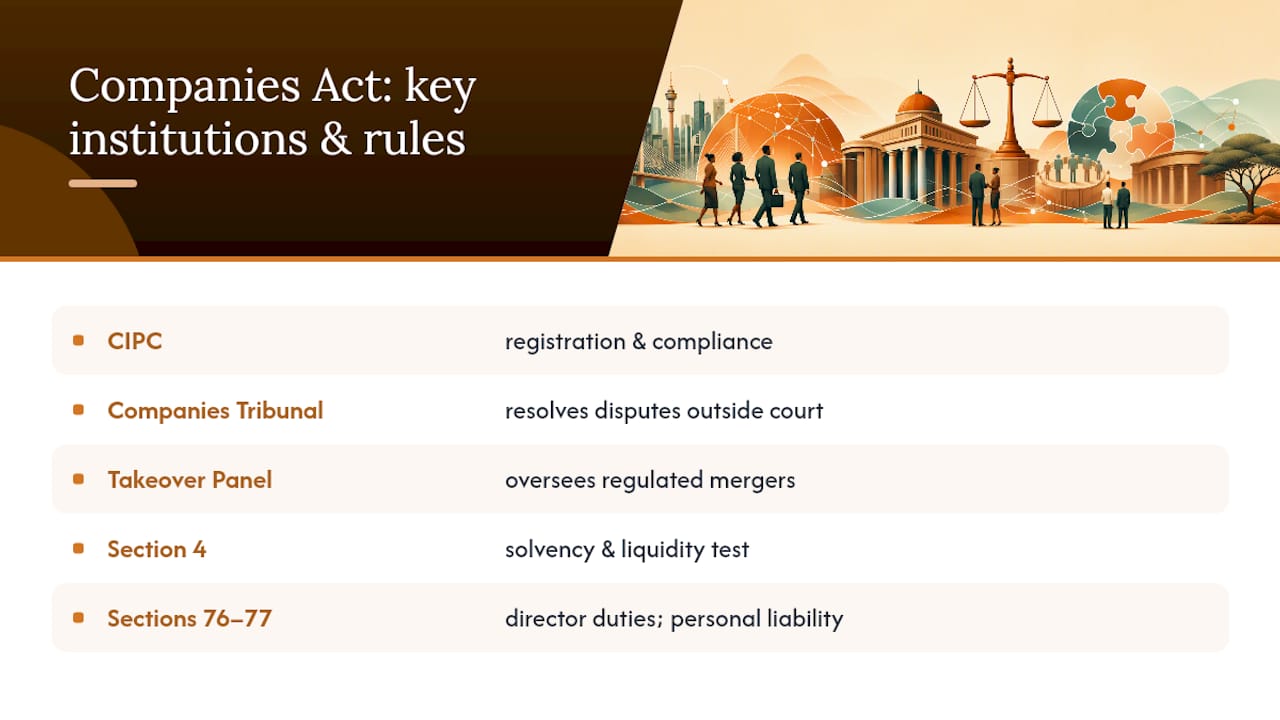
The Companies Act 71 of 2008 is the single most important document for anyone working in this field. It governs incorporation, organization, and management of companies, and it created three institutions students need to know by name: CIPC, which handles registration and compliance; the Companies Tribunal, which resolves certain disputes without going to court; and the Takeover Regulation Panel, which oversees mergers and affected transactions involving regulated companies.
A handful of sections do most of the heavy lifting in practice.
Section 4 sets the solvency and liquidity test, which a company must pass before it makes a distribution, buys back its own shares, or provides financial assistance to a director. Get this wrong and the transaction can be reversed, with directors personally exposed.
Section 61 governs shareholder meetings, including notice periods and the circumstances under which shareholders can compel a meeting. It sounds procedural until a minority shareholder uses it to force accountability on a board that's been avoiding scrutiny.
Sections 76 and 77 codify director duties and personal liability. Section 76 sets out the standard of care, skill, and diligence directors must apply, along with fiduciary duties to act in good faith and avoid conflicts of interest. Section 77 attaches personal liability for specific breaches, including reckless trading and false financial statements.
Sections 163 and 165 give minority shareholders remedies when they're being unfairly prejudiced (oppression relief under s163) or when the company itself has a claim it won't pursue (derivative action under s165).
Chapter 6 sets out business rescue, a rehabilitation process for financially distressed companies that gives them breathing room from creditors while a practitioner tries to restructure the business.
A closer look at what these sections mean in numbers: The solvency and liquidity test under section 4 requires a company to show its assets exceed its liabilities and that it will be able to pay debts as they fall due for the foreseeable future. Directors who authorise a distribution without meeting both legs of that test can face personal liability, which is why practical guidance on the Act treats it as one of the two statutory areas, alongside fiduciary duty, where most director risk concentrates.
Why does any of this matter beyond the exam room? Because a company that ignores section 4 before declaring a dividend can find that dividend clawed back, and directors who signed off on it personally liable for the shortfall. Statutory literacy here isn't academic polish. It's the difference between advice that protects a client and advice that exposes one.
What types of companies exist under South African law?
Choosing the right vehicle shapes everything from governance obligations to how easily a business can raise capital. The Act recognises a handful of core structures, each with different reporting and disclosure burdens.
- Private companies (Pty Ltd): the default vehicle for most small and medium businesses, restricted from offering shares to the public, with lighter disclosure requirements than public companies.
- Public companies (Ltd): can offer shares to the public and face stricter governance, audit, and disclosure obligations, particularly if listed on an exchange.
- Non-profit companies (NPCs): formed for public benefit or other non-commercial objectives, with no shareholders and profits reinvested rather than distributed.
- Personal liability companies (Inc): typically used by professional practices, where directors are jointly liable for company debts incurred during their tenure.
Governance intensity scales with public interest. A small Pty Ltd run by two founders can often get away with a lean MOI and informal shareholder communication. A public company answers to a wider shareholder base, faces mandatory audit committee requirements in many cases, and carries heavier reporting obligations under both the Act and stock exchange rules where applicable.
One historical wrinkle trips up a lot of students: close corporations. No new close corporation has been registered since 1 May 2011, since the Act phased them out in favour of the private company structure, but plenty of existing close corporations are still trading today. That means practitioners still need to understand the old CC regime, even though nobody's forming new ones.
How do director duties and corporate governance actually work?
Director duties are where corporate law stops being abstract and starts creating personal exposure. Section 76 sets the standard: directors must act with the degree of care, skill, and diligence reasonably expected of someone in their position, and they must act in good faith, in the company's best interests, and without unmanaged conflicts of interest. Section 77 is where that standard gets teeth, attaching personal liability for breaches like reckless trading, allowing false statements, or acting outside the company's authority.
King IV, South Africa's corporate governance code, sits above the statutory floor. It isn't law in the way the Act is, but listed companies and increasingly private ones treat it as the benchmark for how a board should actually function, covering board composition, ethical leadership, and stakeholder inclusivity. Audit committees and the company secretarial function are the practical mechanisms through which King IV principles get implemented day to day, monitoring financial reporting integrity and keeping the board's paperwork and disclosures in order.
Common compliance failures follow a predictable pattern:
- Directors approve a distribution without properly testing solvency and liquidity under section 4.
- Boards fail to disclose personal financial interests in a transaction, breaching conflict-of-interest duties.
- Companies miss CIPC annual return deadlines, risking deregistration.
- Minute-keeping lapses, leaving no paper trail to show a board actually deliberated a decision.
- Audit committee composition doesn't meet independence requirements for a public company.
Pro Tip: Directors who want to cut their personal liability exposure should insist on documented board resolutions for every material decision, not just the big ones. A one-line minute recording that the board considered section 4 before approving a dividend is often the single piece of evidence that separates a defensible decision from a reckless one.
How do you register a company and set up its governing documents?
Forming a company is mechanically straightforward, but the documents that come out of the process shape the business for years. Here's the practical sequence lawyers walk clients through.
- Reserve a name and register with CIPC. Company registration happens through CIPC, which issues a registration number and certificate once the founders submit the required forms and the MOI.
- Draft the Memorandum of Incorporation. The MOI is the company's constitutional document. It sets out share structure, director powers, and the default rules that apply unless the founders customise them. Get this wrong at formation and it's expensive to unwind later.
- Consider a shareholder agreement alongside the MOI. The MOI governs the company's relationship with the world and its default internal rules, but a carefully drafted shareholder agreement can govern the specific relationship between particular shareholders where the law allows it, covering things like pre-emptive rights, deadlock resolution, and exit mechanics that founders don't always want made public in the MOI.
- Set up routine compliance systems. This means annual returns to CIPC, updated financial statements, and keeping the securities register current as shares change hands.
- Maintain board minutes and resolutions. Every material board decision should be minuted, both for governance discipline and as evidence if a decision is ever challenged.
Lawyers who work with startups spend a disproportionate amount of time on step three, because founders often assume the MOI covers everything and skip the shareholder agreement entirely, only to discover a deadlock with no mechanism to break it.
What happens in mergers, takeovers, and shareholder disputes?
Transactional work is where corporate law gets adversarial, and it's also where the Act's institutional framework does the most visible work. The Takeover Regulation Panel oversees affected transactions and offers, meaning anyone advising on a bid for a regulated company needs to understand mandatory offer thresholds, disclosure timing, and the Panel's power to intervene if a transaction looks designed to disadvantage minority shareholders.
Due diligence sits underneath every acquisition, and while the depth varies by deal size, the checklist is fairly consistent at a high level:
- Corporate records: MOI, shareholder register, board minutes, and CIPC filing history
- Material contracts: supplier agreements, financing arrangements, and change-of-control clauses
- Litigation and regulatory exposure: pending disputes, compliance breaches, or investigations
- Financial statements and the solvency and liquidity position under section 4
- Employment obligations, including any change-of-control triggers for senior staff
Minority shareholders aren't left without recourse when a transaction or a board decision treats them unfairly. Section 163 provides oppression relief where conduct is unfairly prejudicial, and courts can order remedies including a buy-out of the minority's shares or setting the transaction aside. Section 165 lets a shareholder bring a derivative action on the company's behalf when the company itself won't pursue a valid claim, often against its own directors. Both remedies are powerful but procedurally demanding, and practitioners need to understand the evidential thresholds courts apply before advising a client to pursue either route.
When a company can't meet these obligations because of financial distress rather than a dispute, business rescue under Chapter 6 offers a structured alternative to liquidation, giving the business breathing room from creditors while a practitioner attempts to rehabilitate it. For general transactional documentation practices outside South Africa, resources like KAPVOY Advisory's loan document checklist illustrate how similar due diligence disciplines apply across jurisdictions, even where the underlying statute differs.
How long does it take to become a corporate lawyer in South Africa?
The path from law student to practising corporate lawyer follows a fixed sequence, and it's longer than most first-year students expect.
- Complete an LLB. Most students take the four-year LLB route straight from school, though a conversion LLB is available for graduates who studied a different undergraduate degree first.
- Serve two years of articles of clerkship. This is practical vocational training under a principal, where the theory from law school meets actual client files.
- Pass the LPC professional competency exams. These test both practical and ethical competence before admission is granted.
- Get admitted by the High Court and register with the LPC. Admission and registration are the final formal steps before a graduate can call themselves an attorney.
From LLB to admission, the realistic timeline generally involves completion of a four-year LLB followed by two years of articles, with LPC exams typically taken during or shortly after articles.
Specialisation usually comes after admission, not before. A postgraduate LLM in corporate law, offered by universities including the University of the Western Cape, deepens expertise in transactional work and governance for lawyers already in practice. Shorter learning programmes, like the corporate law short course at Unisa, let working professionals upskill without stepping away from practice entirely. UCT and UJ run comparable postgraduate and short-course offerings for lawyers who want formal training in this area.
Early-career roles typically fall into three buckets: junior associate at a law firm doing transactional and advisory work, in-house counsel supporting a single company's legal function, or a compliance officer role focused on regulatory adherence rather than litigation. Career guidance published by the Law Society of South Africa confirms these three paths remain the dominant early-career destinations, and many lawyers move between private practice and in-house roles more than once over a career.

How do you find a reliable corporate lawyer or check a lawyer's credentials?
Start with the primary sources: the Companies Act itself for statutory questions, CIPC for anything registration or filing related, and the LPC for confirming whether a specific attorney is properly registered to practise. Skipping straight to a search engine result without checking these leaves too much to chance.
There are online directories listing LPC-registered attorneys across South Africa's nine provinces, some offering free Q&A forums where registered attorneys answer general questions. Before instructing anyone found online, run through a short checklist:
- Confirm LPC registration status directly, not just a claim on a website
- Check the lawyer's stated practice area actually matches corporate or commercial work
- Look for genuine client reviews rather than testimonials with no verifiable source
- Verify the firm's physical location and contact details are current
Readers researching attorneys in specific centres can start with listings for Cape Town or Johannesburg, where profile detail makes these checks easier to run.
Primary sources and further reading
For deeper study, go directly to the Companies Act 71 of 2008 for the full statutory text, CIPC for registration and compliance procedures, and the LPC for admission and registration rules. University pages such as UCT's guide to practising law and the UWC LLM in corporate law cover the education route in more depth than any single article can.
Get help from an LPC-registered attorney
Reading the Act and understanding the framework only goes so far when you're facing an actual company dispute, a director liability question, or a transaction that needs proper documentation. Justibly's Legal Q&A forum connects you with LPC-registered attorneys who can answer specific questions for free, and the platform's legal guides walk through related processes step by step. If you need a corporate lawyer directly, search Justibly's directory of attorneys and law firms across South Africa to find someone registered, reviewed, and matched to your practice area.
An editorial take on learning corporate law properly
Most corporate law content online treats the subject like a vocabulary list: define "MOI," define "fiduciary duty," move on. That approach fails students and junior lawyers because it skips the part that actually matters: knowing which two or three statutory provisions carry most of the real-world risk. Section 4's solvency and liquidity test and the section 76/77 duty and liability framework are where director exposure actually concentrates, and a student who understands those two areas cold will out-perform one who's memorised the whole Act shallowly.
The conventional advice, "read the whole Act," is technically correct and practically useless. Read the Act with a hierarchy in mind: governance and liability provisions first, transactional mechanics second, everything else as reference material you look up when a specific matter demands it. The same logic applies to career planning. Articles and LPC admission are non-negotiable steps, but the real differentiator for a corporate law career is exposure, getting onto real due diligence files and board advisory work early, rather than which university's name sits on the LLM certificate.
— Nkosi
This article is general information, not a substitute for advice from a qualified lawyer. Consult a qualified legal professional about your own circumstances before acting on anything here.
Sources
- Practising law in South Africa | University of Cape Town (Law)
- Companies Act 71 of 2008 | South African Government
- LLM in corporate law | University of the Western Cape (Law)
- Companies Act 71 of 2008: A Practical Guide for South African Directors | MJ Kotze Inc
FAQ
How many years does it take to study corporate law?
Studying corporate law within an LLB typically forms part of a four-year degree, but qualifying as a practising attorney adds two years of articles plus LPC exams, putting most people at around six years from first enrolment to admission.
What's the hardest part of studying corporate law?
Most students and junior practitioners find director duties and personal liability under sections 76 and 77 the hardest area, because it requires applying abstract fiduciary standards to messy, fact-specific business situations rather than memorising a rule.
What is corporate law and how does it work?
Corporate law is the set of rules governing how companies form, are managed, transact, and dissolve, built in South Africa around the Companies Act 71 of 2008 and enforced through CIPC, the Companies Tribunal, and the courts.
Can I do corporate law with an LLB?
Yes. An LLB is the required base qualification, but you also need two years of articles of clerkship, LPC exam passes, and High Court admission before you can practise as an attorney specialising in corporate work.
Recommended
By the Justibly editorial team
Published
General legal information for South Africa, checked against the Legal Practice Act, the relevant court rules and the Legal Practice Council roll. It is not legal advice and does not create an attorney-client relationship. For advice on your situation, consult an admitted attorney.
How we research and review · How the Trust Score works · Report an error