Business rescue process: what South African directors do now
Navigate the business rescue process in South Africa effectively. Learn key steps for directors and respond swiftly as a creditor or employee.
Published

Business rescue is the Chapter 6 procedure under the Companies Act 71 of 2008 that places a financially distressed company under temporary supervision, so it can be rehabilitated rather than liquidated. If you are a director, the immediate action is to file CoR123.1 with the CIPC and appoint a licensed Business Rescue Practitioner within several business days. If you are a creditor or employee, you need to check whether that notice has already been filed and know how to respond.
Ask yourself one question first: can the company pay its debts as they fall due, or do liabilities now exceed assets? If the answer is no, delay costs you options.
- Directors: pass the resolution, file CoR123.1, appoint a BRP within several business days.
- Affected persons: apply to court under section 131 if directors won't act, or object once notice is filed.
- Everyone: confirm the financial distress test before doing anything else.
Pro Tip: Don't wait for a formal insolvency review to confirm distress. If cash flow forecasts show you can't meet obligations in the next six months, that's usually enough to justify starting the conversation with a business rescue practitioner now.
Key Takeaways
Business rescue succeeds when directors act within statutory deadlines, appoint a properly licensed BRP, and maintain transparent communication with creditors throughout a process that typically runs far longer than three months.
| Point | Details |
|---|---|
| Act on the distress test early | If liabilities exceed assets or debts can't be paid on time, start the resolution and BRP appointment process immediately. |
| Meet the initial BRP appointment deadline | Directors must appoint a licensed practitioner within several business days of filing CoR123.1. |
| Verify BRP licensing directly | Confirm NQF level 7 qualifications, controlling body membership, and SAQA verification before appointment. |
| Expect a longer timeline | Successful rescues average around a considerably longer period than initially expected to substantial implementation, not the three month statutory target. |
| Document everything | Directors retain fiduciary duties and residual powers, so keep records and get advice when authority is unclear. |
| Use Justibly to find qualified counsel | Search the liquidation and business rescue attorney directory or ask a quick question through the free Q&A forum. |
Table of Contents
- What is the business rescue process and how does it differ from liquidation?
- How do you file for business rescue in South Africa?
- What does a business rescue practitioner actually do?
- What happens to contracts, debts and employees during the moratorium?
- What is the timeline and which CIPC forms matter?
- What does a business rescue plan need to include?
- How does post-commencement funding work?
- What are directors' duties and risks during rescue?
- What should directors, creditors and employees do first?
- How do you verify a business rescue practitioner's licence?
- What South African stakeholders consistently underestimate
- Where to find a business rescue attorney or get a quick answer
- Primary sources and further reading
- Sources
- FAQ
What is the business rescue process and how does it differ from liquidation?
Business rescue exists to save a company, not bury it. Chapter 6 of the Companies Act 71 of 2008 (sections 128 to 152) sets up temporary supervision aimed at restructuring the affairs, business, property, debt and equity of a financially distressed company so it can keep trading, or at least return more to creditors than an immediate winding up would.
The process has three practical goals:
- Stabilise operations enough to stop the bleeding.
- Produce a rescue plan that restructures debt and operations.
- Balance the competing interests of creditors, employees and shareholders rather than favoring one group outright.
Liquidation does the opposite. There's no attempt to keep the business alive. That's the core of the business rescue vs liquidation south africa debate: rescue is a rehabilitation attempt with a moratorium and a plan; liquidation is a formal exit with no such ambition. According to SAIPA's analysis, successful rescues that reach substantial implementation take an average of significantly longer than the initial target period, far longer than the Act's initial statutory target period.
How do you file for business rescue in South Africa?
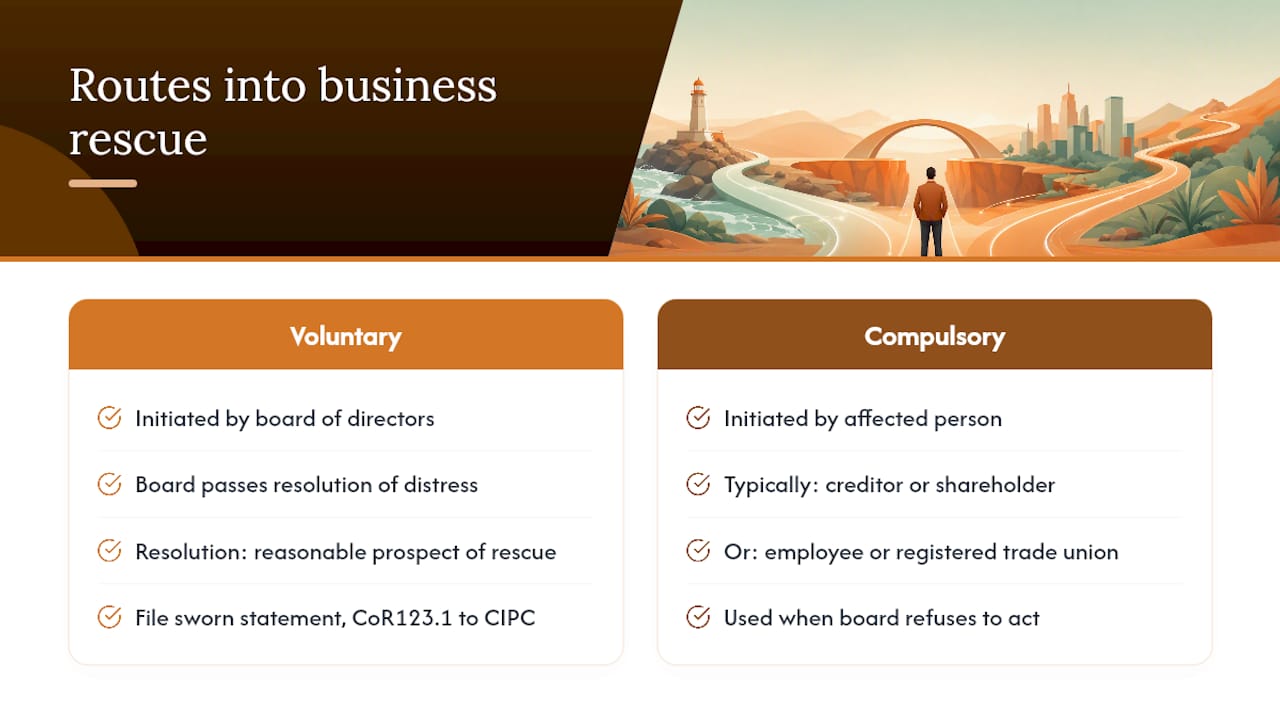
There are two routes into business rescue, and which one applies changes what happens next.
Voluntary commencement starts with the board. Directors pass a resolution stating the company is financially distressed and there's a reasonable prospect of rescue succeeding. The company then files a sworn statement and CoR123.1 with the CIPC, which formally places the company under supervision.
Compulsory commencement happens when an affected person, typically a creditor, shareholder, employee or registered trade union, applies to court under section 131 for a rescue order, usually because the board has refused to act despite clear distress.
Filing the resolution has an immediate legal consequence: it suspends any liquidation application already in progress. But the process is fragile at the start. If the company fails to meet procedural steps, such as publishing notice to affected persons within several business days, the resolution can lapse. An affected person who believes the resolution was improperly passed, or that there's no genuine prospect of rescue, can apply to court to have it set aside.
What does a business rescue practitioner actually do?
The Business Rescue Practitioner (BRP) is the person the entire process hinges on. Once appointed, the BRP takes over management authority for the company's day to day affairs, though not without limits.
Core duties include:
- Investigating the company's affairs, business, property and financial position.
- Convening and presiding over the first meetings of creditors and employees.
- Preparing and publishing a rescue plan.
- Negotiating with creditors, often including compromise offers such as partial repayment "in the rand."
- Managing operations while the company remains under supervision.
Directors don't disappear. They retain certain non-management powers and must still cooperate with the BRP, but day to day control shifts. According to CIPC's licensing guidance, a BRP must be a member in good standing of a recognised controlling body and hold a relevant bachelor's degree at NQF level 7 or higher, with SAQA verification required for foreign qualifications. A weekend seminar certificate does not meet that bar.
Pro Tip: Ask any prospective BRP for proof of their controlling body membership and NQF level 7 qualification before appointment. CIPC has flagged unqualified applicants as a recurring problem, and an improperly licensed BRP can jeopardize the entire filing.
What happens to contracts, debts and employees during the moratorium?
The moment business rescue commences, a general moratorium kicks in. Most legal proceedings against the company, including enforcement action and the exercise of most security rights, are suspended for the duration, with limited statutory exceptions.
For employees, existing contracts of employment continue on the same terms unless changed through the formal rescue process, which typically means consultation and possibly retrenchment procedures under separate labour legislation. Wage claims for services rendered before rescue commenced are treated as claims in the process, not automatically paid out immediately.
For suppliers, the picture is mixed. Some continue supplying under revised terms if the BRP negotiates continuity; others hold the right to terminate, subject to contractual terms and any specific protections the Act grants.
Secured creditors don't lose their security outright, but they generally can't enforce it without either the BRP's consent or leave of the court. Landlords face similar restrictions on eviction or termination action during the supervision period.
What is the timeline and which CIPC forms matter?
The forms and deadlines are where most rescue attempts stumble. Miss a filing window and the resolution can lapse entirely, throwing the company straight back into liquidation risk.
The core forms, all filed through CIPC's e-services platform:
- CoR123.1 — Notice of commencement of business rescue proceedings, filed by the board.
- CoR123.2 — Notice of appointment of the practitioner.
- CoR125.1 — Status report, first due at three-months.
- CoR125.2 — Notice of termination of proceedings.
- CoR125.3 — Notice of substantial implementation of the rescue plan.
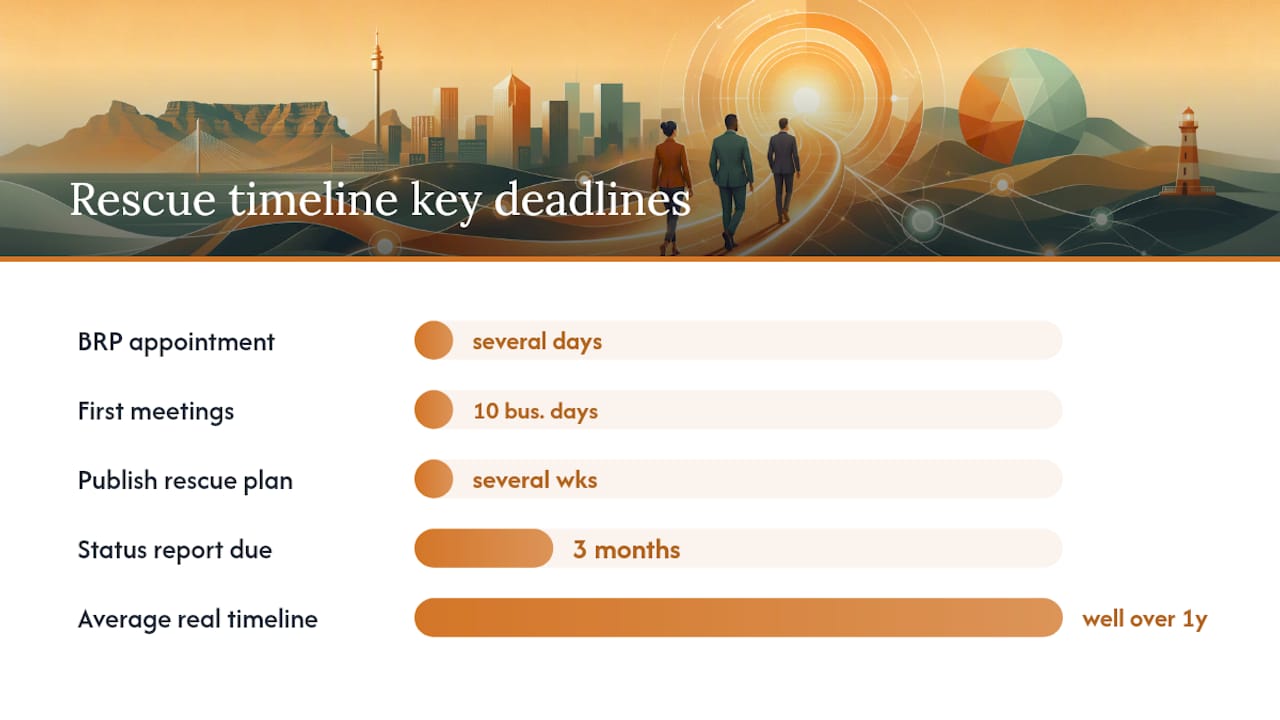
The statutory clock runs fast at the start:
- Appoint a licensed BRP within several business days of filing the resolution.
- The BRP must convene the first meetings of creditors and employees within ten business days of appointment.
- A rescue plan must be published within several weeks of the BRP's appointment, unless extended by creditors or the court.
- A status report is due at three months, with monthly updates if proceedings run longer.
Those numbers describe the legal minimum, not how long real cases actually run. SAIPA's research found that companies reaching substantial implementation took well over a year on average, well beyond the Act's original three-month framing. CIPC has also warned that submitting documents outside the required checklist on the e-services platform delays processing, so filing the right form the first time matters more than filing quickly.
What does a business rescue plan need to include?
A rescue plan isn't a vague promise to do better. It has to contain specific, substantive content that creditors can actually vote on.
Typical elements include:
- A prognosis for the company, including whether rescue offers a better outcome than immediate liquidation.
- Proposed operational changes, restructuring, or asset sales.
- Restructured repayment terms for existing debt.
- Proposals for post-commencement finance, if needed.
- A governance and implementation timeline.
Voting happens at a meeting of creditors, with holders of a "voting interest" (broadly, the value of their claims) casting votes weighted by that interest. Amendments proposed at the meeting need support from the person who proposed the plan before they're incorporated. Approval generally requires majority support of the voting interests present, with a higher threshold when the plan affects the rights of a class of creditors differently.
If creditors adopt the plan, the BRP implements it and eventually files CoR125.3 confirming substantial implementation. If they reject it, the company typically moves toward liquidation, though affected persons can, in narrow circumstances, ask the court to intervene.
How does post-commencement funding work?
Rescue plans rarely work without new money. Post-commencement finance (PCF) is capital advanced after rescue begins, and it usually carries a priority ranking above most pre-existing unsecured claims, precisely because lenders won't advance funds otherwise.
Negotiating PCF in practice means:
- Approaching existing lenders first, since they already understand the company's risk profile.
- Offering suppliers partial repayment or revised terms to keep goods and services flowing.
- Documenting every funding arrangement formally, with the BRP's sign off, rather than relying on informal understandings.
Pro Tip: Get any post-commencement funding arrangement confirmed in writing and cleared with the BRP before funds move. Informal "bridge" arrangements that skip this step are a common source of disputes once the plan goes to a vote.
What are directors' duties and risks during rescue?
Directors don't get a free pass once a BRP is appointed. They retain fiduciary duties, including acting honestly and in the company's best interests, and they keep certain powers the Act doesn't transfer to the practitioner.
Case law has sharpened where that line sits. In Ronica Ragavan v Optimum and the Shiva Uranium litigation, courts clarified that directors retain specific residual powers, including in some circumstances the power to appoint a replacement BRP if the incumbent resigns during voluntary proceedings, a nuance legal commentary has flagged as frequently misunderstood.
Practical risk mitigation: keep detailed records of every decision, get independent legal advice when the boundary between director and BRP authority is unclear, cooperate fully with the practitioner, and avoid any transaction that could be seen as prejudicing creditors.
What should directors, creditors and employees do first?
Each stakeholder group has a different priority list in the first 72 hours, and a different one over the following months.
Directors:
- Confirm the financial distress test applies before drafting a resolution.
- File CoR123.1 promptly once the resolution is passed.
- Appoint a licensed BRP within the five business day window.
- Preserve financial records and avoid any transaction that looks like it favours one creditor.
Creditors:
- Check whether notice of commencement has been filed against the debtor.
- Lodge your claim with the BRP once meetings are convened.
- Consider a court application if directors appear to be stalling despite clear distress.
- Review the rescue plan closely for how your claim class is treated before voting.
Employees:
- Confirm your existing employment terms and wage protections continue under supervision.
- Contact your union or an employee representative for the process.
- Attend meetings the BRP convenes and submit any outstanding wage claims.
How do you verify a business rescue practitioner's licence?
Not every self-described turnaround consultant is a licensed BRP, and appointing an unlicensed one can undo the entire filing.
Ask for:
- Proof of current CIPC licence and good standing with a recognised controlling body.
- A relevant bachelor's degree at NQF level 7 or above, with SAQA evaluation if obtained abroad.
- CPD records and adequate professional indemnity insurance.
The Institute of Accounting and Commerce (IAC) is one recognised controlling body that maintains BRP membership standards, alongside similar bodies for the accounting and legal professions.
Pro Tip: Favour a BRP with demonstrable commercial turnaround experience and access to a multidisciplinary team over someone who simply has years registered as a practitioner. Business rescue has only existed since 2011, so raw tenure tells you less than actual casework does.
What South African stakeholders consistently underestimate
The statutory timeline reads like a sprint: a short deadline to appoint a BRP and publish a plan. Treat those numbers as process milestones, not a promise of a quick resolution. A three-month target on paper regularly stretches to well over a year in practice once you're negotiating with real creditors over real money.
The pitfalls I see repeated most often aren't legal complexity. They're avoidable administrative failures: a missed CIPC filing detail that lapses a resolution, a BRP appointed on price rather than qualification, or a company that goes quiet on creditors for weeks and loses the goodwill it needed for the plan vote. Document every decision. Report transparently, even when the news is bad. And get advice on post-commencement funding early, before cash runs out and your negotiating position weakens.
Where to find a business rescue attorney or get a quick answer
Justibly gives South African directors and creditors a direct route to LPC-registered attorneys who handle liquidation and business rescue, without any pay-to-rank listings skewing which firms show up first.
If you're a director trying to shortlist attorneys with commercial restructuring experience, or a creditor who needs to understand your position fast, search the liquidation and business rescue attorney directory by location and practice focus. For employees with wage or retrenchment concerns during a rescue, labour law attorneys are listed separately. If your question is narrower than a full consultation, Justibly's free Q&A forum connects you with registered attorneys for quick clarification at no cost. This article is informational and doesn't replace advice tailored to your company's specific facts. For anything involving a live filing deadline, find a lawyer who can act immediately.
Primary sources and further reading
- CIPC business rescue page — forms, filing steps and statutory timelines.
- Companies Act Chapter 6 (ss.128–152) — full statutory text.
- CIPC BRP qualification requirements — licensing standards.
- IAC business rescue practitioner guide — duties and professional standards.
- SAIPA duration analysis — realistic timeline data.
This article is general information, not a substitute for advice from a qualified lawyer. Consult a qualified legal professional about your own circumstances before acting on anything here.
Sources
- Business rescue | CIPC
- Companies Act, 2008 (Act No. 71 of 2008) > Chapter 6 : Business Rescue and Compromise with Creditors > Part A : Business rescue proceedings
- Educational qualifications for BRP (CIPC)
- Business rescue practitioner guide (IAC)
- Duration of successful business rescues in South Africa (SAIPA)
FAQ
How long do business rescue proceedings take?
The Companies Act targets three months to plan implementation, but SAIPA's data shows successful rescues average significantly longer than the initial target period to substantial implementation in practice.
Do employees get paid during business rescue?
Employment contracts continue on existing terms unless formally changed through the rescue process, and wage claims for work done before commencement are treated as claims within the proceedings rather than paid immediately.
What are the legal consequences of business rescue proceedings?
Commencement triggers a general moratorium suspending most legal proceedings and enforcement action against the company, suspends any pending liquidation application, and shifts day to day management authority to the appointed BRP.
What qualifications do I need to be a business rescue practitioner?
CIPC requires membership in good standing with a recognised controlling body and a relevant bachelor's degree at NQF level 7 or higher, with SAQA evaluation for foreign qualifications; short courses don't qualify.
Should I use business rescue or liquidation for my company?
Business rescue aims to rehabilitate a company that still has a reasonable prospect of recovery, while liquidation winds it up entirely. A liquidation and business rescue attorney can assess which route fits your company's actual financial position.
Recommended
By the Justibly editorial team
Published
General legal information for South Africa, checked against the Legal Practice Act, the relevant court rules and the Legal Practice Council roll. It is not legal advice and does not create an attorney-client relationship. For advice on your situation, consult an admitted attorney.
How we research and review · How the Trust Score works · Report an error