Act Within 10 Working Days to Appeal a South Africa Visa
Step by step to appeal a South Africa visa refusal. Act within 10 working days, book a VFS slot, and submit written representations.
Published
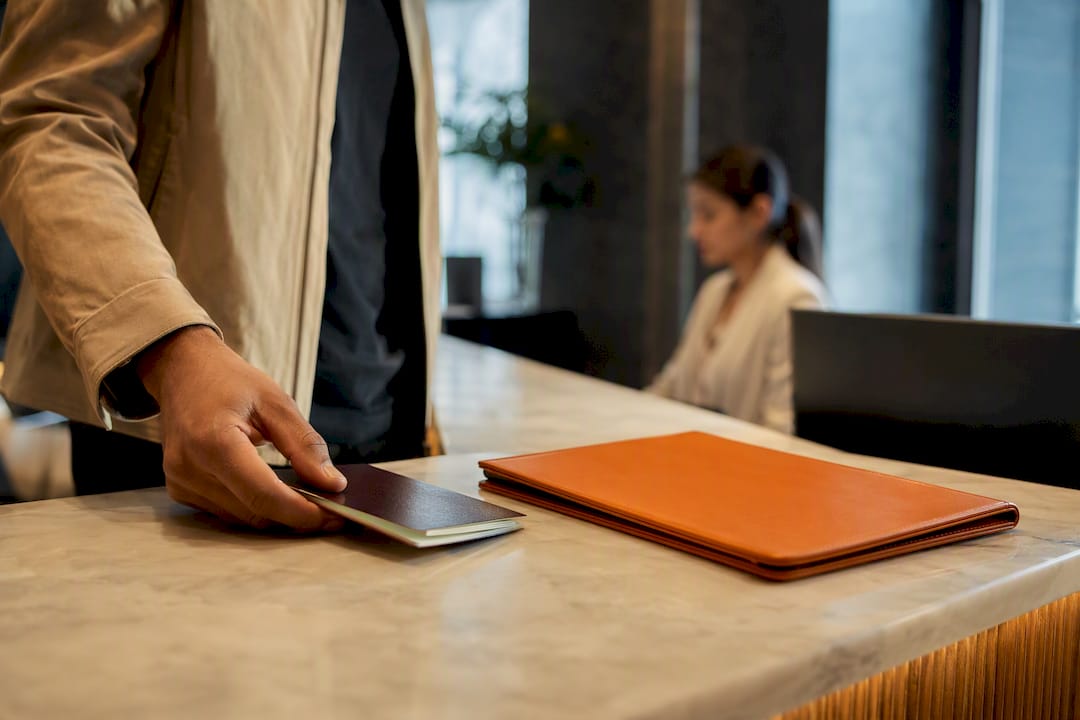
Yes, you can appeal a South Africa visa refusal in most cases, but the clock starts the moment you receive the rejection letter. You have 10 working days to secure a VFS Global booking and prepare written representations to the Director-General. Expect the process itself to take many months, so act on the deadline immediately, not the outcome.
TL;DR:
- Re-applying is usually faster and more effective when the visa refusal is due to fixable issues like missing documents or incorrect visa category selection.
- An appeal is appropriate if you believe the Department of Home Affairs made a legal or factual mistake, such as misinterpreting evidence or applying wrong criteria.
- Booking a VFS appointment immediately is crucial within the 10 working day deadline, and evidence of your booking can serve as a safety net if delays occur.
- Your appeal should include a detailed, standalone case with clear rebuttals, recent supporting documents, and a structured response aligned with each refusal reason.
- Most visa appeals take between 8 and 12 months to process, and legal counsel is recommended mainly when a legal dispute exists or your stay in South Africa is at risk.
Table of Contents
- Should you re-apply or lodge a formal visa appeal?
- How do you lodge a visa appeal through VFS Global?
- What documents go into your written representations?
- How do you write persuasive representations?
- What does the Immigration Act say about appeal levels?
- How long does a visa appeal actually take?
- What causes most visa refusals, and how do you fix them?
- When is it worth hiring an immigration attorney?
- Find an LPC-registered immigration attorney through Justibly
- Sources
- FAQ
Should you re-apply or lodge a formal visa appeal?
The choice between re-applying and lodging a formal appeal depends on why the Department of Home Affairs (DHA) rejected your application in the first place.
A fresh application makes sense when the refusal came down to something fixable, like a missing bank statement, an expired police clearance, or an incomplete form. Re-applying lets you correct the gap and start clean, without waiting on the Director-General or Minister to review anything. It's also usually the faster route if you're outside South Africa when the rejection lands.
A formal appeal is the right tool when you believe the DHA got something wrong, either in law or in fact. Maybe the officer misread evidence you already submitted, applied the wrong visa category's criteria, or ignored a document that was clearly in the file. In that scenario, re-applying just repeats the same argument to the same likely outcome.
Your current status matters too. If you're inside South Africa and your visa has lapsed, an appeal (lodged correctly and on time) can help preserve your legal standing while the review is pending, something a fresh application from scratch may not do as cleanly.
Quick guide to the decision:
- Missing or outdated documents → re-apply
- Wrong visa category selected initially → re-apply
- Officer misapplied the law or ignored submitted evidence → appeal
- You're already inside South Africa and need to protect your status → appeal
- You're abroad and speed matters more than principle → re-apply, per JLIA's guidance for applicants outside South Africa
How do you lodge a visa appeal through VFS Global?
South Africa outsources visa intake to VFS Global (Visa Facilitation Services), and appeals follow the same channel. You don't submit your appeal directly to a DHA office. You lodge it at the VFS visa facilitation centre that processed your original application, and VFS forwards the file to the Department of Home Affairs for review.
Here's the sequence to follow:
- Book a VFS appointment immediately. Don't wait to finish your documents first. Slots fill quickly, and your booking timestamp is what proves you acted within the 10 working day statutory window.
- Compile your appeal file while waiting for your slot: cover letter, written representations, and every supporting document (covered in the checklist below).
- Attend your VFS appointment and submit the physical file in person.
- Pay the applicable service fee at the counter.
- VFS forwards your appeal to the DHA for consideration by the Director-General.
Booking slots have been a genuine bottleneck. When VFS centers ran short of available appointments, the DHA issued Immigration Directive No. 13 of 2024, a temporary concession allowing applicants to secure the earliest available booking and submit proof of that booking attempt within the 10 working day window, even if the actual appointment fell later. If you hit the same problem, screenshot your booking confirmation the moment you make it and keep the email receipt. That proof is your safety net if anyone questions your timing later.
If you're applying from outside South Africa, the same VFS routing generally applies, though which international VFS centre handles your case depends on where your original application was lodged. Confirm this with your nearest South African visa facilitation office before assuming the process runs identically to a domestic appeal.
Pro Tip: Book your VFS slot before you've finished a single supporting document. A half-written appeal with a valid booking date beats a perfect appeal filed one day late.
What documents go into your written representations?
Your appeal file needs to read as a complete, standalone case, not a supplement to what you already sent. Assume the reviewing officer has no memory of your original application.
Build the file in this order:
- Cover letter stating clearly what you're asking for (reversal or modification of the decision) and why.
- Passport bio page and a copy of the rejection letter itself, so the reviewer can match your appeal to the correct case file.
- A complete copy of your original application, including every document you submitted the first time. Don't assume the DHA has an easy-to-access copy on hand.
- Targeted new or corrective evidence matched to each stated refusal ground, for example: recent bank statements and an employer letter for financial concerns, relationship correspondence and joint documentation for spousal visa disputes, or a fresh police clearance certificate if the original had expired.
- Certified copies of anything official, indexed as annexures (Annexure A, B, C) and referenced by name in your written representations.
Dates matter more than most applicants realize. A bank statement from 14 months ago won't persuade anyone that your financial position is currently sound. Pull fresh statements, fresh letters, fresh certificates wherever the refusal reason touches something time-sensitive. If any document needs translation or apostille certification, sort that out early. Justibly's guide on DIRCO's apostille process walks through booking and authentication timelines that often catch appellants off guard.
How do you write persuasive representations?
The single biggest mistake in weak appeals is simple disagreement dressed up as legal argument. Immigration practitioners consistently flag this: telling the DHA "I don't think this is fair" carries no legal weight. What moves a reviewing officer is a structured, evidence-backed rebuttal of the specific reason given for refusal.
Start your written representations with a short, direct request: state whether you're asking the Director-General to reverse the decision entirely or modify it, and cite the applicable point in the Immigration Act's section 8 process if you're arguing a procedural or legal error.
From there, structure the body around the DHA's stated reasons, not your own narrative. If the rejection letter lists three grounds, use three headings:
- Reason 1 (as stated by DHA) → Evidence and law that rebuts it
- Reason 2 → Evidence and law that rebuts it
- Reason 3 → Evidence and law that rebuts it
Under each heading, lead with the fact, then the document that proves it, then (where relevant) the legal point. Keep emotional language out entirely. Reviewing officers respond to verifiable, date-stamped facts, not frustration. Resubmitting the exact documents you already sent rarely helps either. The stronger move is new evidence or a clear explanation of exactly where the original decision went wrong.
Pro Tip: Write each rebuttal section as if a stranger with no context will read only that section and decide your case on it alone. If it doesn't stand on its own, it's not specific enough yet.
This is precisely the stage where a drafting error costs you months. An immigration attorney who's read hundreds of DHA rejection letters will spot the actual legal weakness in your case faster than you will on your own, and phrase your rebuttal in language the Director-General's office is used to seeing succeed.
What does the Immigration Act say about appeal levels?
South Africa's appeal process runs on a strict statutory clock set out in section 8 of the Immigration Act, 2002. Understanding the two levels matters because each has its own deadline and its own decision maker.
Section 8(4) gives an aggrieved applicant 10 working days from the date of the decision to apply to the Director-General for review or appeal. If the Director-General's decision remains unsatisfactory, section 8(6) allows a further application to the Minister, also within 10 working days of that decision.
The Director-General (or the Minister, at the second stage) can confirm the original refusal, reverse it outright, or modify it, for instance approving a shorter visa validity period than originally requested. The Immigration Regulations fill in the procedural detail behind the Act itself, including formatting and filing requirements worth checking before you submit.
How long does a visa appeal actually take?
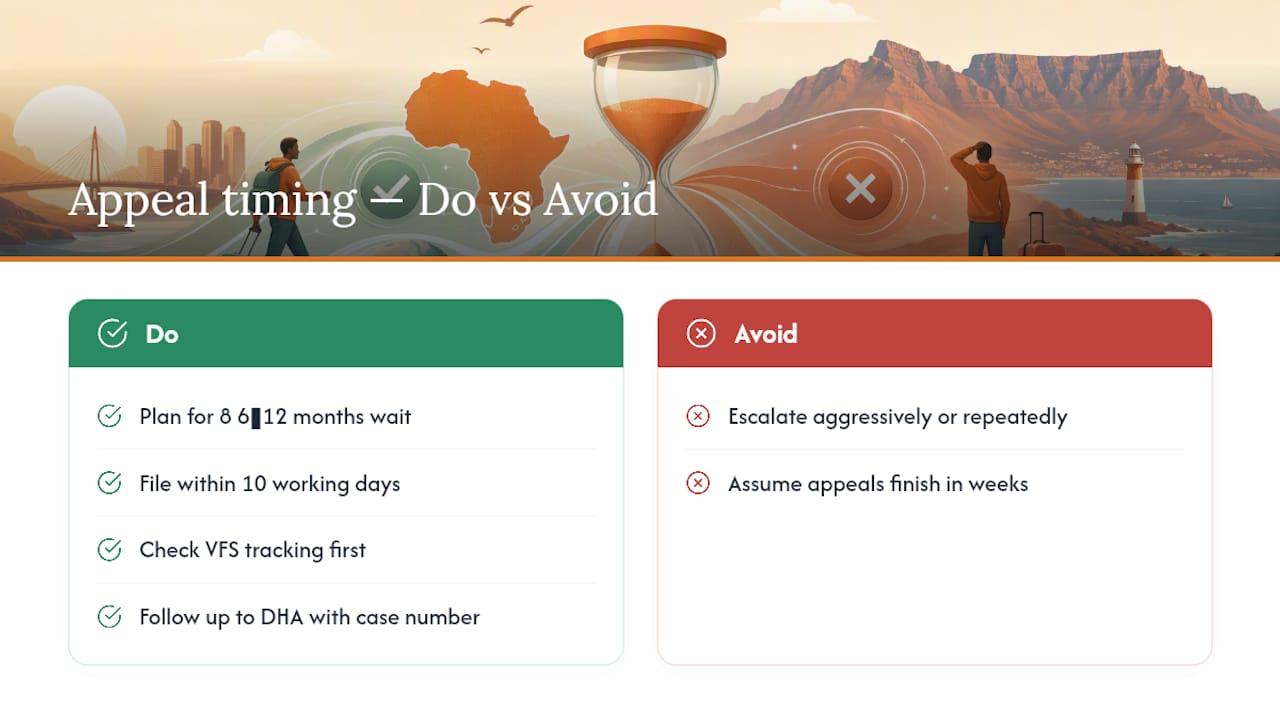
Plan for a wait measured in months, not weeks. Practitioner guides and immigration blogs consistently report that VFS-routed appeals commonly take 8 to 12 months, sometimes longer, before the Director-General's office issues a decision.
The backlog stems from a mix of factors: high appeal volumes relative to processing staff, the two-stage statutory review chain, and periodic VFS booking shortages like the one addressed by Immigration Directive No. 13 of 2024. None of that shortens your 10 working day filing window, though. That deadline is fixed regardless of how long the review afterward takes.
Once your appeal is lodged, check status through VFS's tracking channel first. If months pass with no movement and VFS has no update, a polite written follow up to the DHA referencing your case reference number is reasonable. Escalating aggressively or repeatedly rarely speeds anything up and can complicate your file.
What causes most visa refusals, and how do you fix them?
Refusal reasons tend to cluster into a handful of recurring categories, and each one calls for a different fix.
- Missing or inadequate documents. The DHA flagged something absent or insufficient, like a bank statement covering too short a period. Fix it with the exact document requested, dated as recently as possible.
- Wrong visa category. If you applied under the wrong category entirely, an appeal won't help. Re-apply under the correct one.
- Financial insufficiency. Bank statements showing consistent income over several months, plus an employer letter confirming salary and employment status, tend to carry more weight than a single snapshot balance.
- Disputed relationship evidence. For spousal or life partner visas, corroboration beyond a marriage certificate matters: joint lease agreements, shared bank accounts, communication records, and affidavits from people who know the relationship.
- Health or security concerns. Supply updated medical records or a formal explanation addressing the specific concern raised, ideally from a registered practitioner.
When is it worth hiring an immigration attorney?
The weakest appeals I've seen share one trait: they argue disagreement instead of building a case. Applicants write "this decision is unfair" without ever mapping the DHA's actual stated reason to a specific document or legal point. That's an easy fix once you see it, but most people don't see it until it's already cost them a decision.
Hire counsel when your case involves a genuine legal dispute (not just a paperwork gap), when you're up against a second refusal, or when your status inside South Africa is at risk while the appeal sits pending. Straightforward document omissions rarely need a lawyer. A misapplied legal test almost always does.
If you're weighing that decision, Justibly's directory of immigration law attorneys and free Q&A forum are worth a look before you commit to representation, or before you decide you can handle the appeal alone.
— Nkosi
Find an LPC-registered immigration attorney through Justibly
Justibly is the practical next step when a DIY appeal starts feeling out of your depth. You can filter Justibly's directory of LPC-registered attorneys by immigration law and by province, so you're not cold-calling law firms hoping one specializes in DHA appeals.
Not ready to commit to a full retainer yet? Post your situation on Justibly's free legal Q&A forum and get a response from a registered attorney before you spend a cent. It's a useful way to sanity check your written representations, or to find out fast whether your case genuinely needs legal drafting or whether you can handle the filing yourself. If you're based in Gauteng or the Western Cape, Justibly's Johannesburg law firm listings and Cape Town attorney listings are a direct starting point. Search your province now and get matched with someone who actually handles DHA appeals.
This article is general information, not a substitute for advice from a qualified lawyer. Consult a qualified legal professional about your own circumstances before acting on anything here.
Sources
- Immigration Act, 2002 (Department of Home Affairs)
- Immigration Directive No. 13 of 2024 (concession on appeal booking shortages)
- How to appeal a visa rejection in South Africa (Abroadscope)
FAQ
How long does it take for a visa appeal to be approved?
Most VFS-routed appeals take 8 to 12 months, sometimes longer, due to review volume and the two-stage statutory process.
What are valid reasons for appeal?
Valid grounds usually involve a legal or factual error, such as an officer misapplying visa criteria or ignoring evidence you already submitted, rather than simple missing paperwork, which is better handled by re-applying.
How much does a visa appeal cost?
VFS typically charges a standard service fee for appeal submissions, reported by practitioner guides in the region of R1,550, though you should confirm the current fee directly with VFS before your appointment.
Can I appeal if my visa is rejected?
Yes, section 8 of the Immigration Act gives you 10 working days to apply to the Director-General for review, provided you secure your VFS booking and file your written representations within that window.
Recommended
By the Justibly editorial team
Published
General legal information for South Africa, checked against the Legal Practice Act, the relevant court rules and the Legal Practice Council roll. It is not legal advice and does not create an attorney-client relationship. For advice on your situation, consult an admitted attorney.
How we research and review · How the Trust Score works · Report an error