What are transfer costs in South Africa really going to cost you?
Discover how transfer costs in South Africa can impact your property purchase. Learn the breakdown of fees and budget effectively today!
Published

If your purchase price sits at or below R1,210,000, you owe SARS nothing in transfer duty. Above that, duty climbs in stages to 13% on the portion over R13,310,000. Budget roughly 2 to 4% of the price for a low-value cash purchase, and 6 to 12% once you add a bond, a higher price bracket, and the full set of legal fees, according to cost breakdowns from RateWeb.
That range covers a specific list of once-off charges, not a vague estimate:
- Transfer duty (or VAT if you're buying from a VAT-registered developer)
- The transfer attorney's conveyancing fee, guided by the LSSA tariff
- A separate bond attorney fee if you're financing
- Deeds Office registration fees
- Disbursements: FICA checks, courier costs, rates clearance certificates
- The bank's loan initiation fee, capped under the National Credit Act
Pro Tip: Get a written quote from the conveyancer before you sign anything. The LSSA figures are guidelines, not fixed prices, and actual invoices shift with the complexity of the deal.
Key Takeaways
Transfer costs in South Africa depend on price bracket, financing choice, and whether VAT or transfer duty applies, and buyers who verify figures early avoid the mid-transfer cash crunch.
| Point | Details |
|---|---|
| Zero-duty threshold | Properties priced at or below R1,210,000 attract no SARS transfer duty. |
| Duty is bracketed | Only the portion of the price within each SARS band is taxed at that band's rate. |
| Cash due mid-transfer | Duty, legal fees, and disbursements are typically called for in weeks 4 to 10, in cash. |
| VAT can replace duty | Buying from a VAT-registered developer means VAT applies instead of transfer duty. |
| Verify fees early | Justibly's conveyancing directory helps you find an LPC-registered attorney and confirm a written quote before you commit. |
This article is general information, not a substitute for advice from a qualified financial advisor. Consult a qualified financial professional about your own circumstances before acting on anything here.
Table of Contents
- Worked examples: what you'd actually pay at four price points
- What are the current SARS transfer duty rates?
- Why do you get two separate legal bills?
- What other costs and delays should you plan for?
- Does VAT ever replace transfer duty on a property purchase?
- How should you budget and negotiate transfer costs?
- Sources
- FAQ
Worked examples: what you'd actually pay at four price points
Transfer duty is calculated in bands, not as one flat percentage on the full price. Here's how the math plays out using the SARS brackets effective from April 1, 2025.
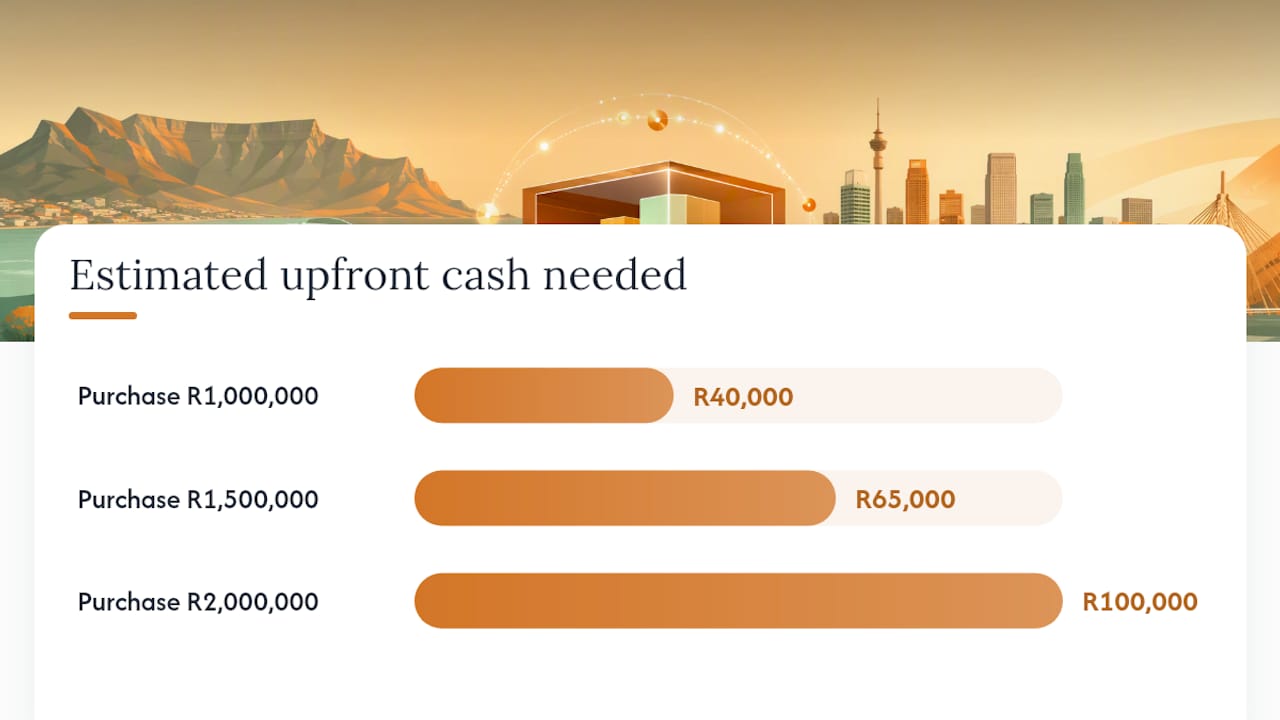
- R1,000,000 purchase. Below the R1,210,000 threshold, so transfer duty is R0. You'd still pay a conveyancing fee (roughly R25,370 excluding VAT under the LSSA guideline), plus Deeds Office fees and disbursements. Total cash need lands around R35,000 to R45,000.
- R1,500,000 purchase. Duty applies only to the amount above R1,210,000: 3% of R290,000 equals R8,700. Add a conveyancing fee in the R28,000 to R30,000 range plus disbursements, and you're looking at roughly R60,000 to R70,000 all in.
- R2,000,000 purchase. The amount above R1,663,800 falls into the next band: R13,614 plus 6% of R336,200, which comes to roughly R33,986 in duty. LSSA guideline fees near this price point sit around R35,620 excluding VAT. Combined with Deeds Office and bank charges, budget close to R100,000.
- R5,000,000 purchase. This falls into the band above R2,994,800 and attracts a transfer duty calculated as R106,784 plus 11% of the amount above R2,994,800. Legal and bank fees at this level typically raise the total cash required significantly.
Transfer duty, conveyancing fees, and Deeds Office charges must generally be paid in cash before registration. Bond initiation fees are the one cost banks often let you capitalise into the loan, per Mortgagecalculator, which eases the cash crunch but adds interest over the life of the loan.
To run these numbers yourself: find your price band on the SARS table, calculate duty on the portion above the band's floor, add the LSSA-guideline conveyancing fee for that price range, then layer in Deeds Office fees and disbursements.
What are the current SARS transfer duty rates?
The SARS transfer duty table, effective from April 1, 2025 and still current through 2026, works as a series of marginal bands rather than one rate applied to the whole price.
| Property value | Transfer duty rate |
|---|---|
| R0 to R1,210,000 | 0% |
| R1,210,001 to R1,663,800 | 3% of the value above R1,210,000 |
| R1,663,801 to R2,329,300 | R13,614 + 6% of the value above R1,663,800 |
| R2,329,301 to R2,994,800 | R53,544 + 8% of the value above R2,329,300 |
| R2,994,801 to R13,310,000 | R106,784 + 11% of the value above R2,994,800 |
| Above R13,310,000 | R1,241,456 + 13% of the value above R13,310,000 |
Each band only taxes the slice of the price that falls within it.
There's one major exception: if you buy from a VAT-registered developer, you pay VAT instead of transfer duty, not both.
- The buyer is legally responsible for paying transfer duty, not the seller.
- The conveyancer must pay SARS before the deed can be lodged for registration, so this cost lands early in the process, often weeks before you get the keys.
- Missing this payment window stalls the entire registration, which is why conveyancers call for these funds well ahead of the transfer date.
Why do you get two separate legal bills?
You'll typically deal with two different attorneys during a property purchase, and each bills separately. The transfer attorney (the conveyancer) is appointed by the seller and handles the deed transfer. The bond attorney is appointed by your bank to register the mortgage bond. Both fees are guided by the same LSSA tariff structure, which practitioners treat as a benchmark rather than a fixed law.
Example guideline figures, excluding VAT:
- R1,000,000 purchase: roughly R25,370 conveyancing fee
- R2,000,000 purchase: roughly R35,620 conveyancing fee
- Bond attorney fees generally track a similar (slightly lower) scale, plus a separate Deeds Office bond registration fee
Your bank also charges a loan initiation fee, capped under the National Credit Act at figures like R6,037.50 for many standard home loans, according to MortgageCalculator.co.za. Banks frequently offer to add this fee to your loan balance rather than requiring cash upfront.
Pro Tip: Ask early whether the bank plans to capitalise the initiation fee. It's a convenient bridge for tight cash flow, but it grows your loan and the interest you pay over time.
What other costs and delays should you plan for?
Beyond duty and legal fees, a handful of smaller charges add up fast:
- Rates clearance certificate from the municipality: varies by outstanding balance, often a few thousand rand
- FICA compliance checks: minor administrative cost, usually under R1,000
- Courier and document costs: typically a few hundred rand
- Deeds Office lodgement and registration fees: fixed by government schedule, generally R2,000 to R3,000 depending on price bracket
The cash calls tend to follow a predictable sequence:
- Offer accepted and bond granted. Little cash needed yet beyond a deposit if required.
- Mid-transfer, roughly weeks 4 to 10. Your conveyancer calls for transfer duty, legal fees, and disbursements, usually the single biggest cash demand in the whole process.
- Registration and final payout. Once SARS confirms payment and the Deeds Office registers the transfer, the bond pays out and ownership shifts.
Outstanding municipal rates or a missing compliance certificate are the most common causes of delay, and delays can mean extra interim interest on a bridging arrangement.
Pro Tip: Ask your conveyancer for the projected cash-call date the day you sign the offer. Knowing the exact week lets you move savings or sell an asset in time, instead of scrambling.
Does VAT ever replace transfer duty on a property purchase?
Yes. If you buy directly from a VAT-registered developer, the sale attracts 15% VAT instead of transfer duty, and developers usually build that VAT into the advertised price rather than adding it on top, according to The African Vestor.
This means a "no transfer duty" new-build listing isn't automatically cheaper than a comparable resale home. A R2,000,000 new unit with VAT baked in could carry a similar or higher all-in cost than a R2,000,000 resale home that pays roughly R33,986 in transfer duty plus legal fees.
- Confirm in writing whether the advertised price is VAT-inclusive before comparing it to a resale option.
- Your conveyancer should verify the seller's VAT-registration status as part of due diligence, since that status determines which tax regime applies.
How should you budget and negotiate transfer costs?
A short cash checklist keeps you from getting caught out:
- Confirm your total once-off cost estimate with the conveyancer within a week of signing the offer.
- Set aside the mid-transfer cash call amount (duty plus legal fees) in an accessible account, not tied up in a fixed deposit.
- Hold back a 10 to 15% buffer above your estimate for rates arrears or unexpected disbursements.
Negotiating the purchase price down to or below R1,210,000 delivers a double benefit: a lower headline price and zero transfer duty, since both move in your favour at once. It's worth pushing for, especially near that threshold. You can also ask the seller to contribute toward minor costs like the rates clearance certificate, though sellers rarely cover transfer duty itself since the buyer carries that liability by law.
Pro Tip: Capitalising the bank's initiation fee into your bond preserves cash now but adds interest for the full loan term. Treat it as a short-term bridge, not your default choice, if you can afford to pay it upfront.
A note on what actually trips buyers up
The biggest mistake isn't misunderstanding the SARS table. It's assuming transfer costs come out of the bond. They don't. Most of this money is due in cash, weeks before you get the keys, and that timing catches even experienced buyers off guard.

Verify your numbers with a real conveyancer early, not the week registration is meant to happen. Justibly's conveyancing directory lists LPC-registered attorneys by province, and the free Q&A forum is a fast way to check a specific cost question before it becomes a crisis.
Find a conveyancer who won't surprise you at the mid-transfer cash call
Justibly gives you a way to shortlist LPC-registered conveyancers before you're locked into whoever the seller happened to appoint. Every listing reflects verified LPC data, not a paid ranking, so you can compare attorneys on real standing rather than marketing spend.

If you're still working out whether your fee quote lines up with the LSSA guideline, or you just need a fast answer on who pays what and when, the free Q&A forum connects you with a registered attorney without booking a paid consultation first. When you're ready to move forward, search Justibly's property and conveyancing directory by province, get in touch with two or three attorneys, and ask each for a written quote before your transfer date locks in.
Sources
- Transfer Duty — SARS (rates effective 1 April 2025)
- Conveyancing fee guidelines 2025 — LSSA
- The real costs of buying a house in South Africa (RateWeb, 2026)
- Mortgagecalculator
FAQ
How do you calculate transfer duty in South Africa?
Find your price bracket on the SARS table, then apply that band's rate only to the portion of the price above the band's floor, adding any fixed amount the band specifies.
What are the SARS transfer duty rates for 2026?
Rates effective from April 1, 2025 remain current through 2026: 0% up to R1,210,000, then progressive bands rising to 13% on amounts above R13,310,000, per SARS.
Do I pay transfer duty on a new development?
No. If you buy from a VAT-registered developer, VAT applies instead of transfer duty, and that VAT is usually already included in the advertised price.
Who pays the conveyancing fee, buyer or seller?
The seller typically appoints the conveyancer, but the buyer pays the conveyancing fee in nearly all South African property transactions.
Can transfer costs be added to my home loan?
Transfer duty and legal fees generally must be paid in cash before registration, but banks often allow the loan initiation fee to be capitalised into the bond balance.
Recommended
By the Justibly editorial team
Published
General legal information for South Africa, checked against the Legal Practice Act, the relevant court rules and the Legal Practice Council roll. It is not legal advice and does not create an attorney-client relationship. For advice on your situation, consult an admitted attorney.
How we research and review · How the Trust Score works · Report an error