4 Tests Courts Use to Allow Self Defence in South Africa: case law
South Africa legal explainer: the four tests courts apply for self defence, what the Tuta case means, a short post incident checklist, and how to find LPC...
Published
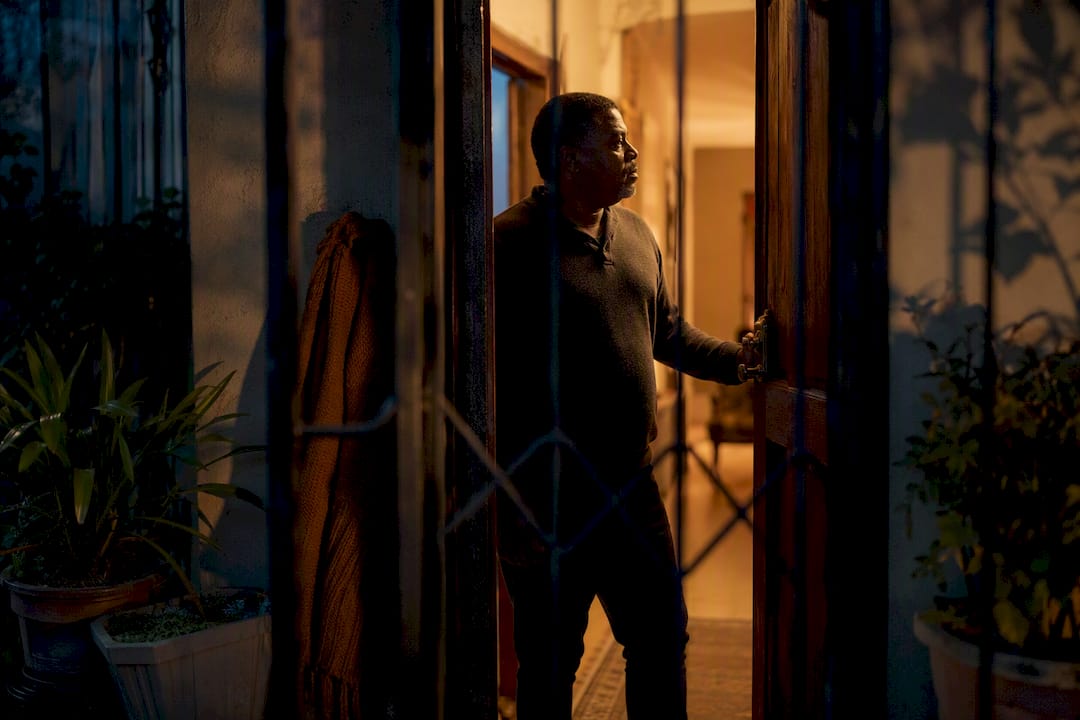
Yes, South African law recognises private defence, but only when four objective tests are met: necessity, proportionality, direction at the attacker, and imminence. Firearms and dangerous weapons carry separate licensing rules that operate independently of any self-defence claim. If you use force, report it to police immediately and speak to an attorney before you speak to anyone else.
TL;DR:
- Using force in self-defence requires meeting four criteria: an imminent unlawful attack, no reasonable alternatives, action aimed at the attacker, and proportional response.
- Possessing a firearm for self-defence demands a valid license; unlicensed guns significantly undermine your legal position and credibility.
- Carrying items like knives or pepper spray depends on context; visible weapons or carriers who suggest unlawful intent risk prosecution under the Dangerous Weapons Act.
- Home defence allows more force, but lethal measures are justified only against genuine threats; non-threatening intruders or fleeing suspects are unlikely to be legally justified.
- Civil claims for damages can follow a criminal self-defence case, with lower proof standards, meaning acquittal does not guarantee exemption from civil liability.
Table of Contents
- What is South Africa's self-defence law and how does it apply?
- Do you need a firearm licence to use a gun in self-defence?
- Can you carry pepper spray or a knife for self-defence in South Africa?
- Can you shoot an intruder in your home under South African law?
- Putative private defence and what Tuta v The State changed
- What to do immediately after using force in self-defence
- Self-defence in a criminal trial vs a civil claim
- Does it matter where you defend yourself: home, street, or workplace?
- Is there a duty to retreat after defending yourself in South Africa?
- How legal guidance changes the outcome of a self-defence case
- Get proper legal help before or after a self-defence incident
- Sources
- FAQ
What is South Africa's self-defence law and how does it apply?
Private defence is the legal term South African courts use for what most people call self-defence. It protects several legal interests, not just your life: your body, your property, your dignity, and your reputation can all justify a defensive response under the right conditions.
The courts apply four objective elements before excusing what would otherwise be a crime:
- An unlawful attack that has started or is genuinely imminent, not one you anticipate might happen someday.
- Necessity, meaning you had no reasonable alternative such as retreating or calling for help.
- Action directed at the attacker, not at bystanders or property belonging to someone uninvolved.
- Proportionality, meaning the force used matches the severity of the threat you faced.
Once you raise private defence, the burden shifts to the prosecution to disprove it beyond reasonable doubt. Judges weigh these elements against the actual facts of the incident, not what you believed in the moment, which is a distinction that trips up a lot of people who assume fear alone is enough. The SAFLII record on the constitutional right to self-defence confirms this is a recognised right, but one shaped entirely by the threat you actually faced.
Do you need a firearm licence to use a gun in self-defence?
Yes, and an unlicensed firearm damages your legal position even if the shooting itself was otherwise justified. The Firearms Control Act 60 of 2000 governs who may own a gun, how many, and for how long, and none of those rules bend just because the firearm was used defensively.
Section 13 licences cover handguns and shotguns for self-defence and are typically valid for a term defined by law before renewal. Section 14 covers restricted firearm categories with additional conditions attached, with licence validity terms specified by regulation. According to SAPS firearms guidance, the number of firearms you may hold under combined section 13 and section 15 licences is capped, and each licence type carries its own renewal and compliance obligations.
- Carrying or possessing a firearm without a valid licence is a standalone criminal offence, separate from anything you did with the weapon.
- An illegal firearm used in a defensive shooting rarely helps your case. Courts and prosecutors treat unlawful possession as a factor that undercuts the credibility of a private-defence claim.
- Where, when, and how you used the firearm all matter. A shot fired in a dark alley against an armed attacker reads very differently to a court than one fired at a fleeing, unarmed person.
Judges weighing a firearm-related private defence claim look hard at the threat level you actually faced versus the force you deployed, and licensing status is one of the first things a prosecutor checks.
Can you carry pepper spray or a knife for self-defence in South Africa?
Carrying an everyday item for protection can itself become a crime, depending entirely on the circumstances police or a court infer from how you carried it. The Dangerous Weapons Act 2013 makes it an offence to possess a "dangerous weapon" under circumstances that raise reasonable suspicion of unlawful intent, and the official promulgation notice defines that category broadly: any object other than a firearm capable of causing death or serious bodily harm. Conviction carries a fine or up to three years' imprisonment.
Here's how common items typically sit under that framework, based on practical guidance from PGPS Law's breakdown of legally carriable weapons:
- Pepper spray and stun guns generally don't require a licence and are widely carried without incident.
- Knives are legal to own but become a Dangerous Weapons Act problem the moment you carry one in a way, place, or time that suggests intent to harm rather than a lawful purpose like work or cooking.
- Batons and similar striking tools attract the same suspicion the moment they're visible in a public setting with no obvious lawful use.
The Act specifically excludes lawful activities like employment or sport, so a builder carrying a box cutter to a job site sits in different legal territory to someone carrying the same knife on a night out.
Pro Tip: Keep any self-defence item in a bag or holster rather than visibly on your person, and if you're ever questioned by police, calmly explain the lawful reason you're carrying it. How you present the item matters almost as much as what it is.
Can you shoot an intruder in your home under South African law?
Defending your own life takes priority over defending property, and that hierarchy shapes almost every home-intrusion case that reaches a South African court. Using lethal force purely to protect a television or a car, with no threat to a person, is rarely going to be judged lawful.
South Africa doesn't have a codified "castle doctrine" the way some other countries do, but the practical effect of private defence law inside your own home works similarly: courts recognise that you have fewer options to retreat from your own bedroom than you would on a public street, and that context feeds directly into the necessity and proportionality analysis. The ISS Crime Quarterly analysis on lawful use of firearms stresses that the decisive factors are whether the attack was current or genuinely imminent, and whether the response matched that threat.
- Likely lawful: confronting an armed intruder who has broken in at night and is advancing toward you or a family member.
- Likely unlawful: shooting someone fleeing your property with stolen goods and no continuing threat to anyone inside.
Measure proportionality by the threat in front of you, not by anger or the value of what's being stolen. A locked door and a phone call to police often protects you legally as much as any weapon does.
Putative private defence and what Tuta v The State changed
Putative private defence covers a different scenario: you honestly believed you were under attack, but that belief turned out to be mistaken. Private defence itself is judged objectively, meaning the attack had to genuinely exist and the response had to genuinely fit it. Putative private defence is judged subjectively, focused on what you actually believed at the time, even if a reasonable person would have seen the situation differently.
The Obiter analysis of Tuta v The State set out how the Constitutional Court separated these two tests and why that separation matters for intention.
An honest but mistaken belief removes intention for crimes that require it, but it does not automatically excuse negligence. Reasonableness becomes relevant to whether the mistake itself was negligent, not to whether the belief existed.
- If you genuinely believed you were being attacked, intention for a crime like murder may fall away.
- That same honest belief won't shield you from a lesser charge, such as culpable homicide, if a reasonable person in your position would have realised there was no real threat.
- Document what you saw, heard, and believed immediately after any incident. Contemporaneous accounts carry far more weight than a story reconstructed months later for trial.
What to do immediately after using force in self-defence
Your actions in the minutes and hours after a defensive incident shape your legal position almost as much as the incident itself.
- Call emergency services first if anyone is injured, then contact SAPS to report the incident.
- Preserve the scene. Don't move objects, weapons, or evidence unless safety genuinely requires it.
- Write down what happened while it's fresh, including times, positions, and what was said.
- When police arrive, you're entitled to legal representation. Answer factual questions honestly, but avoid volunteering speculation or admissions about your state of mind.
- Contact a criminal defence attorney before your next formal statement. Justibly's criminal defence network connects you with LPC-registered lawyers across all nine provinces who handle exactly this kind of case.
Pro Tip: Save the names and contact details of any witnesses on the spot. Witnesses move on quickly, and a phone number scribbled down that night is worth more than any recollection weeks later.
Self-defence in a criminal trial vs a civil claim
A single act of self-defence can trigger two completely separate legal processes, and winning one doesn't guarantee winning the other. The criminal case asks whether the state can prove you committed an offence beyond reasonable doubt, and it's here that private defence operates as a full defence: prove the four objective elements, and the unlawfulness of your conduct falls away entirely.
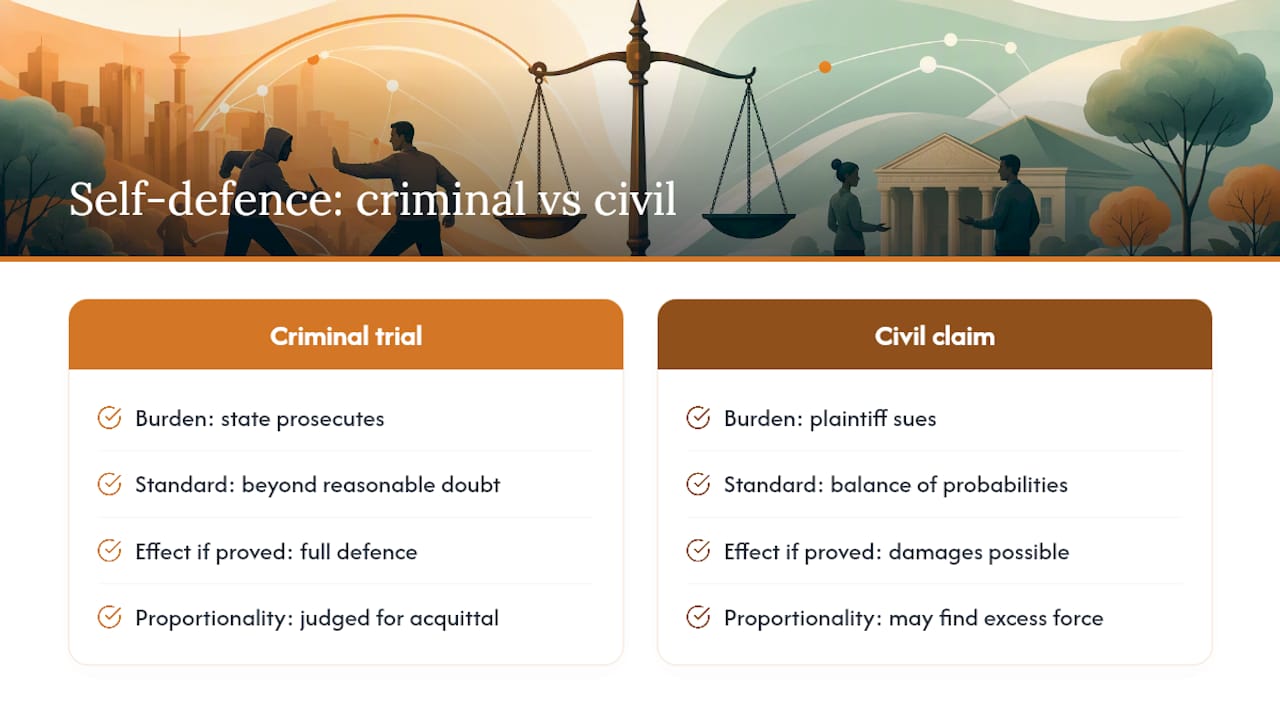
The civil side works differently. If the person you defended against, or their family, sues you for damages, the standard of proof drops to a balance of probabilities, which is a far easier bar for a plaintiff to clear. You can walk out of a criminal court acquitted and still face a civil claim for medical costs, lost income, or pain and suffering from the same incident.
Civil courts also weigh proportionality with their own lens. A criminal court might accept that your response was justified enough to avoid conviction, while a civil court finds you used marginally more force than necessary and awards partial damages on that basis. The two proceedings run on separate tracks, use different evidence rules, and can reach different conclusions from the same set of facts.
This is one of the more overlooked risks in the "I acted in self-defence" narrative. People assume an acquittal closes the book. It doesn't. If you've used force against someone, particularly where injuries were serious, expect the civil exposure to potentially outlast the criminal process by months or years, and budget for the possibility of a second legal fight even after the first one ends in your favour.
Does it matter where you defend yourself: home, street, or workplace?
Location changes the practical weight courts give to necessity and your ability to retreat, even though the same four-part legal test applies everywhere in South Africa.
On a public street, you generally have more escape routes available, and a court asking whether force was "necessary" will often ask why you didn't simply walk away, cross the road, or call for help before things escalated. That doesn't mean you must always retreat. If someone corners you or an attack is sudden and violent, the necessity element bends to reflect that you genuinely had no safer option, but the burden to show that tends to be higher in open public spaces where alternatives are more visible.
On your own private property, particularly inside your home, the calculation shifts. Courts recognise that you have fewer places to retreat to when someone has broken into your bedroom at 2am, and that context supports a more forceful response than the same threat might justify on a sidewalk. A workplace sits somewhere in between: you have some ability to retreat toward exits or colleagues, but you're not expected to abandon a position entirely if doing so exposes you to greater danger.
Public places also raise the risk of harming bystanders, which courts weigh heavily against you. A defensive response that endangers people who have nothing to do with the confrontation, whether through a wild swing with a weapon or a shot fired in a crowded space, can undo an otherwise reasonable private-defence argument regardless of how genuine the original threat was. The setting doesn't rewrite the law, but it absolutely reshapes how a court applies it.
Is there a duty to retreat after defending yourself in South Africa?
South African law doesn't impose a rigid legal duty to retreat before defending yourself, but your conduct during and immediately after the incident heavily influences how a court reads your intentions. Judges don't just look at the moment force was used. They examine the whole sequence: what led up to it, how you responded once the threat ended, and what you did in the minutes afterward.
Continuing to attack someone after they've stopped posing a threat, whether they've fled, been disarmed, or collapsed, is one of the clearest ways a lawful defensive act turns into a criminal one. The proportionality test doesn't freeze at the first blow; it applies continuously throughout the encounter. A court will ask whether force stopped being necessary at some identifiable point, and if you kept going past that point, the defence weakens fast.
Behaviour after the act matters just as much. Calling police immediately, cooperating with investigators, and showing visible distress or concern for the other person's welfare all support a genuine private-defence account. Fleeing the scene, discarding evidence, or coaching witnesses afterward tends to suggest the opposite, even when the original act might have been justified. Legal scholars writing on this point note that private defence exists to protect legal interests temporarily, standing in for the state's protection in an emergency, not to hand you ongoing licence to punish or pursue someone once the danger has passed. Your conduct in the aftermath is often the clearest evidence a court has of what you actually intended in the moment itself.
How legal guidance changes the outcome of a self-defence case
Every self-defence case turns on details that rarely look as clean in a police station as they did in the moment: who moved first, how close the attacker was, whether retreat was genuinely possible. Getting those details onto paper accurately and early, with someone who understands how the objective and subjective tests actually get argued in court, changes outcomes more than people expect.
Justibly's free Q&A connects you with LPC-registered attorneys who can flag issues, like an unlicensed firearm or a delayed police report, before they quietly undermine an otherwise valid defence. That network spans all nine provinces, and it exists precisely so nobody has to navigate a private-defence claim, or the aftermath of using force, without someone qualified in their corner.
— Nkosi
Get proper legal help before or after a self-defence incident
Justibly is the practical alternative to guessing your way through a legal system that punishes hesitation and rewards early, correct advice. Instead of searching blind for a criminal defence lawyer after an incident, you search Justibly's directory of LPC-registered attorneys by location and practice area, see real credentials with no pay-to-rank inflation, and reach out directly.
If you're unsure whether a past or upcoming situation crosses into criminal territory, Justibly's free Q&A forum lets you put the question to a registered attorney without cost or commitment. If you've already used force and need representation now, go straight to Justibly's criminal defence attorney directory and filter by your province to find counsel who can act immediately. For a broader look at how the law treats related situations, Justibly's legal guides cover the practical side of criminal processes in plain language. Start with whichever entry point matches where you are right now: asking a question, or needing a lawyer today.
This article is general information, not a substitute for advice from a qualified lawyer. Consult a qualified legal professional about your own circumstances before acting on anything here.
Sources
- Police promulgation: Dangerous Weapons Act, 2013 (media statement)
- SAPS firearms FAQ — licence categories and conditions
- Putative private defence in criminal law — Tuta v The State analysis (Obiter)
- When can I fire? (ISS Crime Quarterly No. 8)
- The Constitutional Right to Self-Defence 1995 (SAFLII)
FAQ
What are the four elements of self-defence in South Africa?
South African courts require an unlawful attack that has begun or is imminent, necessity, action directed at the attacker, and proportionality between the threat and the response.
Can I carry a knife for self-defence in South Africa?
Owning a knife is legal, but carrying one in circumstances that suggest unlawful intent, such as concealed in a public place with no lawful purpose, can trigger a Dangerous Weapons Act charge.
Can you carry a gun for self-defence in South Africa?
Yes, provided you hold a valid firearm licence under the Firearms Control Act; carrying an unlicensed firearm is a separate crime and weakens any private-defence claim.
How many guns can you own for self-defence in South Africa?
The number depends on licence category; section 13 and section 15 licences carry defined maximums, and each firearm requires its own valid, current licence under SAPS rules.
Does self-defence protect you from a civil lawsuit as well as criminal charges?
Not automatically. An acquittal in a criminal case doesn't prevent a civil claim for damages, which is judged on a lower standard of proof.
Recommended
By the Justibly editorial team
Published
General legal information for South Africa, checked against the Legal Practice Act, the relevant court rules and the Legal Practice Council roll. It is not legal advice and does not create an attorney-client relationship. For advice on your situation, consult an admitted attorney.
How we research and review · How the Trust Score works · Report an error