Win urgent interdicts in South Africa by meeting four tests
Practical checklist for preparing and filing an interdict application in South Africa. Learn the four urgency tests, how to order evidence, timelines, and...
Published
Yes, you can apply for an interdict in South Africa, and if your matter cannot wait for the ordinary court roll, you can apply for an urgent interdict under Uniform Rule 6(12). Getting one granted depends on meeting four cumulative legal requirements, not just on how serious your situation feels. Your first move should be a quick consultation with an attorney or a triage question through Justibly's Q&A forum to confirm whether your facts actually meet the urgency threshold before you start drafting.
TL;DR:
- An urgent interdict requires meeting four specific legal conditions, including clear rights and irreparable harm, and cannot be based on perceived urgency alone.
- Anti-dissipation interdicts demand concrete evidence of asset dissipation with intent to defeat a claim, not just financial instability.
- The appropriate court type depends on the matter's value and complexity, with the High Court used for broader or more complex orders and Magistrates' Court for local, lower-value cases.
- Proper paperwork discipline, clear supporting evidence, and a well-structured affidavit are crucial for success, especially when time is limited.
- Most applications fail due to vague relief, unexplained delays, or insufficient evidence proving urgency and specific harm.
Table of Contents
- Types of interdicts and when each is appropriate
- When to seek an urgent interdict and the limits of ex parte relief
- Step-by-step: preparing, filing and attending an interdict application
- How to structure the founding affidavit and present evidence effectively
- Choosing the right court: High Court or Magistrates' Court?
- How long does it take and what does it cost?
- Common pitfalls that get interdict applications refused
- How Justibly and this guide fit into your next step
- What people underestimate about interdict applications
- Sources
- FAQ
Types of interdicts and when each is appropriate
An interdict is a court order that forces someone to stop doing something, start doing something, or preserve assets until a dispute is resolved. Which type you need depends entirely on what you're trying to achieve.
- Prohibitory interdict: stops someone from doing something, such as a neighbour continuing unlawful building work or an ex-partner harassing you.
- Mandatory interdict: compels positive action, like ordering a landlord to restore your electricity supply or a company to hand over documents.
- Anti-dissipation interdict: freezes assets a respondent is likely to hide or sell before a judgment can be enforced against them.
- Interim interdict: temporary relief pending a final decision, granted on a lower threshold, a prima facie right rather than a fully proven one.
- Final interdict: permanent relief granted after a full hearing, requiring a clear right, actual or reasonably apprehended injury, and no other adequate remedy, as Polity's overview of interdicts as a legal remedy sets out.
Anti-dissipation orders deserve special caution. Courts don't grant them just because someone's finances look shaky. Following the Knox D'Arcy line of authority, you need a prima facie claim plus evidence the respondent is actually secreting or dissipating assets with intent to defeat your claim, a point the Supreme Court of Appeal reaffirmed in 2024.
When to seek an urgent interdict and the limits of ex parte relief
Courts don't treat "urgent" as a feeling. Under Uniform Rule 6(12), you need to satisfy four cumulative requirements before a judge will jump your matter ahead of the ordinary roll:
- A clear or prima facie right worth protecting, even if disputed.
- A well-grounded apprehension of irreparable harm if relief isn't granted immediately.
- No satisfactory alternative remedy, such as an ordinary damages claim later.
- The balance of convenience favouring you over the respondent, according to practitioner guidance on urgent interdict requirements.
Your affidavit must explain, in plain terms, why the standard court timetable would leave you without a real remedy. Courts are wary of self-created urgency, so unexplained delay between discovering the problem and filing your application can sink an otherwise strong case.
Ex parte applications, where you approach the court without notifying the other side, are reserved for genuine emergencies where notice would defeat the purpose of the order (tipping off someone about to move money offshore, for instance). Any order granted this way is strictly interim and comes with a return date, a fixed date when the respondent can appear and argue for it to be discharged.
Step-by-step: preparing, filing and attending an interdict application
Getting an interdict application right is mostly about sequencing and paperwork discipline. Here's the practical order attorneys follow:
- Decide on jurisdiction and seat. Confirm whether the Magistrates' Court or High Court has jurisdiction over your respondent and the relief you want.
- Draft your Notice of Motion. State the exact relief sought, and if urgent, include an abridged timetable for the respondent to respond.
- Attach a draft order. Give the judge a ready-to-sign document reflecting precisely what you're asking for, worded tightly enough that there's no ambiguity to argue over.
- Write the founding affidavit. Structure it under clear sub-headings that mirror the four-part test, referencing each supporting exhibit by number.
- Compile your exhibits. Gather contracts, WhatsApp screenshots, emails, valuations, and photographs, each dated where possible.
- Paginate and index everything. Courts expect a continuously numbered, indexed bundle, according to Barter McKellar's guide to interdicts in South Africa.
- Arrange service. The sheriff typically serves the papers on the respondent, with urgent matters sometimes served on shortened notice.
- Attend the hearing. On the urgent roll, expect either a provisional order with a return date, a final order, or a postponement with directions.
Pro Tip: Draft your order first, then write the affidavit to justify every line of it. Judges reward applications where the relief sought and the evidence line up cleanly, and it stops you asking for relief you can't actually support.
If you're also weighing whether interim maintenance or spousal relief fits your matter better than an interdict, Justibly's guide to Rule 43 applications for interim relief covers that adjacent process.
How to structure the founding affidavit and present evidence effectively
Your founding affidavit is the entire case, in most urgent matters, there's no oral evidence, just what's on paper. Structure it to make the judge's job easy:
- Background: who you are, who the respondent is, and the relationship between you.
- Rights relied on: the specific legal or contractual right you're protecting.
- Facts: a chronological account of what happened, cross-referenced to exhibits.
- Irreparable harm: exactly what you'll lose if the order isn't granted now.
- Alternatives considered: why damages later, or another remedy, won't fix the problem.
- Urgency: the timeline showing you acted promptly once the issue arose.
- Prayer for relief: the specific order you want, matching your draft order.
Label exhibits sequentially ("Annexure A", "Annexure B") and reference them inline rather than dumping them at the back unexplained. Dated screenshots, signed contracts, and short witness confirmatory affidavits carry more weight than a narrative account alone, a point GoLegal's overview of interdict requirements makes repeatedly.
Pro Tip: Address the balance of convenience head-on rather than waiting for the respondent to raise it. If granting your order costs the respondent little compared to the harm you'd suffer without it, say so explicitly, courts notice when applicants pre-empt the obvious counterargument.
Choosing the right court: High Court or Magistrates' Court?
Not every interdict needs the High Court, and choosing wrong wastes time and money.
- Magistrates' Court: often faster and cheaper for disputes within its jurisdictional limits, useful for localised, lower-value matters.
- High Court: necessary for relief with national effect, complex legal questions, or amounts exceeding Magistrates' Court limits.
- Urgent applications: Uniform Rule 6(12) governs High Court urgency specifically; Magistrates' Courts have their own, generally less developed, urgent procedures.
- Practical factors: check which court in your area actually runs a functioning urgent roll, some regional courts move faster than others depending on caseload.
How long does it take and what does it cost?
Genuinely urgent matters can reach a judge within hours to a couple of days, with firm guidance on urgent interdicts confirming same-day or next-day hearings in extreme cases. Standard, non-urgent applications typically run weeks to months before a final hearing.
Expect these cost components:
- Attorney fees for consultations, drafting, and court attendances.
- Court filing fees.
- Sheriff or process-server fees for service.
- Possible security for costs in some disputes.
Clear, concise affidavits and well-organised exhibits cut both time and cost, mainly by avoiding the back-and-forth that sloppy papers invite. Triaging your matter early through Justibly's Q&A before instructing an attorney can also save a consultation or two.
Common pitfalls that get interdict applications refused
Judges refuse interdicts for predictable reasons, most of them avoidable.
- Vague draft orders: relief that's ambiguous or impossible to enforce gets rejected outright.
- Thin urgency evidence: asserting urgency without a dated timeline of events undermines your own application.
- Unexplained delay: waiting weeks to act, then claiming urgency, is a classic red flag courts pick up immediately.
- No alternative remedy addressed: failing to explain why damages or another route won't work.
Pro Tip: Timestamp everything as it happens, not when you decide to sue. A screenshot dated the day of the incident is worth more to a judge than a beautifully written paragraph reconstructing it three weeks later.
How Justibly and this guide fit into your next step
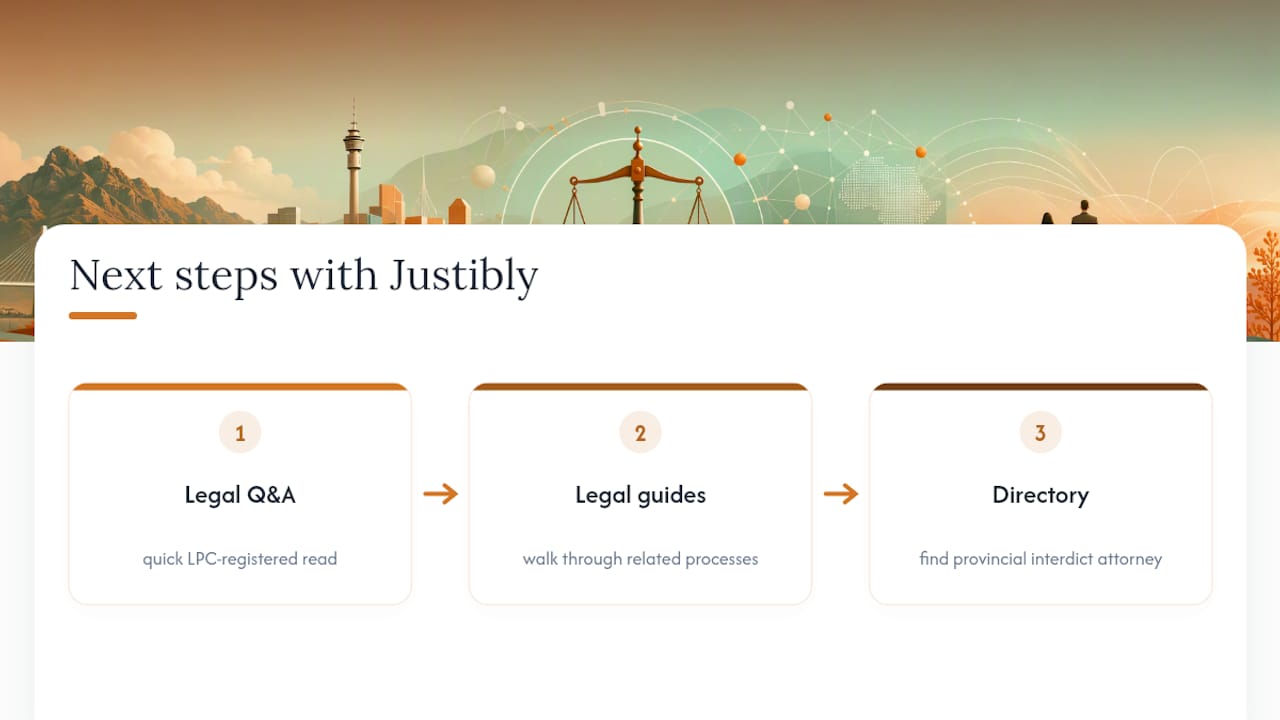
This checklist gives you the structure attorneys use, but an interdict application still needs a qualified eye on your specific facts. Justibly's Legal Q&A lets you get a quick read from an LPC-registered attorney on whether your matter meets the urgency threshold before you spend money on drafting. From there, Justibly's legal guides walk through related processes, and the full directory of practice areas helps you find an attorney who handles interdicts in your province.
What people underestimate about interdict applications
Most people treat an interdict as a formality, something you file when you're clearly in the right and the court simply agrees. That's not how it works, and the gap between that expectation and reality causes more failed applications than bad facts ever do.
The four-part test isn't a checklist you tick lightly; it's an argument you have to win on paper, often within days, with no chance to fix a weak affidavit once it's filed. I'd argue the single most underrated skill in this process isn't legal knowledge, it's document discipline. Attorneys who win urgent interdicts aren't necessarily the ones with the strongest facts. They're the ones who paginate cleanly, timestamp evidence obsessively, and write draft orders a judge can sign without editing.
There's also a quiet expectation gap around anti-dissipation interdicts specifically. Clients often assume that proving someone is spending or moving money is enough. Courts want intent, evidence the respondent is acting specifically to defeat a claim, not just living their life. That distinction has sunk more matrimonial and commercial disputes than any other single misunderstanding I've seen in this area.
The practical lesson: treat the affidavit as an argument to a skeptical reader, not a diary entry. Get a second set of eyes on it before it's filed, ideally someone who has actually stood on the urgent roll and watched a judge scan an affidavit for the gaps.
— Nkosi
This article is general information, not a substitute for advice from a qualified lawyer. Consult a qualified legal professional about your own circumstances before acting on anything here.
Sources
- ZASCA decision on anti-dissipation interdict (SAFLII)
- Urgent interdict requirements (Global Law Experts)
- Barter McKellar: A Complete Guide to Interdicts in South Africa
- How to apply for an urgent interdict (Burger Huyser Attorneys)
- Interdicts: court process, requirements and onus (GoLegal)
FAQ
How Much Does an Interdict Cost?
Costs vary by matter but typically include attorney fees for drafting and appearances, court filing fees, and sheriff service fees, with urgent applications often costing more due to compressed timelines and after-hours work.
What Are the Requirements of an Interdict?
A final interdict requires a clear right, actual or reasonably apprehended injury, and no satisfactory alternative remedy; an interim or urgent interdict needs a prima facie right, irreparable harm, no alternative remedy, and a favourable balance of convenience.
How Long Does a Court Interdict Take?
Genuinely urgent matters can be heard within hours to a few days, while standard, non-urgent interdict applications typically take weeks to months to reach a final hearing.
What Are the Three Types of Interdicts?
The three main types are prohibitory (stopping an action), mandatory (compelling an action), and anti-dissipation (freezing assets), and each can be sought on an interim or final basis depending on the urgency and evidence available.
Recommended
By the Justibly editorial team
Published
General legal information for South Africa, checked against the Legal Practice Act, the relevant court rules and the Legal Practice Council roll. It is not legal advice and does not create an attorney-client relationship. For advice on your situation, consult an admitted attorney.
How we research and review · How the Trust Score works · Report an error