A garnishee order in South Africa: what it means and what to do first
Learn what a garnishee order in South Africa entails and discover the first steps to take if you receive one. Protect your rights now.
Published

A garnishee order lets a creditor recover a debt by attaching money owed to you, while an emoluments attachment order (EAO) specifically targets your salary. Courts must authorise every EAO, and the law caps deductions at 25% of your basic salary. If you've been served, do this first:
- Ask your employer's payroll department for a copy of the order.
- Check the document for a valid court stamp and a case number.
- Confirm which magistrate's court issued it and whether the amount matches what you actually owe.
Key Takeaways
Judicial oversight caps every emoluments attachment order at 25% of basic salary, and most successful challenges hinge on procedural defects rather than disputing the debt itself.
| Point | Details |
|---|---|
| Know which order you have | EAOs attach salary under section 65J; garnishee orders under section 72 can attach bank funds too. |
| Verify before you panic | Check the court stamp, case number, signature, and sheriff's return before assuming the order is enforceable. |
| Respect the 25% cap | Deductions on basic salary, excluding allowances and bonuses, can't legally exceed a quarter of that figure. |
| Move within the notice period | File an intention to oppose within the 10-day window, or apply later to vary, suspend, or rescind. |
| Get matched with the right attorney | Justibly connects you to LPC-registered consumer and debt attorneys and offers a free Q&A for quick guidance. |
Statutes, forms, and guides worth keeping on hand
- Magistrates' Courts Act 32 of 1944, section 65J sets out the statutory basis for EAOs.
- Form J919 is the prescribed court form used in EAO proceedings.
- Vukuzenzele's explainer gives a public, plain-language checklist for verifying an order.
- De Rebus's analysis covers the history of EAO abuse and the safeguards introduced since.
This article is general information, not a substitute for advice from a qualified lawyer. Consult a qualified legal professional about your own circumstances before acting on anything here.
Table of Contents
- Garnishee order vs emoluments attachment order in South Africa
- How a garnishee order or EAO gets issued
- Checking whether the order served on you is valid
- The 25% cap and protections for you and your dependants
- How to oppose, vary, suspend or rescind an order
- What your employer must do once served
- When the order was unlawful: getting your money back
- Your first two weeks after being served: a practical checklist
- Sources
- FAQ
Garnishee order vs emoluments attachment order in South Africa
The two terms get used interchangeably, but they aren't quite the same thing. An emoluments attachment order is issued under section 65J of the Magistrates' Courts Act and attaches a portion of your salary directly through your employer. A garnishee order, issued under section 72, is broader. It can attach any debt owed to you, including money sitting in a bank account, not just wages.
- EAOs target salary and require your employer to deduct and pay over a fixed amount each pay cycle.
- Garnishee orders under section 72 reach other assets, such as funds a third party (like a bank) holds on your behalf.
- Both need court oversight. Following Constitutional Court litigation, EAOs can no longer be rubber-stamped by a clerk. A magistrate must be satisfied it's just and equitable before authorising one.
Knowing which order you're dealing with changes your defence strategy entirely, since the paperwork and grounds to challenge each differ.
How a garnishee order or EAO gets issued
The order should come from the magistrate's court in the district where you live or work, not wherever the creditor happens to prefer. That jurisdiction requirement is one of the first things worth checking.
The process typically runs like this:
- The creditor applies to court, often after obtaining a judgment against you or relying on your prior written consent to a specific instalment.
- A magistrate reviews the application and, for EAOs, must confirm the deduction is affordable and fair before authorising it.
- The sheriff of the court serves the order on your employer (and usually on you), attaching a return of service as proof.
- A properly issued order carries a case number, an official court stamp, and a signature from the clerk or magistrate.
Missing any of those elements is often the first sign something went wrong procedurally.
Checking whether the order served on you is valid
Before assuming the order is enforceable, run it through a short set of checks. Courts have set aside orders for exactly these kinds of defects.
Confirm there's a genuine court stamp and a case number that traces back to a real court file.
Verify the order was signed by a clerk or magistrate, not just typed and printed by the creditor's attorney.
Check that the sheriff actually served it, and that a return of service exists.
Make sure it was issued in the correct district, matching where you live or are employed.
Look for red flags: wrong ID or staff number, unsigned consent forms, or signs you agreed to deductions under pressure rather than freely.
Improperly obtained consent and defective service remain two of the most common weaknesses creditors' paperwork carries, according to academic analysis of EAO litigation. The Vukuzenzele government explainer offers a similar checklist for the public.
Pro Tip: Photograph or scan the order the moment you receive it, front and back, before anyone at payroll files it away. You'll need every stamp and reference number visible if you decide to challenge it later.
The 25% cap and protections for you and your dependants
The law caps EAO deductions at 25% of your basic salary, meaning your basic pay before allowances, bonuses, or overtime. That cap exists because Parliament amended section 65J after constitutional challenges forced Parliament to build in judicial oversight and affordability checks.

A magistrate must be satisfied that authorising the deduction is just and equitable, which means weighing whether you can still cover rent, groceries, and dependants' needs after the deduction. Where multiple EAOs exist against the same salary, they're aggregated. The combined total still can't exceed that 25% ceiling, according to Recording Law's explainer on current EAO rules.

How to oppose, vary, suspend or rescind an order
You have real legal room to push back, and the timing depends on where in the process you are.
Before an EAO gets authorised, you're typically given a 10-day notice period to file an intention to oppose. Use it. Grounds include disputing the debt amount, disputing that you ever consented, or arguing the deduction would leave you unable to support yourself or your dependants.
After authorisation, you can still apply to the magistrate's court to vary, suspend, or rescind the order. Common grounds include:
- The deduction exceeds what you can genuinely afford.
- The creditor calculated the outstanding balance incorrectly.
- The order was issued in the wrong jurisdiction or without proper court authorisation.
Build your case with documents, not just complaints:
- Recent payslips showing basic salary versus gross pay.
- Bank statements covering the last three months.
- Proof of prior payments already made toward the debt.
- A written household budget showing rent, groceries, school fees, and other fixed costs.
Pro Tip: Courts and clerks regularly accept applications from debtors who represent themselves, provided the affordability schedule and supporting payslips are clearly laid out. A messy application gets delayed; a clean one often gets heard fast.
What your employer must do once served
Once served, your employer becomes the garnishee and takes on specific legal duties, not just a payroll adjustment.
- Deductions may only start once the order is properly served, not before, and the employer can retain a small commission for administering it.
- The employer must send quarterly statements showing what's been deducted and paid over, and must stop deducting immediately if a court suspends or rescinds the order.
- If deductions continue after you've shown proof the order was stopped, keep every payslip and bank record. That paper trail becomes your evidence for a restitution claim.
When the order was unlawful: getting your money back
If an order turns out to be defective or unlawful, and money has already been deducted, you're not without a remedy.
- You can apply to court for restitution against the creditor, and in some cases against the employer, for wrongly deducted amounts plus costs.
- If your employer keeps deducting after being shown proof the order was suspended or rescinded, that's a separate legal problem the court can address through an urgent application.
- Interim relief is possible where hardship is severe, since magistrate's courts can list urgent matters on short notice.
- In rare cases involving forged consent or fraudulent paperwork, a complaint to the relevant regulatory or law enforcement body may also be warranted.
Your first two weeks after being served: a practical checklist
Move fast, but move with paper in hand.
- Request from payroll: the full order, proof of service, and your basic salary breakdown.
- Request from the creditor or their attorney: an up-to-date statement of the outstanding balance and any signed consent form they're relying on.
- Calculate your own affordability using a simple budget, comparing 25% of your basic salary against your actual fixed costs.
- Contact the clerk of the magistrate's court to confirm the case number is real and check filing deadlines for opposition.
- If you're unsure at any point, ask a quick question through Justibly's free legal Q&A before deciding your next move.
Pro Tip: Set calendar reminders for the notice period deadlines the moment you receive the order. Missing a 10-day opposition window is one of the most common, and most avoidable, mistakes debtors make.
When to bring in a lawyer, and how Justibly makes that easier
Get proper legal representation when the amount involved is large, when you suspect fraud or forged consent, or when a rescission application is heading to a contested hearing.
- Justibly's directory connects you with LPC-registered attorneys working in consumer and debt matters, searchable by your own province and district.
- Its free Q&A forum lets you get initial guidance from registered attorneys before booking anything formal.
- Bring your order, payslips, and any correspondence with the creditor to your first appointment.
What the paperwork usually reveals
Most of the orders that get successfully challenged fail on something procedural: a missing stamp, a jurisdiction mismatch, consent signed under pressure rather than freely given. Acting within the notice period, rather than after deductions have already eaten into three months of pay, is what separates a quick fix from a drawn-out court battle. Work through the checklist above, and if anything about your case feels uncertain, get a second opinion through Justibly's attorney network before the next pay cycle hits.
— Nkosi
Get matched with a debt attorney who knows this process
Justibly is the practical alternative to guessing your way through a magistrate's court application alone. Instead of trawling generic legal articles or hoping a call centre attorney returns your call, you search a directory of over 44,351 LPC-registered attorneys by practice area and province, see genuine LPC standing with no pay-to-rank listings inflating anyone's position, and ask a free question through the Q&A forum while you decide your next step.
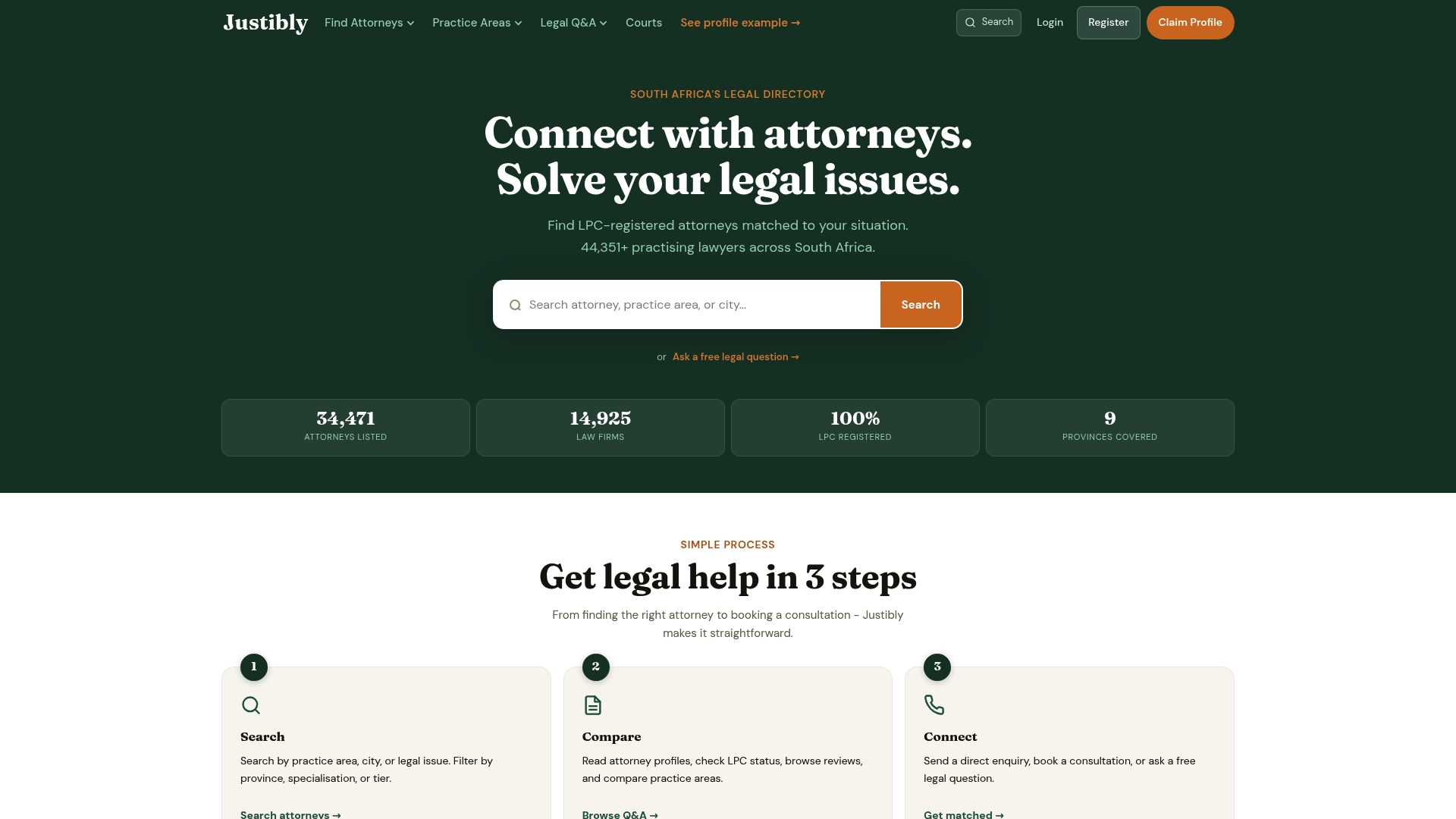
If your situation involves a disputed EAO or a garnishee order you believe was wrongly issued, find a consumer and debt attorney near you and book a consultation this week, before your next deduction goes through.
Sources
- Magistrates' Courts Act 32 of 1944 – section 65J (Acts Online)
- Repository
- Vukuzenzele – Garnishee orders: what you need to know
- De Rebus – 'Separating the baby and the bath water' (garnishee and EAOs)
FAQ
What are the legal requirements for a garnishee order?
A magistrate must authorise it, service must go through the sheriff of the court, and for EAOs the deduction can't exceed 25% of your basic salary while still leaving you able to support yourself and dependants.
How do I stop a garnishee order?
File an intention to oppose within the notice period before authorisation, or apply to the magistrate's court afterward to vary, suspend, or rescind it using payslips, bank statements, and a household budget as evidence.
What are the downsides of a garnishee order?
Beyond the reduced take-home pay, a garnishee order can strain your relationship with your employer's payroll department and, if mishandled by the employer, lead to disputes over incorrect or continued deductions after a court has stopped the order.
Are garnishee orders still valid and enforceable in South Africa?
Yes, they remain fully valid and enforceable, but Constitutional Court litigation now requires judicial oversight for EAOs specifically, meaning a court, not just a clerk, must authorise them before they take effect.
Recommended
By the Justibly editorial team
Published
General legal information for South Africa, checked against the Legal Practice Act, the relevant court rules and the Legal Practice Council roll. It is not legal advice and does not create an attorney-client relationship. For advice on your situation, consult an admitted attorney.
How we research and review · How the Trust Score works · Report an error