Facing Arrest in South Africa? Criminal Law, LPC Lawyers on Justibly
Practical criminal law help in South Africa: know your rights from arrest to appeal and find LPC verified lawyers through Justibly's directory and free Q&A.
Published

Criminal law defines which acts count as crimes and sets out the rights every accused person holds against the power of the state, chief among them the right to a fair trial and legal representation. In South Africa, those rights sit in the Constitution and get enforced through statutes like the Criminal Procedure Act. If you or someone you know has been arrested or charged, the priority is simple: know your rights, say little without a lawyer present, and get proper legal advice fast.
TL;DR:
- Most criminal offences require proving both the physical act (actus reus) and the intent or negligence behind it (mens rea); missing either element can defeat the case.
- The right to legal aid in South Africa applies when a person cannot afford private counsel and the case is serious enough to warrant state-funded representation.
- Bail decisions depend on factors like flight risk, danger to witnesses, and prior record, with bail often refused for serious offences or flight concerns.
- Sentencing options include fines, community-based sentences, or imprisonment, with statutory minimums applying to certain crimes but sentencing still subject to court discretion.
- An appeal must be filed within strict deadlines and challenges legal or factual errors without a new trial, making prompt legal consultation vital after sentencing.
Table of Contents
- What does criminal law actually cover?
- What rights do arrested and accused people have?
- How does the criminal process work from arrest to trial?
- How does the Child Justice Act treat children differently?
- What offences exist and what must be proved?
- What happens at sentencing?
- How do you find a criminal defence attorney and legal aid?
- Does a criminal record follow you forever?
- What is the appeal process after a conviction?
- How is criminal law different from civil law?
- Balancing rights and public safety
- Find a criminal defence attorney through Justibly
- Sources
- FAQ
What does criminal law actually cover?
Criminal law exists to punish conduct that harms society and to protect the public through deterrence, rehabilitation, and, in serious cases, incapacitation. It differs from most legal systems people first learn about because the state, not a private party, brings the case.
Two principles anchor everything else. The first is legality: nullum crimen sine lege, meaning nobody can be convicted for an act that wasn't a crime when they committed it. This stops the state from inventing new offences retroactively to target someone after the fact.
The second is liability itself, built from two elements. Actus reus is the guilty act, the physical conduct. Mens rea is the guilty mind, the intent or negligence behind it. Taking a bicycle you genuinely believed was yours lacks mens rea; taking one you know belongs to a neighbor does not. Courts have to establish both before a conviction can stand, and criminal law principles in South Africa rest heavily on this distinction.
Four sources shape South African criminal law:
- The Constitution, which overrides any conflicting statute
- Statutes like the Criminal Procedure Act and the Child Justice Act
- Common law, inherited from Roman Dutch legal tradition
- Case law, where higher courts interpret and refine the rules
Pro Tip: If you're trying to understand a specific charge, look for the actual elements the prosecution must prove. Most defence strategy starts by attacking one missing element, not the whole case.
What rights do arrested and accused people have?
Section 35 of the Constitution is the single most important legal text for anyone facing criminal charges in South Africa. It guarantees that every accused person has the right to a fair trial, including being told the charge in a language they understand, access to legal representation, and the right to challenge evidence brought against them.
Two of those rights deserve special attention. The right to remain silent means nothing you refuse to say can be held against you. The presumption of innocence means the state carries the full burden of proof, not you.
Here's what protects you at each stage:
- At arrest — you must be told why you're being arrested and informed of your right to a lawyer.
- At the police station — you can request legal counsel before answering substantive questions.
- At first court appearance — you can ask for a postponement to secure representation.
- Throughout the process — you can request state-funded legal aid if you cannot afford a private attorney and the matter is serious enough that going without counsel would cause substantial injustice.
Legal Aid South Africa applies a means and merits test for state-funded representation. If you qualify, ask the presiding officer or the court's legal aid office directly at your first appearance.
Pro Tip: Never volunteer details "to clear things up" before a lawyer has seen the charge sheet. Investigators cannot use silence against you, but they can and do use loose talk.
How does the criminal process work from arrest to trial?
An arrest lets police search you, seize items connected to the offence, and take you into custody. The Criminal Procedure Act governs these powers, and search, seizure, and arrest procedures have specific limits designed to stop arbitrary detention.
Not every case starts with a physical arrest. Prosecutors have three routes to get you before a court:
- Summons — a written notice telling you to appear on a set date, used for less serious matters
- Written notice/warning — an informal instruction to appear, common for minor offences
- Arrest — physical detention, reserved for more serious or urgent cases
Once arrested, you must ordinarily be brought before a court promptly. The timing can extend when the arrest occurs close to a weekend or public holiday, as courts do not always sit, so the practical wait may be longer than expected.
Bail exists to balance your liberty against the risk you'll flee or interfere with the case. Courts weigh factors like the seriousness of the charge, your ties to the community, and any previous record. Common reasons for refusal include a real flight risk, danger to witnesses, or a history of skipping court dates. You or your attorney can apply for bail at the first appearance, and for more serious schedule offences, a formal bail application with evidence may be required.
The trial itself moves through recognisable stages:
- Plea (guilty, not guilty, or no plea entered pending representation)
- Trial, where the state presents evidence and the defence responds
- Verdict
- Sentencing, if convicted
- Appeal, if either side contests the outcome
Magistrates generally won't push an accused person to plead in serious matters until a lawyer is present, precisely because the plea locks in so much of what follows.
How does the Child Justice Act treat children differently?
Children accused of crimes go through a separate system built around rehabilitation rather than punishment. The Child Justice Act 75 of 2008 sets the age of criminal capacity, and children below that threshold cannot be prosecuted at all; older children face a process weighted toward diversion.
For most children, the case starts with a preliminary inquiry, an informal, court-based session held within 48 hours of arrest wherever feasible. This inquiry decides whether the matter can be diverted away from formal prosecution entirely.
Diversion options include:
- Community service or supervised programmes
- Compulsory school attendance orders
- Victim offender mediation
- Counselling or family group conferencing
A probation officer must assess the child before the inquiry, and a parent, guardian, or appropriate adult should attend alongside legal representation. Restorative justice for children isn't leniency dressed up in softer language. It's a structured accountability process that pulls in victims, families, and community members, and it often produces a more demanding outcome than a simple caution would.
Pro Tip: If a child in your care is arrested, contact a probation officer or legal aid immediately. The 48 hour clock for the preliminary inquiry starts running fast, and missing that window can push the case toward formal court proceedings.
What offences exist and what must be proved?
Charges generally fall into a handful of broad categories, each carrying its own required elements:
- Property offences — theft, burglary, fraud, malicious damage to property
- Violent offences — assault, robbery, murder, culpable homicide
- Sexual offences — rape and related crimes under dedicated legislation
- Inchoate offences — attempt, conspiracy, incitement, where the completed crime never happened
Whatever the category, the state must prove every element beyond reasonable doubt. Miss one element and the charge collapses, regardless of how the rest of the evidence looks.
Take assault: the state must show both the physical act (actus reus) and the intent to cause harm (mens rea). A genuine accident, proper self-defence, or a reasonable mistake of fact can all defeat the mens rea element even where the act itself is undisputed. Insanity operates differently, arguing the accused lacked the capacity to appreciate wrongfulness at all.
A small category of strict-liability offences, mostly regulatory (certain traffic and licensing violations), doesn't require proof of intent at all. That's exactly why the usual defences matter so much elsewhere: they're often the only route to challenging a charge once the physical act itself is not in dispute.
What happens at sentencing?
Sentencing balances four goals: punishment, deterrence, rehabilitation, and public protection. Courts weigh the crime's seriousness, the offender's circumstances, and the harm caused before landing on an outcome.
Common sentences include:
- Fines
- Suspended or conditional sentences
- Correctional supervision (community-based)
- Direct imprisonment
Certain offences carry statutory minimum sentences, but courts retain discretion to deviate where strict application would produce an unjust result. The South African Law Commission's Project 101 report specifically flagged provisions in the Criminal Procedure Act that raise constitutional tension with the Bill of Rights, a reminder that even settled statutory rules face ongoing scrutiny.
Restorative justice increasingly supplements formal sentencing for both adults and children, focused on repairing harm to victims rather than pure punishment. A convicted person can appeal both the conviction and the sentence, provided proper grounds and timelines are met.
How do you find a criminal defence attorney and legal aid?
Contact a lawyer the moment you're arrested, or ideally before you answer any substantive questions. Bring whatever documentation you have: the charge sheet, arrest details, dates, and names of any officers involved.
Before hiring anyone, verify their standing:
- Confirm the attorney is registered with the Legal Practice Council (LPC), which regulates all practising attorneys in South Africa.
- Ask specifically about criminal defence experience, not general practice history.
- Request an estimate of costs and likely timelines before signing anything.
- If you can't afford private counsel, ask the court about state-funded legal aid, which applies where going without representation would cause substantial injustice.
Justibly's criminal defence directory lists attorneys by practice area with LPC status attached, so you can check registration before you ever pick up the phone. If your question is smaller and doesn't need a full consultation yet, the site's free Q&A forum connects you with registered attorneys for quick clarification.
Pro Tip: Write down everything you remember about the arrest as soon as possible, times, names, what was said. Memory fades fast, and your attorney will need those details.
Does a criminal record follow you forever?
A criminal record can restrict employment, travel, and even housing applications for years after a case closes, since many South African employers run background checks as standard practice. That reach often surprises people who assume a minor conviction stays quietly in the past.
Expungement offers a legal route to have certain records removed from the National Register for Sex Offenders and criminal record databases, but it isn't automatic and it isn't available for everything. Generally, expungement applies to specific categories: certain minor offences after a set waiting period with no reoffending, and cases where the sentence didn't include direct imprisonment beyond a defined threshold.
The application goes through the Department of Justice and Constitutional Development, not the court that handled the original case. You'll typically need your case number, proof of sentence completion, and confirmation of a clean record since. Processing isn't instant, and applying too early or with incomplete documentation is a common reason applications stall.
If your livelihood or immigration status depends on a clean record, don't wait for a job application to force the issue. Speak to an attorney about whether your specific conviction qualifies before assuming it does or doesn't.
What is the appeal process after a conviction?
An appeal challenges the conviction, the sentence, or both, on the basis that the trial court made a legal or factual error. It is not a retrial. No new witnesses take the stand and no fresh evidence gets introduced except in narrow, exceptional circumstances.
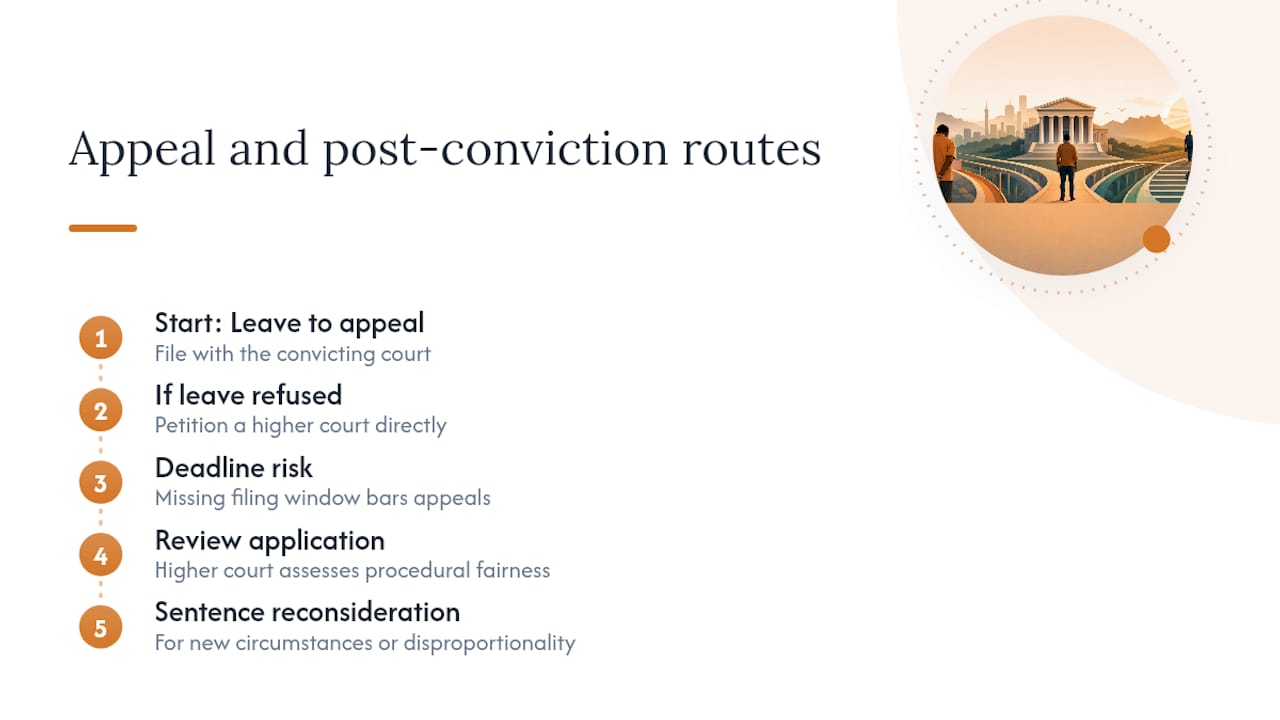
The process generally starts with an application for leave to appeal, filed with the same court that convicted you, within a set period after sentencing. If leave is refused, you can petition a higher court directly. Missing the filing window is one of the most common ways a valid appeal gets lost before it's ever heard.
Beyond appeal, post-conviction remedies include review applications, where a higher court examines whether the original proceedings were procedurally fair rather than whether the verdict itself was correct. This matters most when the complaint is about how the trial was conducted, not what the evidence showed.
Sentence reconsideration is also possible in specific circumstances, particularly where new circumstances arise or where a minimum sentence provision produced a result a court later finds disproportionate. None of these routes are guaranteed to succeed, and all of them run on strict deadlines, which is exactly why speaking to an attorney immediately after sentencing, rather than months later, matters so much.
How is criminal law different from civil law?
Criminal law and civil law answer two different questions. Criminal law asks whether someone broke a rule society enforces through the state; civil law asks whether one party owes another a remedy for harm between them.
The differences show up at every stage:
- Who brings the case — the state prosecutes criminal matters; a private party (or company) sues in civil matters.
- The standard of proof — criminal cases require proof beyond reasonable doubt; civil cases only need proof on a balance of probabilities, a much lower bar.
- The outcome — a criminal conviction can mean imprisonment, a fine payable to the state, or a criminal record; a civil judgment usually means paying damages or complying with a court order.
- The label — criminal defendants are "accused"; civil defendants are simply "the defendant," with no accusation of wrongdoing against society itself.
One act can trigger both processes at once. A driver who causes a serious accident might face a criminal charge for reckless driving and a separate civil claim from the injured party for damages, run in entirely different courts with entirely different standards of proof.
Balancing rights and public safety
Criminal law only works when both sides of the scale get real weight, the accused person's rights and the public's need for safety. I've found the biggest gap isn't in the law itself but in how few people actually assert the rights they already have. Section 35 exists whether you invoke it or not, but silence and a lawyer in the room protect you far more than either one alone.
If you're facing charges or supporting someone who is, don't wait to get advice. Use a directory that verifies credentials, ask direct questions, and move early.
— Nkosi
Find a criminal defence attorney through Justibly
The directory helps you find verified criminal defence attorneys by displaying attorney registration status based on LPC data, without pay-to-rank shortcuts. That matters most in criminal matters, where the gap between a properly registered attorney and an unverified one can decide how your case actually goes.

The process is three steps. Search the criminal law practice directory by location and speciality, check the attorney's LPC status directly on their profile, then contact them or post a quick question first through the free Q&A forum if you need clarity before committing to a consultation. If your matter overlaps with another area, family law during a related dispute, for instance, the full practice directory covers that too.
Start by searching Justibly's criminal defence attorney listings for your province and get in touch with a verified attorney today.
This article is general information, not a substitute for advice from a qualified lawyer. Consult a qualified legal professional about your own circumstances before acting on anything here.
Sources
- Constitution of the Republic of South Africa, Chapter 2: Bill of Rights
- Criminal Procedure Act 51 of 1977 (consolidated)
FAQ
What is the definition of criminal law?
Criminal law is the body of rules that defines which acts are offences against the state and sets the procedures and rights that apply when someone is accused of one, including the right to a fair trial and legal representation.
What are four types of crime?
Common categories include property offences (theft, fraud), violent offences (assault, robbery), sexual offences, and inchoate offences like attempt or conspiracy, each requiring the state to prove specific elements beyond reasonable doubt.
Where can I study criminal law in South Africa?
Criminal law is taught as a core module within LLB degrees at South African universities, and practising attorneys must also register with the Legal Practice Council after completing their required practical training.
How do I know if a criminal defence attorney is properly registered?
Check that the attorney holds current LPC registration before engaging them. Justibly's criminal defence directory displays verified LPC status on every listed profile.
Can I get a lawyer for free if I'm charged with a crime?
State-funded legal aid is available where going without a lawyer would cause substantial injustice, subject to a means and merits assessment applied at your first court appearance.
Recommended
By the Justibly editorial team
Published
General legal information for South Africa, checked against the Legal Practice Act, the relevant court rules and the Legal Practice Council roll. It is not legal advice and does not create an attorney-client relationship. For advice on your situation, consult an admitted attorney.
How we research and review · How the Trust Score works · Report an error