Get a Court Copy First: 5 Steps to a Divorce Decree in South Africa
Treat the decree as a court document. Follow five steps to get a certified divorce decree in South Africa and avoid registry or archive delays.
Published

A divorce decree is the court order that legally ends a marriage in South Africa, recording the date, the presiding court, and how assets, custody, and maintenance were settled. It is not something Home Affairs hands out. To get a certified copy, contact the Registrar of the High Court or the Clerk of the Magistrate's Court that granted your divorce, quoting your case number and full names so the registry can pull the correct file.
TL;DR:
- Most requests for certified copies require knowing the specific court that granted the divorce, as there is no nationwide online portal for direct downloads.
- Retrieving older or archived files may take several weeks, especially if they have been transferred out of active court storage or if the case details are incomplete.
- A certified copy often suffices for overseas authentication, but it must be followed by an apostille or legalisation to be accepted internationally.
- Courts typically accept requests in person, but contacting the registry beforehand can speed up the process and reduce in-person waiting time.
- Disputes, contested asset divisions, or missing files should involve LPC-registered family attorneys, who can expedite formal archive requests and overseas legalisation.
Table of Contents
- What's actually in a divorce decree (and why it isn't the same as a Home Affairs update)
- When you'll actually need a certified copy
- How to request a certified copy or replacement in South Africa
- What if the original file is missing?
- Getting your decree authenticated for use overseas
- How long it takes and what it costs
- Finding an LPC-registered family law attorney when you need one
- How to read what your decree actually says
- What the decree legally changes once it's granted
- Provisional vs final decrees: what's the real difference
- Challenging or appealing a divorce decree
- Why a decree request gets delayed or rejected
- The gap between what people expect and how this process actually works
- Sources
- FAQ
What's actually in a divorce decree (and why it isn't the same as a Home Affairs update)
The decree is a court judgment, and it reads like one. It records the date of the order, the court that granted it, and the terms of the settlement folded into the ruling: how the estate was divided, who has custody of any children, maintenance obligations, and whether either party's surname reverts.
A few things people mix up constantly:
- The decree is the legally binding court order. It's what proves the marriage ended.
- The settlement agreement is the negotiated contract between spouses that the court incorporates into the decree, effectively giving it legal teeth.
- Home Affairs status is just an administrative update. Once a court grants the decree, Home Affairs adjusts the National Population Register to show you as divorced, but it never issues the decree itself.
The court that issued yours will be either a High Court or a Regional Magistrate's Court, depending on where the matter was heard.
When you'll actually need a certified copy
Most people don't think about their decree again until an institution demands it. That moment tends to arrive without warning.
- Remarrying: your new marriage officer or antenuptial contract attorney will want proof the last marriage is legally dissolved.
- Pension funds and insurance claims: administrators typically require the decree to process a payout or update a beneficiary.
- SARS, property transfers, and deceased estates: conveyancers and estate executors often need the full decree, not just a summary.
- Immigration and visa applications: foreign authorities frequently ask for a certified copy, sometimes with additional authentication.
- Proving custody or maintenance terms: schools, banks, or even a new employer's HR department may ask for evidence of what was ordered.
How to request a certified copy or replacement in South Africa
There's no national online portal where you type in your name and download your decree. Every request goes through the specific court that finalised your divorce, which means step one is figuring out exactly which registry holds your file.
- Identify the issuing court. Was it a High Court division (Gauteng, Western Cape, KwaZulu-Natal, and so on) or a Regional Magistrate's Court? Your original divorce summons or settlement agreement usually states this.
- Check with your original attorney first. If an attorney handled the divorce, their file often has a copy already, which can save you weeks of waiting on a court archive.
- Gather your identifiers. You'll need the case number, both parties' full names, ID numbers, and the year the divorce was finalised. The more precise you are, the faster the registrar can locate the file.
- Submit the request. Most registries want you there in person, though some accept a request through your attorney of record, and a few will engage with an emailed enquiry to start the search before you visit.
- Pay the applicable fee and collect the certified copy. The registrar stamps and signs the copy to certify it as a true reproduction of the court record.
Pro Tip: If you're short on time, ask your divorce attorney to submit the request on your behalf. Registrars often move faster for attorneys of record than for walk-in members of the public, partly because the request arrives with the exact case reference already attached.
Bring a valid ID document to every step of this process. Courts will not release a certified copy to someone they can't verify, even if you know the case number by heart.
What if the original file is missing?
Court files don't vanish often, but they do get archived, misfiled, or transferred to storage that takes longer to search. If your case is old, be prepared for a longer wait rather than a dead end.
- Archived files can still be retrieved, though a request routed through National Archives may take considerably longer than a straightforward registry search.
- Registrars can sometimes issue a certified replacement copy or an unsigned duplicate marked as a reproduction, depending on what the archive yields.
- Your attorney's file is often the fastest fallback. If the court copy is delayed, a certified copy from your original attorney's records may satisfy the institution asking for it.
- You may need to submit an affidavit confirming the loss of the original, along with your ID, to support a replacement request.
Getting your decree authenticated for use overseas
A certified copy from a South African court and an apostille are not the same document, and foreign authorities usually want both. The certified copy proves the court issued the order; the apostille (or consular legalisation) proves that certification is genuine to an authority in another country.
- Step one is always the certified copy. You cannot apply for authentication before you have this in hand.
- Step two is the apostille or DIRCO legalisation, depending on whether the destination country is a signatory to the Apostille Convention.
- Some foreign authorities also want a sworn translation, particularly if the receiving country doesn't use English as an official language.
Around one in three cross-border document requests stall at this exact step, because applicants try to skip straight to authentication without a properly certified base document from the court's own resources. Get the order right, and the rest moves quickly.
How long it takes and what it costs
A straightforward certified copy from a court that still has the file on hand can often be issued the same day or within a few days. Retrieval from an archive is a different story, and can stretch to several weeks depending on how far back the case goes and where the file physically sits.
- Registry fees are minor and typically payable in cash or by card directly at the court, though amounts vary by registry.
- Apostille or authentication requests carry a separate fee, on top of whatever the court charged for the certified copy.
- Search fees may apply if the registrar has to dig through archived records rather than an active file.
Pro Tip: Before you drive to court, phone the registry and ask whether they'll accept an emailed enquiry to start searching for your file. Some registries will begin the search before you arrive, which cuts your in-person visit down to a signature and a payment.
Finding an LPC-registered family law attorney when you need one
Some situations genuinely call for a lawyer, not just patience with a registrar. Contested asset division, a missing file that needs a formal archive request, or overseas legalisation with a foreign authority are all cases where a specialist earns their fee.
Justibly lists LPC-registered attorneys across all nine provinces, filterable by practice area, so you can find family law attorneys near you without wading through search results of dubious quality. The listings reflect actual Legal Practice Council data, not paid placements, which matters when you're trying to verify someone is properly registered before handing over your case details.
- Contested retrieval or disputed settlement terms: an attorney can file the correct application and follow up with the registrar directly.
- Missing files requiring archive escalation: attorneys often have existing relationships with registries that speed up formal search requests.
- International legalisation: a family law specialist can coordinate the apostille process alongside the certified copy request.
- Quick questions before you commit to an attorney: Justibly's free Q&A forum lets you ask LPC-registered attorneys directly, at no cost, before deciding whether you need full representation.
If your matter was heard in Gauteng, browse divorce attorneys in Johannesburg or Pretoria; Western Cape readers can start with Cape Town listings.
How to read what your decree actually says
The front page usually gives you the essentials: case number, the names of both parties, the date the order was granted, and which court granted it. That's often all an institution like a pension fund needs to confirm you're divorced.
The pages that follow are where the substance lives. Look for a clause confirming the decree "incorporates" the settlement agreement, which is the legal mechanism that turns a private contract between two people into something a court will enforce. If maintenance was ordered, the amount and payment schedule should be spelled out precisely, not left vague. Custody arrangements should name who has primary care, what contact schedule applies, and whether either parent needs consent from the other for decisions like relocation or schooling.
Property division clauses can be dense. If the decree references an antenuptial contract, check whether it operated with or without accrual, because that single detail determines how the joint estate, if any, was actually split. If you're unsure whether a clause means what you think it means, that uncertainty is worth resolving before you rely on it for a property transfer or a pension claim, not after.
Watch for restoration of a maiden or previous surname. It's often a single line, easy to miss, but it matters for updating your ID document and other records with Home Affairs afterward.
What the decree legally changes once it's granted
The moment the court grants the decree, the marriage is over in the eyes of the law.
Maintenance orders become enforceable court obligations, not polite arrangements. If a former spouse stops paying court-ordered maintenance, the other party can approach the court to enforce the decree, which can include garnishing wages or other remedies available under South African law. The same logic applies to custody and contact orders: they're binding, and violating them carries legal consequences, not just moral disapproval.
Property division takes effect according to the order's terms, which sometimes means immediate transfer and sometimes means a phased settlement over time, depending on what the parties agreed or what the court decided. Debt responsibility follows the same pattern. If the decree assigns a bond or loan to one party, that allocation is what banks and creditors will look to, though existing joint liability with a financial institution may still need separate paperwork to formally transfer.
One effect people underestimate: the decree becomes the reference document for practically every institution you deal with afterward. Get a term wrong or leave something ambiguous, and you'll be explaining that ambiguity to a pension administrator or a bank years later.
Provisional vs final decrees: what's the real difference
South African divorce law doesn't really use "provisional" and "final" in the way some other jurisdictions do, and this is one of the most common points of confusion for people researching their own case. A single order typically finalises the divorce outright once granted.
Where the term "provisional" tends to surface is in the run-up to that order, particularly with rule 43 applications, which grant interim relief while the divorce is still being litigated. An interim order might set temporary maintenance or temporary custody arrangements while the matter proceeds, but it is not the divorce decree itself and doesn't dissolve the marriage. Readers dealing with these interim steps can find a plain-language breakdown in Justibly's Rule 43 application guide.
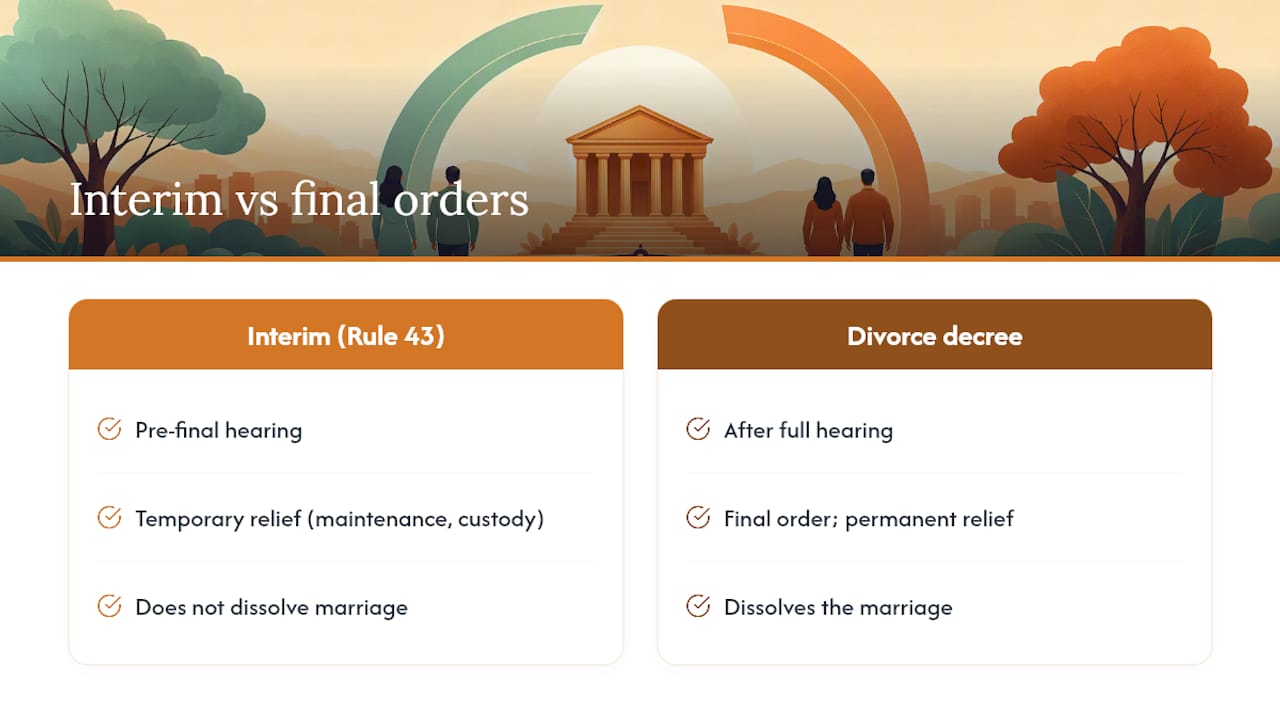
Once the court hears the full matter, whether by agreement or after a contested trial, it issues the actual decree of divorce, and that order is final. There isn't a separate "final decree" issued later to replace a "provisional" one, the way some countries structure it. If someone tells you they have a "provisional decree" in the South African context, they most likely mean an interim order made before the divorce itself was finalised, not an unfinished version of the divorce judgment.
Challenging or appealing a divorce decree
Once granted, a decree isn't easy to unwind, and courts don't entertain second thoughts lightly. There are limited grounds on which a party can challenge the order, and the path depends on what exactly is being disputed.
If you believe the court made a legal error in granting the order or in its terms, an appeal to a higher court is the standard route, and it typically has to be lodged within a strict timeframe after the judgment. Missing that window generally closes the door on a straightforward appeal.
If new facts emerge, such as evidence that one party concealed assets during the settlement negotiations, a party can approach the court to have the order varied or rescinded, though this usually requires showing the concealment was material and that it genuinely affected the outcome. Courts don't reopen settled divorces over minor disagreements, only over substantive issues that would have changed the ruling.
Disputes over maintenance or custody terms are handled differently again. These can often be revisited through a variation application if circumstances have materially changed, without needing to challenge the divorce decree as a whole. This is one of the clearer reasons to bring in a family law attorney early: the correct procedural route depends entirely on what you're actually disputing, and choosing the wrong one wastes months.
Why a decree request gets delayed or rejected
Registrars reject or stall requests for reasons that are almost always fixable, once you know what they're checking for.
Incomplete case details top the list. A request with the wrong year, a misspelled surname, or no case number forces the registry to search blind, which can push a same-day request into a weeks-long hunt. Mismatched identification is another common snag: if the ID number on your request doesn't match court records exactly, expect a delay while the registrar verifies you're actually a party to the case.
Archived files cause the longest holdups. Older divorces, particularly those finalised more than a decade ago, may have been transferred out of active court storage, and retrieving them can take considerably longer than a file still sitting in the registry. Jurisdictional confusion adds to this: requesting a copy from the wrong court entirely, say, approaching a Magistrate's Court when the matter was actually heard in the High Court, guarantees a rejection and a fresh start at the correct registry.
Unpaid or incorrect fees, missing signatures on an affidavit for a lost original, and requests submitted by someone who isn't a party to the case or an authorised attorney round out the usual list. None of these are complicated once flagged. They're just the small administrative gaps that turn a five-minute request into a frustrating month.
The gap between what people expect and how this process actually works
Most guidance on divorce paperwork treats the decree like a formality you file away once and forget. That's backwards. The decree is the single most consulted legal document most South Africans will ever hold, quietly resurfacing at every remarriage, every pension claim, every property transfer for the rest of their lives.
The bigger failure in how this topic gets covered is the assumption that Home Affairs sits somewhere in the retrieval chain. It doesn't, and that misconception sends people to the wrong counter entirely, wasting a morning before they even reach the court that actually holds their file. The fix isn't complicated: know which court granted your divorce, and go there first, every time.
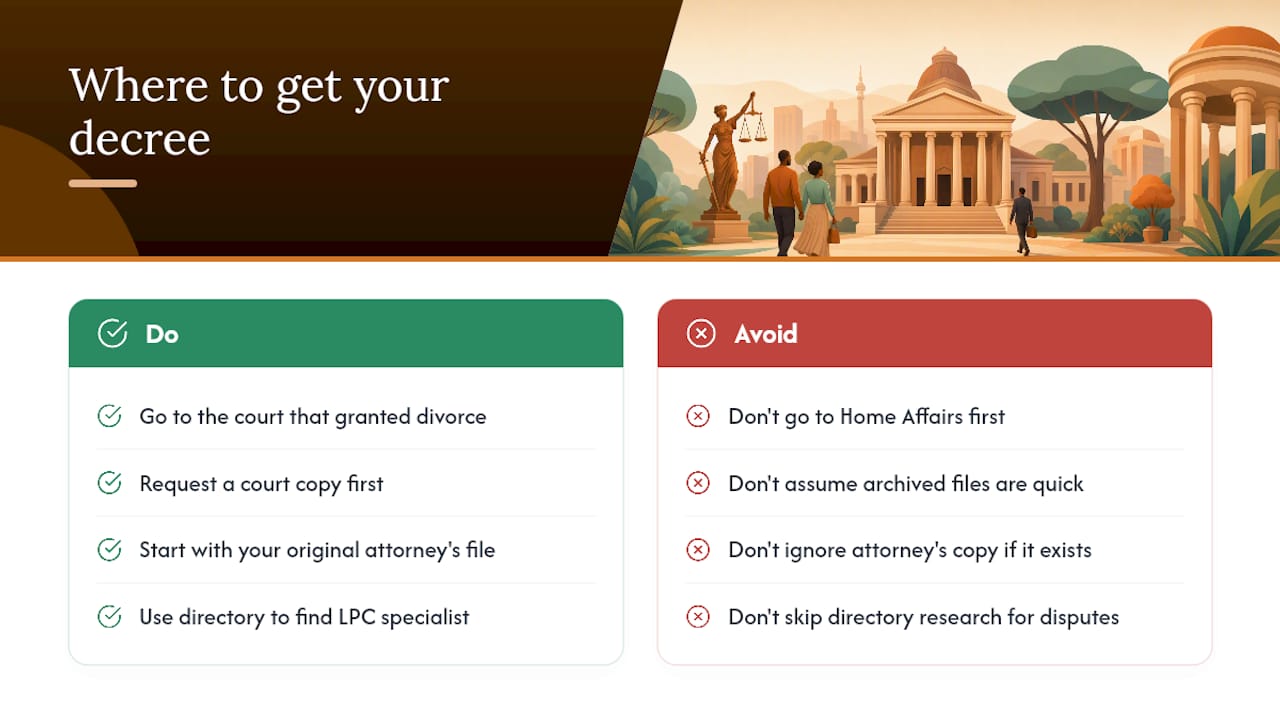
What conventional advice consistently underplays is how much faster this moves when you start with your original attorney's file instead of the court archive. Courts aren't obligated to make retrieval convenient, and archived records genuinely take longer to surface. An attorney's copy, when one exists, is usually the shortcut nobody mentions until they've already spent three weeks waiting.
If your situation involves a contested dispute, a missing file, or overseas authentication, don't treat a directory listing as optional research. Treat it as the fastest way to get an LPC-registered specialist who's dealt with your exact registry before.
— Nkosi
This article is general information, not a substitute for advice from a qualified lawyer. Consult a qualified legal professional about your own circumstances before acting on anything here.
Sources
FAQ
How do I get a copy of my divorce decree in South Africa?
Contact the Registrar of the High Court or the Clerk of the Magistrate's Court that granted your divorce, and provide your case number, full names, ID numbers, and the year of the order to help the registry locate your file.
Is a divorce order the same as a divorce decree?
Yes, "divorce order" and "divorce decree" refer to the same legally binding court judgment that ends a marriage in South Africa.
What happens to my finances after a divorce?
Your finances follow whatever the court ordered in the decree, whether that's a division of a joint estate, allocation of debt, or ongoing maintenance payments, and these terms become enforceable obligations once the order is granted.
How long does it take to get a decree of divorce in South Africa?
An uncontested divorce with an agreed settlement can often be finalised within weeks to a few months, while contested matters can take a year or longer; retrieving a certified copy afterward is usually quick unless the file has been archived.
Recommended
By the Justibly editorial team
Published
General legal information for South Africa, checked against the Legal Practice Act, the relevant court rules and the Legal Practice Council roll. It is not legal advice and does not create an attorney-client relationship. For advice on your situation, consult an admitted attorney.
How we research and review · How the Trust Score works · Report an error