Criminal Defence Attorney in South Africa: How to Choose
Arrested or charged in South Africa? Learn what a criminal defence attorney does, your rights after arrest, how to check LPC registration, fees and Legal Aid.
Published

If you or someone close to you has been arrested or charged, hire a criminal defence attorney who is on the Legal Practice Council (LPC) roll, who regularly handles charges like yours in the court where your case will be heard, and who agrees fees in writing before starting. Do it early: the first hours after an arrest, including the warning statement and the first bail decision, shape much of what follows.
This guide explains what a defence attorney does at each stage, what the law says about your first 48 hours, how to check registration, what to ask in the first consultation, how fees work and when Legal Aid SA may step in.
TL;DR
- A criminal defence attorney can act from the police station through bail, trial, sentencing and appeal. The earlier you appoint one, the more stages they can influence.
- An arrested person must be brought before a lower court within 48 hours of arrest, and must be told of the right to apply for bail.
- Confirm that the attorney is on the LPC practising roll and holds a Fidelity Fund Certificate before you pay anything.
- Get a written mandate and fee arrangement. Be wary of anyone who guarantees bail, an acquittal or a particular sentence.
- If you cannot afford a lawyer, Legal Aid SA may represent you after a means test and a merit test.
Table of Contents
- What a criminal defence attorney does
- Your first 48 hours after arrest
- How to check that your lawyer is registered
- How to choose a criminal defence attorney
- What to bring and ask at the first consultation
- What a criminal defence attorney costs
- Legal Aid SA: representation if you cannot pay
- Perspective: why verified registration matters when your freedom is at stake
- Find a registered attorney on Justibly
- Self-defence: the requirements, briefly
- FAQ
- Sources
What a criminal defence attorney does
A criminal defence attorney represents the accused person from arrest until the matter ends, whether in acquittal, sentence or a successful appeal. Their work rests on the fair-trial rights in section 35 of the Constitution, and the practitioner must be an admitted attorney under the Legal Practice Act 28 of 2014.
In practice the work falls into stages.
At the police station
Before any charge is decided, an attorney can attend interviews with you, advise you on what you are not obliged to say, and help manage a warning statement so that you do not incriminate yourself by accident. If you are being asked to "just come and clarify" something, you are entitled to ask for a lawyer first.
Bail
Bail applications at first appearance are usually the most urgent task. Bail is dealt with in sections 59 and 60 of the Criminal Procedure Act 51 of 1977. Your attorney prepares the facts about your ties to the community, your employment, your address and the strength of the state's case, and argues why you should be released while the case runs. Some practitioners also offer urgent and after-hours help when an arrest happens at night or over a weekend.
Docket review and plea advice
The attorney reviews the police docket, tests the charge sheet for defects, and identifies possible defences. They can also make written representations to the prosecutor asking that charges be withdrawn or not pursued. If a plea deal makes sense, they advise on a section 105A plea and sentence agreement, or on diversion.
Trial
At trial the attorney cross-examines state witnesses, challenges the admissibility of evidence, raises disclosure problems and argues points of law. Where needed they bring in an advocate, an interpreter, an investigator or an expert witness.
Sentencing and appeal
If you are convicted, the attorney presents mitigation and can argue for non-custodial options such as those under section 297. After conviction they advise on appeal (section 316) or review (section 304) and, later, on expunging a criminal record where that is possible.
The range of matters is wide: DUI and drug possession, assault, theft, fraud, domestic violence charges, white-collar crime, cybercrime and serious violent offences. Some attorneys also act in asset forfeiture and restraint matters and in applications to set aside warrants of arrest or search and seizure.
Your first 48 hours after arrest
Knowing the timeline helps you judge whether the people acting for you are moving fast enough. Under the Criminal Procedure Act, a person who is arrested must be informed of the right to institute bail proceedings as soon as reasonably possible, and, if not released, brought before a lower court as soon as reasonably possible but within 48 hours of the arrest. If the 48 hours end outside ordinary court hours, the Act provides for the period to run to the end of the first court day.
What this means for you:
- Ask for a lawyer immediately. Give the police a name and number, or ask a family member to contact an attorney.
- Do not sign anything you do not understand. A warning statement or an admission of guilt payment can have lasting consequences, and an attorney can review both.
- Be ready for the first appearance. Your attorney will want proof of address, employment details and any previous convictions disclosed honestly.
- Expect a postponement. First appearances often end with the case postponed for further investigation, so bail is the main issue on the day.
For a look at how the sequence from arrest to release runs in another country, see this DUI arrest process overview. The principle is the same everywhere: the sooner someone qualified is involved, the more options you keep.
How to check that your lawyer is registered
Anyone can put "criminal lawyer" on a website. What matters is registration. The LSSA advises that you contact the Legal Practice Council to confirm that the attorney is on the practising roll and holds a Fidelity Fund Certificate. The Fidelity Fund Certificate matters because it is what allows an attorney to handle client money.
On Justibly, listings are built from verified LPC data, so the registration status you see on a profile is the one the Council records. You can still confirm it with the LPC directly before you sign a mandate, and for something as serious as a criminal charge that is a sensible habit.
How to choose a criminal defence attorney
Registration is the minimum. These are the criteria that separate a suitable attorney from an unsuitable one.
Experience with your kind of charge, in your court
A bail application for a first-time DUI arrest is a different job from defending a fraud trial or a murder charge. Ask whether the attorney has handled similar charges and whether they know the court where your matter will be heard, including its prosecutors and its practices. A criminal defence specialist should be comfortable with section 35 rights, bail, trial work and the testing of evidence, not only general legal practice.
Who will actually do the work
Ask who will prepare your case and who will appear in court. In some firms the person you meet is not the person who stands up at the hearing. Both can be fine, but you should know in advance.
Practical needs of your case
A good attorney can tell you early what evidence has to be obtained or preserved (CCTV footage, phone records, medical reports), whether you are likely to need an advocate, interpreter, investigator or expert, and what decisions have to be made right now.
Realistic talk, not promises
A serious attorney gives you an honest first view of the risks. Walk away from anyone who promises guaranteed bail, an acquittal or a specific sentence, or who claims privileged access to police, prosecutors or judges. Nobody can lawfully promise those things.
Location and availability
Cases are heard where the offence happened or the accused was arrested, so an attorney near that court saves travel costs and time. Ask about after-hours contact, because arrests often happen on Friday nights.
You can search attorneys by practice area and province on Justibly and compare LPC-verified profiles in any of the nine provinces before you make contact.
What to bring and ask at the first consultation
The first meeting is where you decide whether this person is right for you. Come prepared.
Bring:
- Your ID and FICA documents (proof of address and identity).
- A short written summary: names, dates, times, where you were arrested, what you were charged with and what has happened so far.
- Any paperwork you have been given, such as a notice of rights, a bail notice, a J175 or summons, or a warning statement.
- A list of questions.
Be completely honest. What you tell your attorney is confidential, and they cannot build a defence around facts they have not heard.
Ask:
- Have you handled charges like mine, and in this court?
- What is your honest view of the risks and the likely stages?
- Who will work on my case and who will appear?
- How often will you update me on court dates and progress?
- What exactly does the initial mandate cover, and what happens if the case is postponed or goes to trial?
- What will it cost, and when is payment due?
Expect a written mandate describing what work the initial retainer covers. Without it, disputes about scope and cost tend to arise at the worst possible time.
What a criminal defence attorney costs
Private attorneys set their own fees, so no honest article can give you one number. What you can expect is a structure. Criminal matters are often charged as a flat fee or by the hour, and some are staged by phase (bail, trial, appeal). Before work begins, ask for:
- A written fee arrangement stating whether fees are fixed, hourly or staged.
- A breakdown of what the fee covers, and what extra charges apply if the matter goes to trial.
- The deposit required and whether VAT applies.
- Expected third-party costs such as an advocate, expert reports, interpreters and travel.
- How postponed or additional court appearances are billed.
It is also reasonable to ask for a written estimate of total costs. A trial can run longer than planned, and a clear arrangement protects both sides.
To compare costs, contact two or three attorneys from the directory with the same short summary of your matter and ask each for the same breakdown. That makes the quotes comparable.
Legal Aid SA: representation if you cannot pay
The Constitution gives an accused person the right to a lawyer at state expense if substantial injustice would otherwise result. In practice that is delivered mainly through Legal Aid South Africa, which grants representation after a means test and a merit test. Its guide to legal aid explains that the means test is applied together with constitutional considerations such as substantial injustice.
The means test thresholds are adjusted for inflation. As an example, from 1 April 2024 an applicant for legal aid in a criminal case had to earn less than R8,700 a month after tax, with limits on the value of movable and immovable assets, and minors under 18 qualify automatically in criminal cases. Because the figures are revised, check the current thresholds with your nearest Legal Aid SA office.

Two practical points. First, Legal Aid SA pays its attorneys by tariff. Its criminal tariff states that trial fees are all-inclusive and that travel, accommodation and other incidental disbursements are not recoverable except as the tariff provides. Second, if you earn above the threshold but still cannot afford a long trial, a private attorney who agrees a staged fee may be the workable route.
Perspective: why verified registration matters when your freedom is at stake
We built Justibly because choosing a lawyer in a crisis should not depend on who shouts loudest online. When someone is arrested, the family often has an hour or two to find help, and what they find first is usually an advert.
Our listings reflect verified Legal Practice Council data, and attorneys cannot pay to rank higher. For a criminal matter that matters: you want to know the person is on the roll before you hand over a deposit and your story.
We also see how much a clear question to a registered attorney can settle early. That is why our free Q&A forum is answered only by LPC-registered lawyers, and why we match people to attorneys by practice area and location rather than by advertising budget.
Our advice is simple. Move early, ask for the mandate in writing, and pick an attorney who tells you the truth about your risks rather than the most comfortable story.
Nkosi
Find a registered attorney on Justibly
Justibly is a directory of South African LPC-registered attorneys, searchable by practice area and location, with a three-step process to get from search to first contact. You can browse criminal law attorneys in your province, read their profiles and, if you want a quick opinion first, put a question to our free Q&A forum, where only registered lawyers answer.
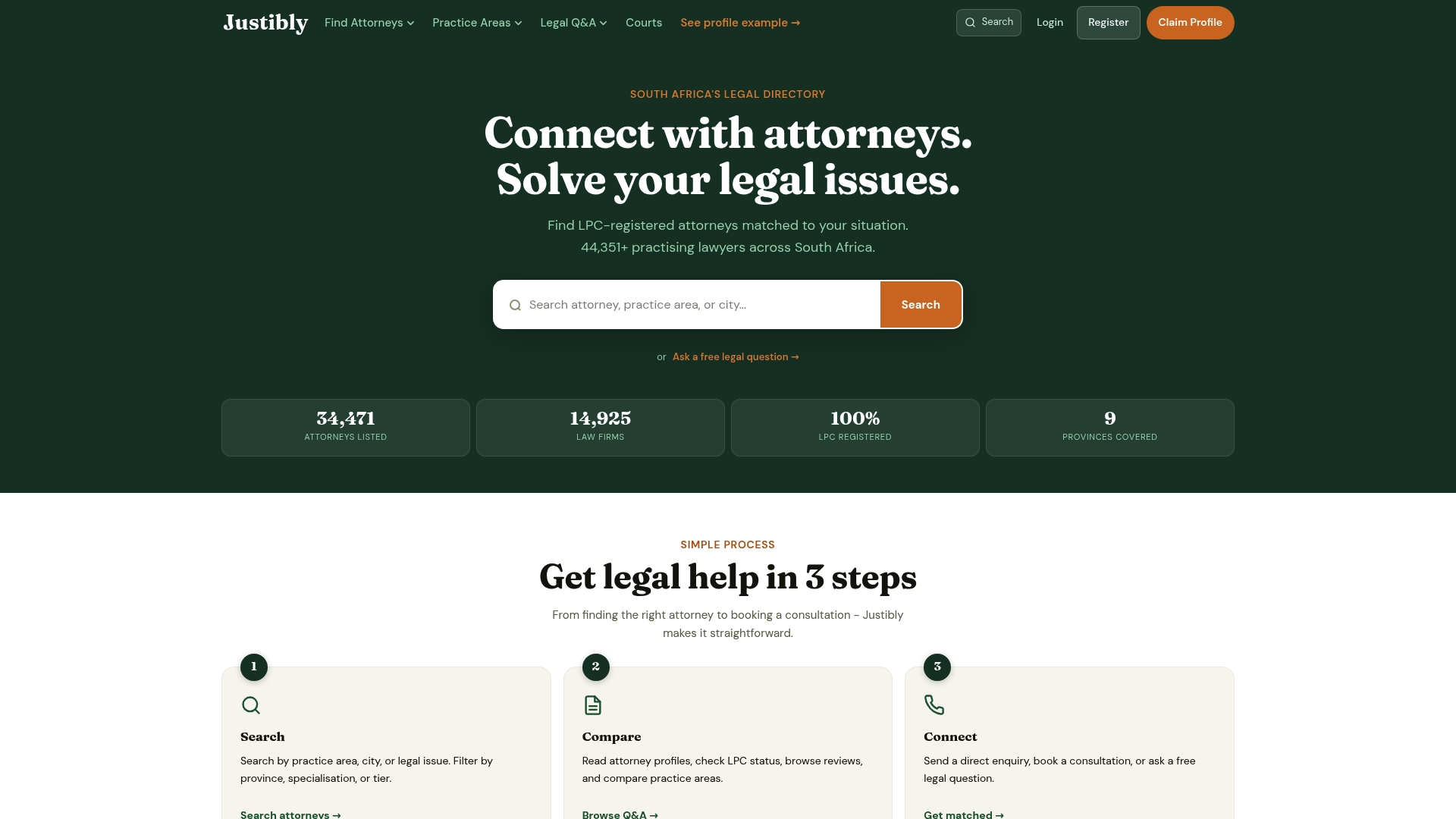
Start at Justibly and find an LPC-registered criminal defence attorney near the court that will hear your matter. If you are an attorney who wants to reach people in your area, our attorney plans include profile upgrades and appointment matching.
Self-defence: the requirements, briefly
Many readers arrive here after a violent incident and ask whether what they did counts as private defence. Courts commonly describe a four-part test: there must be an unlawful attack, it must be imminent or under way rather than over, the defensive act must be necessary to avert it, and the force used must be reasonable and proportionate in the circumstances.
The fact that the danger has passed is critical. A past threat does not justify later retaliation. Whether your conduct meets this test is decided on the facts, so speak to a criminal defence attorney before you give any statement to the police. Do not try to assess it yourself in a warning statement.
FAQ
Do I need a lawyer if I have only been questioned and not charged?
Yes, it is wise to have one. Police-station advice lets an attorney protect you from self-incrimination and manage any warning statement before charges are formulated. You are entitled to ask for legal advice before you answer questions.
Can I get a criminal lawyer if I have no money?
Possibly. Legal Aid SA grants representation after a means test and a merit test, and the Constitution provides for a state-funded lawyer where substantial injustice would otherwise result. Contact your nearest Legal Aid SA office as soon as you can, since the process takes time and your first appearance will not wait.
How long can the police hold me before I see a court?
A person who is arrested and not released must be brought before a lower court as soon as reasonably possible and not later than 48 hours after arrest, with an extension where the 48 hours end outside ordinary court hours. You must also be told of your right to apply for bail.
How do I know a criminal lawyer is genuine?
Check with the Legal Practice Council that the attorney is on the practising roll and has a Fidelity Fund Certificate. Then ask for a written mandate and fee arrangement before you pay a deposit.
Sources
- Criminal Procedure Act 51 of 1977, procedure after arrest
- LSSA: check whether a legal practitioner is registered
- Legal Aid SA guide to legal aid
- Legal Aid SA means test media statement, April 2024
- Legal Aid SA tariff of fees in criminal matters
- DUI arrest process overview
- Self-defence vs vigilantism in South Africa
By the Justibly editorial team
Published
General legal information for South Africa, checked against the Legal Practice Act, the relevant court rules and the Legal Practice Council roll. It is not legal advice and does not create an attorney-client relationship. For advice on your situation, consult an admitted attorney.
How we research and review · How the Trust Score works · Report an error