44,351 LPC Attorneys: Find One via Courts Online, South Africa
Use courts online to confirm LPC registration and Fidelity status, then contact a vetted attorney on Justibly or ask a free Q&A.
Published

To find and contact a qualified attorney through courts online resources, start with the Legal Practice Council's public practitioner search or a reputable directory like Justibly that lists LPC-registered attorneys. Verify their practising status and Fidelity Fund Certificate before you engage, then choose a free Q&A for quick questions or book a paid consultation when you need actual representation.
TL;DR:
- Always verify an attorney's current practising status via the LPC register by checking the practitioner's name, province, and "practising at present" status before engagement.
- Cross-check the LPC number and Fidelity Fund Certificate with official records to confirm legitimacy, especially before making any payments or deposits.
- Use the LPC register for existing contacts and directories for initial searches based on practice area or location, then confirm legitimacy through both sources when stakes are high.
- Send a clear, detailed first message to attorneys including case summary, key dates, existing documents, and preferred contact method to ensure timely and accurate responses.
- Rely on verified attorney directories and free Q&A forums for initial guidance, reserving paid consultations for formal representation or complex, sensitive cases.
Table of Contents
- Where to look for courts online and legal help: LPC register vs reputable directories
- How do you verify an attorney's practising status online?
- What should your first message to an attorney include?
- Free Q&A or a paid consultation: which do you actually need?
- What types of courts can you engage with through online legal help?
- Accessing online systems for filing and case information
- Submitting documents and evidence electronically
- Scheduling and attending a virtual hearing or consultation
- How does online case tracking work?
- Technical requirements and common troubleshooting for online legal interactions
- Why verification changes the outcome, not just the process
- Find, verify, and contact an attorney through Justibly
- Sources
- FAQ
Where to look for courts online and legal help: LPC register vs reputable directories
Two sources anchor any serious search for legal help in South Africa, and they serve different purposes.
The Legal Practice Council keeps a public search practitioners tool that lets anyone check whether a specific person is currently registered and practising. You filter by province and practitioner type, whether attorney, advocate, conveyancer, or notary, and the result tells you plainly whether that individual is "practising at present." This is the authoritative source. It is also, frankly, not built for browsing. You need a name already in mind, and the interface gives you registration status, not context about specialty, experience, or how to actually get in touch.
That's where a directory earns its place. A reputable platform lets you search by practice area (family law, criminal defence, property, tax litigation) and location, read attorney profiles, and often ask a preliminary question before committing to a paid consultation. A reputable directory structures its listings around genuine LPC data rather than pay-to-rank placement, and may add a free Q&A forum so users get quick input from registered attorneys without booking anything first.
The decision rule is simple:
- Use the LPC register when you already have a name and just need to confirm someone is legitimate and currently practising.
- Use a directory when you don't have a name yet and need to find someone by specialty, city, or the kind of legal problem you're facing, such as an attorney in Cape Town or one handling family law matters.
- Use both when the stakes are high. Find candidates through a directory, then cross check the result against the register before you pay anyone anything.
Directories add convenience and searchability. The register adds certainty. Skipping the register step because a directory listing looked polished is how people end up dealing with someone who lapsed off the roll two years ago.
How do you verify an attorney's practising status online?
Verification takes about five minutes and it's the single step people skip most often, usually because the attorney "seemed fine" on a call or came recommended by a friend. Recommendations are not registration checks.
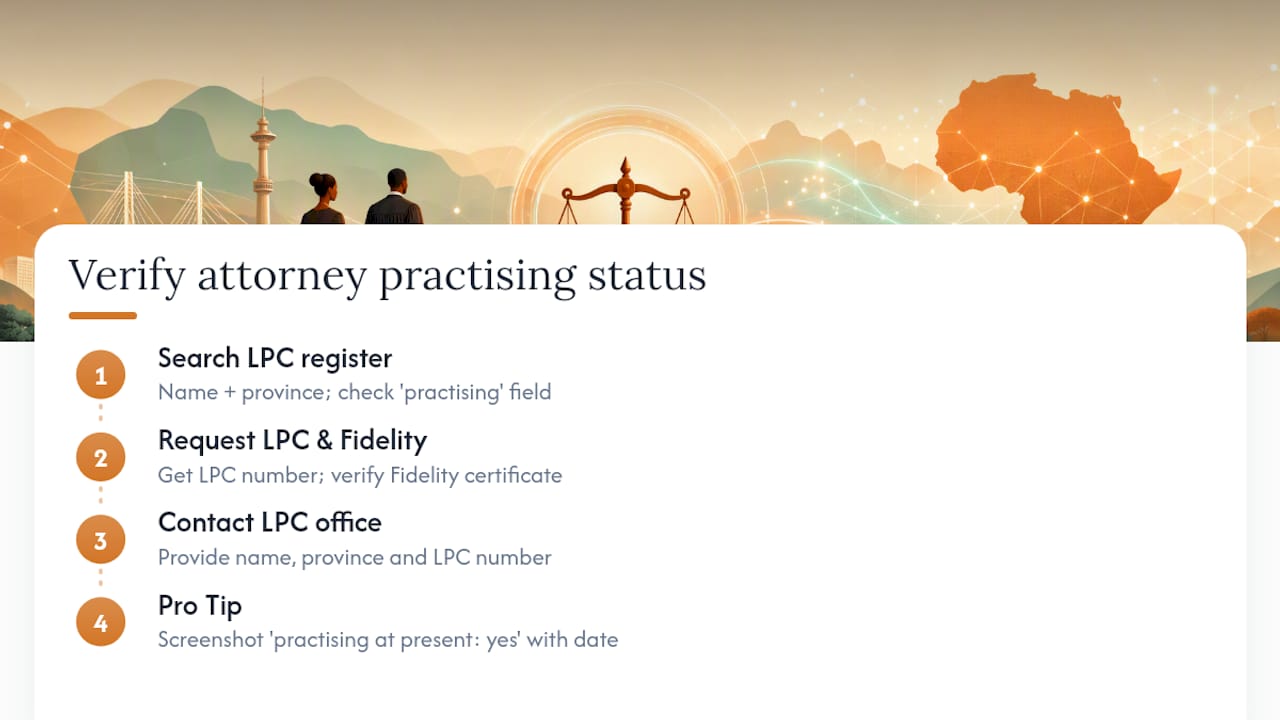
1. Search the LPC register by full name and province. Every practising attorney in South Africa must be registered with the Legal Practice Council under the Legal Practice Act 28 of 2014. Enter the practitioner's name, select the province where they practise, and check the result against the "practising at present" field. A name appearing in the register is not enough on its own. Some entries are historical or lapsed, and the register distinguishes practising status precisely so users don't assume presence equals current authorization.
2. Ask for the LPC number and Fidelity Fund Certificate. Legitimate attorneys expect this question and generally provide it without hesitation. Match the LPC number to the register entry yourself rather than taking the attorney's word for it. The Fidelity Fund Certificate confirms the attorney is authorized to hold client funds in trust, which matters enormously if you're paying a deposit or settlement money through them.
3. Contact an LPC regional office if the register result is unclear. The Law Society of South Africa points users toward the LPC directly for exactly this situation, and regional offices can confirm status when an online search returns an ambiguous or incomplete record. Include the practitioner's full name, the province they claim to practise in, and, if you have it, the LPC number they gave you.
Pro Tip: Screenshot the register result showing "practising at present: yes" and the date you checked it. If a dispute ever arises about representation, that timestamp is useful evidence that you did your due diligence before engaging.
What should your first message to an attorney include?
A vague message gets a vague, slow response, or none at all. A message with the right details gets read, understood, and answered within a working day at most reputable firms.
Include these essentials in your first contact:
- A one-paragraph summary of the legal issue, written in plain terms, not legal jargon you're guessing at.
- Key dates: when the incident occurred, any deadlines you're aware of (court dates, notice periods, contract expiry).
- What documents you already have on hand, even if you're not attaching them yet.
- Your preferred way to meet: phone call, video consultation, or in-person if you're near their office.
Once you get a reply, ask direct questions before agreeing to anything: How is the fee structured, hourly or fixed? What's a realistic timeline given the type of matter? Do they require a signed written mandate or a deposit before starting work?
A written mandate matters more than people realize. It's the document that formally establishes the attorney-client relationship and spells out scope and fees, and its absence is one of the clearest signs of an unprofessional setup. Guidance from the Gawie le Roux Institute of Law recommends confirming bank details independently against the firm's official records, not just trusting whatever account number appears in an email, since payment redirection scams targeting legal clients have become a recognized fraud pattern in South Africa. If a firm's banking details in an email differ even slightly from what's listed on their verified website or LPC record, stop and call the office directly before transferring anything.
Free Q&A or a paid consultation: which do you actually need?
The honest answer depends on whether you need information or representation, and conflating the two wastes time either way.
A free Q&A forum, like the one Justibly runs, works well for clarifying questions: Do I have grounds for a claim? What's the general process for X? How long does this typically take? Registered attorneys answer these publicly, and you get a genuine, if general, response without paying anything or committing to a firm. What it cannot do is create a formal mandate, draft or file documents on your behalf, or represent you anywhere. Q&A answers inform your next move; they don't substitute for one.
A paid consultation is the right call once you need:
- Formal representation in a dispute, negotiation, or court matter.
- Document drafting or review, contracts, wills, settlement agreements.
- A deeper dive into your specific facts that a general forum answer can't responsibly cover.
Urgency and privacy both push toward booking directly. If a deadline is days away or your situation involves sensitive details you don't want posted publicly, skip the forum and go straight to a consultation.
What types of courts can you engage with through online legal help?
Different legal problems route through different courts, and knowing which one applies shapes how an attorney approaches your case from the first message.
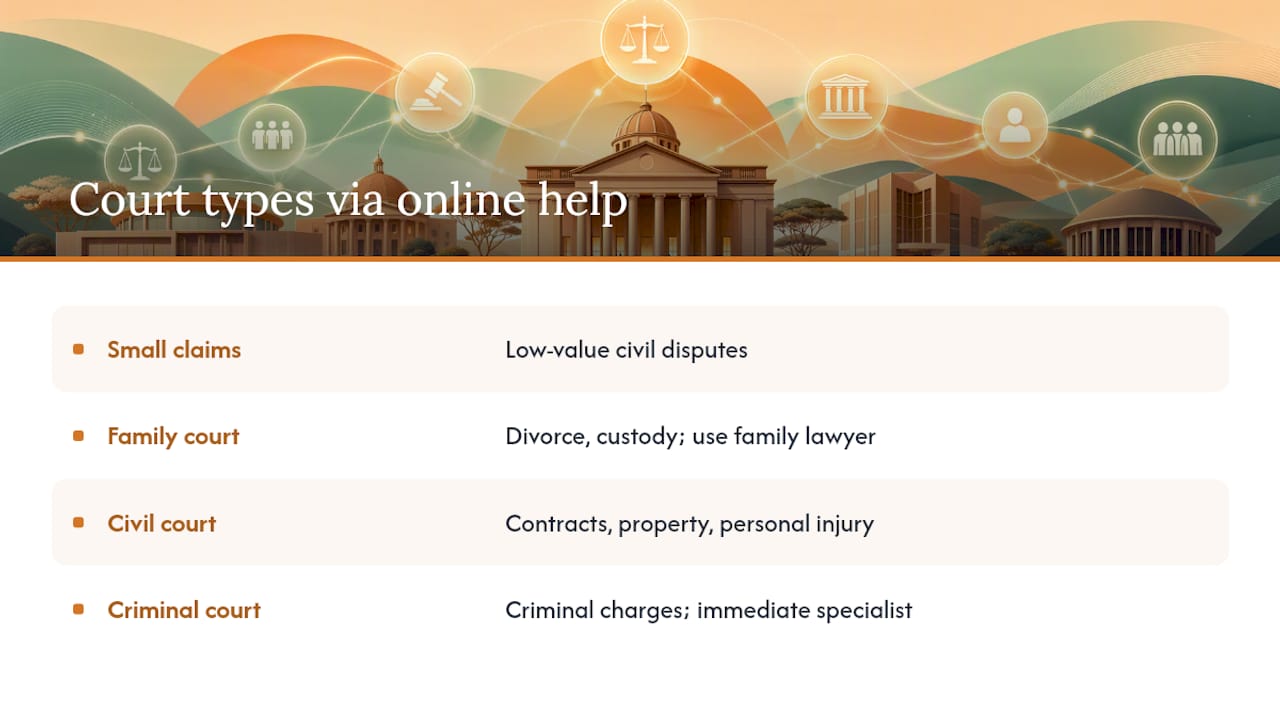
Small claims court handles lower-value civil disputes, typically debt recovery or damages claims below a set monetary threshold, without needing full legal representation in the hearing itself. Justibly's guide on small claims filing in Cape Town walks through the paperwork most people need to prepare before they even speak to an attorney.
Family court matters, divorce, custody, maintenance, and domestic violence protection orders, often move faster and with less friction when a family law attorney is involved from the outset, since procedural mistakes in these matters can delay outcomes for months.
Civil court covers a broad range: contract disputes, property matters, personal injury claims, and commercial litigation. These cases vary enormously in complexity, and the right attorney depends heavily on the specific area, tax disputes need a tax litigation specialist, not a generalist.
Criminal court matters require immediate, specialized representation. If you're facing charges or a police investigation, a criminal defence attorney needs to be involved as early as possible, ideally before you make any statement.
Each court type has its own procedural rhythm, and an attorney who regularly practises in that specific area moves through it far more efficiently than one working outside their usual lane.
Accessing online systems for filing and case information
Most courts and legal service providers now run some form of online portal for case administration, though the sophistication varies by jurisdiction and court level. Accessing these systems generally starts with registration, creating an account tied to your identity number or, for represented parties, your attorney's credentials.
Once registered, portals typically let you view case numbers, check scheduled dates, and in some instances submit documents directly rather than filing in person. The learning curve is real for first-time users, mismatched file formats, unclear naming conventions, and confusing menu structures trip up even careful people.
This is precisely where having a verified attorney pays off beyond just legal advice. An attorney who works with these systems regularly knows the quirks: which document formats a specific court portal accepts, what counts as a properly served notice, and how to avoid a rejected filing over a technicality. If you're navigating a portal alone for a small claims matter, budget extra time for the learning curve and double check every submission confirmation you receive.
Reading through a preparatory guide before you start, rather than during a filing deadline, saves considerable stress. It's also worth asking your attorney directly whether they'll handle portal submissions themselves or expect you to manage that part.
Submitting documents and evidence electronically
Electronic submission generally follows a consistent logic regardless of which system you're using: prepare, format, upload, confirm.
Preparation means gathering every relevant document, contracts, correspondence, photographs, medical records, and converting them into the format the receiving system requires, almost always PDF. Scanned images of physical documents need to be legible; a blurry photo of a contract page can get evidence rejected or questioned later.
Formatting matters more than people expect. Many systems impose file size limits, naming conventions, or page count restrictions per upload. Splitting a large bundle into clearly labeled, logically ordered files (not one 200-page PDF with no structure) makes life easier for everyone involved, including the person on the other side who eventually has to review it.
Upload and confirmation close the loop. Always retain a copy of the confirmation receipt or reference number generated after submission. This is your proof the document was received on a specific date, which matters enormously if a deadline is later disputed.
If your attorney is handling submissions, ask them directly to forward confirmation receipts to you. It's a small request that removes any ambiguity later about what was filed and when.
Scheduling and attending a virtual hearing or consultation
Virtual hearings and remote consultations have become routine for many procedural matters, though final hearings involving contested evidence still commonly happen in person depending on the court and case type.
Scheduling generally works through the same portal or system used for filing, or through direct coordination with your attorney's office. Confirm the format well ahead of time, video link, dial-in number, or platform-specific application, and test your setup a day before, not ten minutes before.
For consultations specifically, whether with an attorney you found through a directory search or one referred by contacts, treat the virtual meeting with the same preparation you'd bring in person. Have your documents open and organized, write down your questions beforehand, and confirm at the start whether the session is being recorded.
Pro Tip: Ask your attorney or the court administrator to confirm the exact virtual platform and send a test link in advance. Technical failures during an actual hearing create real complications, and most are avoidable with a five-minute check the day before.
How does online case tracking work?
Once a matter is filed, tracking its status online typically means logging back into the same portal used for filing and checking for updates against your case reference number. Status categories usually distinguish between stages, filed, under review, scheduled, or decided, though exact terminology varies by court and jurisdiction.
Update frequency is not instant. Court administrative processes move on their own timeline, and checking a portal daily rarely produces new information; checking weekly, or when your attorney flags a specific development, is usually more productive.
If you're working with a verified attorney, they typically monitor case status on your behalf and flag genuinely important developments, hearing dates, requests for additional documents, or opposing party filings, rather than leaving you to interpret status codes alone. That's part of what a paid engagement buys you beyond the advice itself: someone tracking the administrative side so nothing slips past a deadline unnoticed.
Technical requirements and common troubleshooting for online legal interactions
Most friction with online legal systems comes down to a handful of recurring, fixable problems.
A stable internet connection matters more for video hearings than most people anticipate; a dropped connection mid-hearing can create real complications depending on the proceeding's formality. Test your connection speed beforehand if you're on a borderline network.
Browser compatibility trips people up constantly. Older or unusual browsers sometimes fail to render portal forms correctly, or block upload functions silently without an obvious error message. Using a current version of a mainstream browser, Chrome, Firefox, Edge, resolves most of these issues before they start.
File format and size errors are the most common filing complaint. If an upload fails, check the file size against the system's stated limit first, then confirm the format matches exactly what's requested (PDF is nearly universal, but some systems are stricter about version compatibility than others).
Login and account access problems tend to spike right before deadlines, precisely when you have the least patience for them. Set up and test your account access well in advance rather than the day a filing is due, and keep your login credentials somewhere you can actually find them under pressure.
Why verification changes the outcome, not just the process
People treat attorney verification as a formality, something you do because a guide told you to, rather than a step that materially changes their risk exposure. That's backwards. The riskiest legal engagements aren't the complicated ones. They're the simple ones where someone skipped a two-minute register check because the person on the other end sounded confident.
Justibly built its entire model around this idea: listings reflect actual LPC data rather than who paid for placement, and the platform connects users with a network of over 44,351 practising, LPC-registered attorneys across the country. The free Q&A forum exists specifically so people can ask a clarifying question before they've committed money or trust to anyone. Combined with the practical guides on the platform, walking through filing procedures and common legal processes, the goal is to remove the guesswork before it becomes a problem.
None of that replaces judgment. Verification takes a few minutes; skipping it can cost a lot more than that.
— Nkosi
Find, verify, and contact an attorney through Justibly
A reputable legal directory gives a faster, more transparent starting point than cold-searching the web for "attorney near me" and hoping the top result is legitimate. Ideally, every listing reflects genuine Legal Practice Council data rather than paid placement, so what you see is what's actually registered, not who spent the most on advertising.
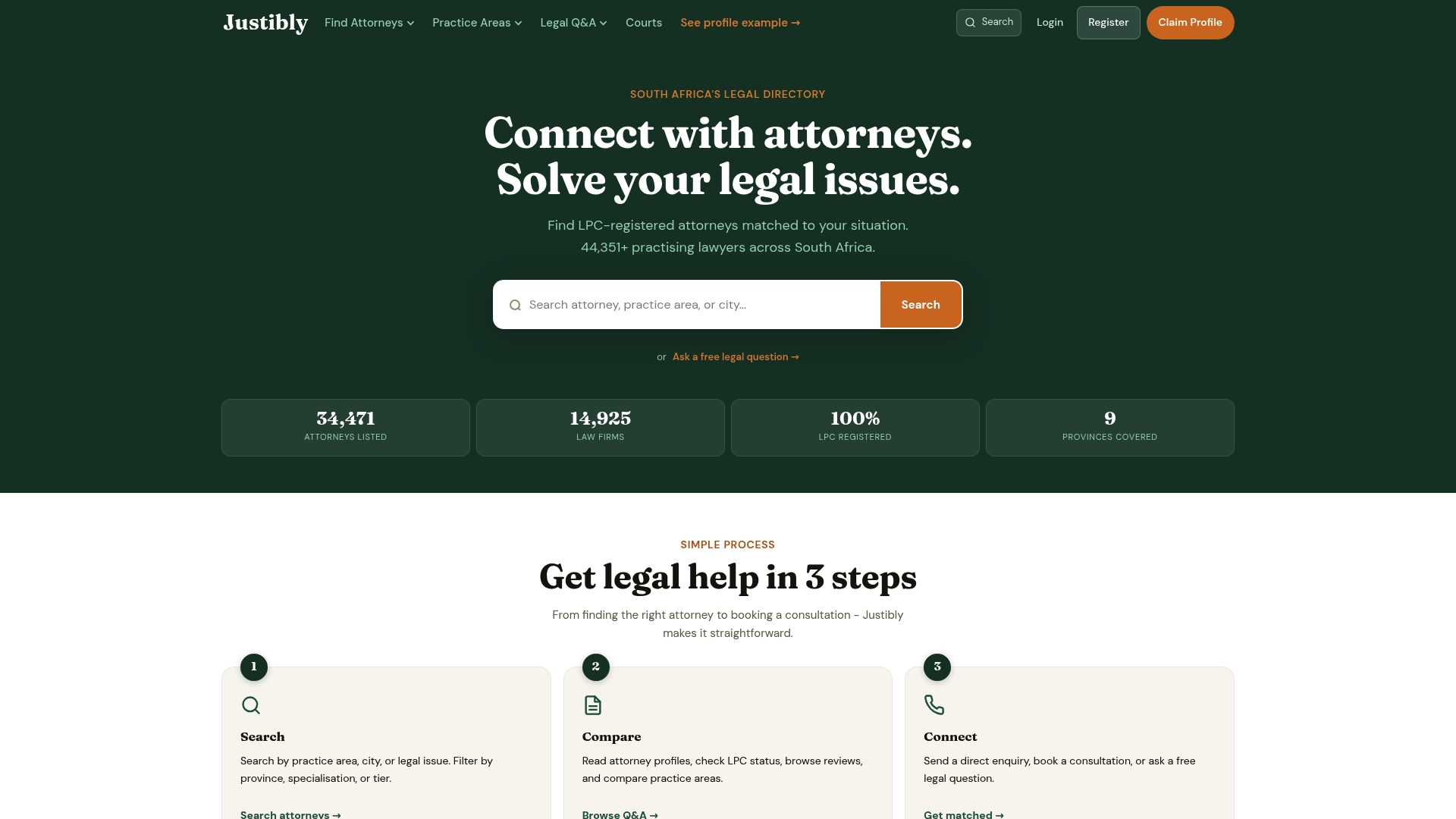
Start by searching attorneys by practice area and location, whether that's a criminal defence attorney handling an urgent matter or a trusts specialist for estate planning. If your question doesn't need a full consultation yet, post it in the free Q&A forum and get a response from a registered attorney at no cost. And if you're preparing for a specific process, filing a claim, drafting a document, understanding a procedure, the legal guides section breaks it down step by step before you ever pick up the phone.
Head to Justibly now and search by practice area to find an LPC-registered attorney near you today.
Sources
Confirm any attorney's status directly through the LPC's practitioner search or review the governing Legal Practice Act. If a register result is unclear, LPC regional offices can confirm status directly. For a practical next step, search Justibly's directory or post a question in its free Q&A forum.
This article is general information, not a substitute for advice from a qualified lawyer. Consult a qualified legal professional about your own circumstances before acting on anything here.
- Legal Practice Act 28 of 2014 - Government of South Africa
- Search Practitioners - Legal Practice Council
- Find a Legal Practitioner - LSSA
FAQ
How do I confirm an attorney is registered in South Africa?
Search the attorney's full name and province on the LPC's public practitioner search and check that the result shows "practising at present: yes."
What is a Fidelity Fund Certificate and why does it matter?
It's the document confirming an attorney is authorized to hold client funds in trust; ask for it directly and match the attorney's LPC number to the register before making any payment.
Should I use a free Q&A forum or book a paid consultation?
Use a free Q&A forum, such as Justibly's, for general clarifying questions; book a paid consultation once you need formal representation, document drafting, or a deep review of your specific case.
What should I send in my first message to an attorney?
Include a brief case summary, key dates, what documents you already have, and your preferred meeting format (call, video, or in person).
What if the LPC register result is unclear or incomplete?
Contact an LPC regional office directly, providing the practitioner's full name, province, and LPC number if you have it, since the Law Society of South Africa directs unclear cases there for confirmation.
Recommended
By the Justibly editorial team
Published
General legal information for South Africa, checked against the Legal Practice Act, the relevant court rules and the Legal Practice Council roll. It is not legal advice and does not create an attorney-client relationship. For advice on your situation, consult an admitted attorney.
How we research and review · How the Trust Score works · Report an error