Cooling off period in South Africa: your rights explained
Discover your rights during a cooling off period in South Africa. Learn how to cancel contracts legally and protect your interests.
Published

South Africa's law gives you a statutory right to cancel certain contracts without penalty, but only in specific situations. Under section 16 of the Consumer Protection Act (Act 68 of 2008), you have a short statutory period to rescind a transaction concluded through direct marketing. If you signed an offer or deed of alienation for land, section 29A of the Alienation of Land Act gives you a separate right of limited duration. The Electronic Communications and Transactions Act (ECTA) adds a statutory cooling-off window for certain electronic transactions. Outside these three regimes, most contracts are binding the moment you sign, with limited exceptions — buyer's remorse alone is not a legal ground for cancellation.
Act within the window. Send written or recorded notice of rescission immediately. Keep proof of delivery. Do not return or use goods until you have confirmation of the refund process.
Your immediate checklist:
- Identify which statute applies (CPA s16, Alienation of Land Act s29A, or ECTA s44)
- Count your days from the later of contract conclusion or delivery of goods
- Send written notice by registered post or email with a read receipt
- Keep every document: the contract, your notice, and proof it was received
- Do not destroy, use, or dispose of goods pending the refund
Key takeaways
South Africa's cooling-off rights are statute-specific, time-limited, and only enforceable if you give written notice within the correct window.
| Point | Details |
|---|---|
| CPA s16 deadline | Five business days from the later of contract conclusion or delivery of goods. |
| Alienation of Land Act s29A | Five days from the purchaser's signature date on the offer or deed. |
| Supplier refund obligation | Supplier must return all payments within 15 business days (CPA) of receiving valid notice. |
| Written notice is mandatory | Verbal cancellation is unenforceable; send by registered post or email with a read receipt and keep proof. |
| Justibly for legal help | Search Justibly's directory of 44,351+ LPC-registered attorneys or use the free Q&A forum for quick guidance. |
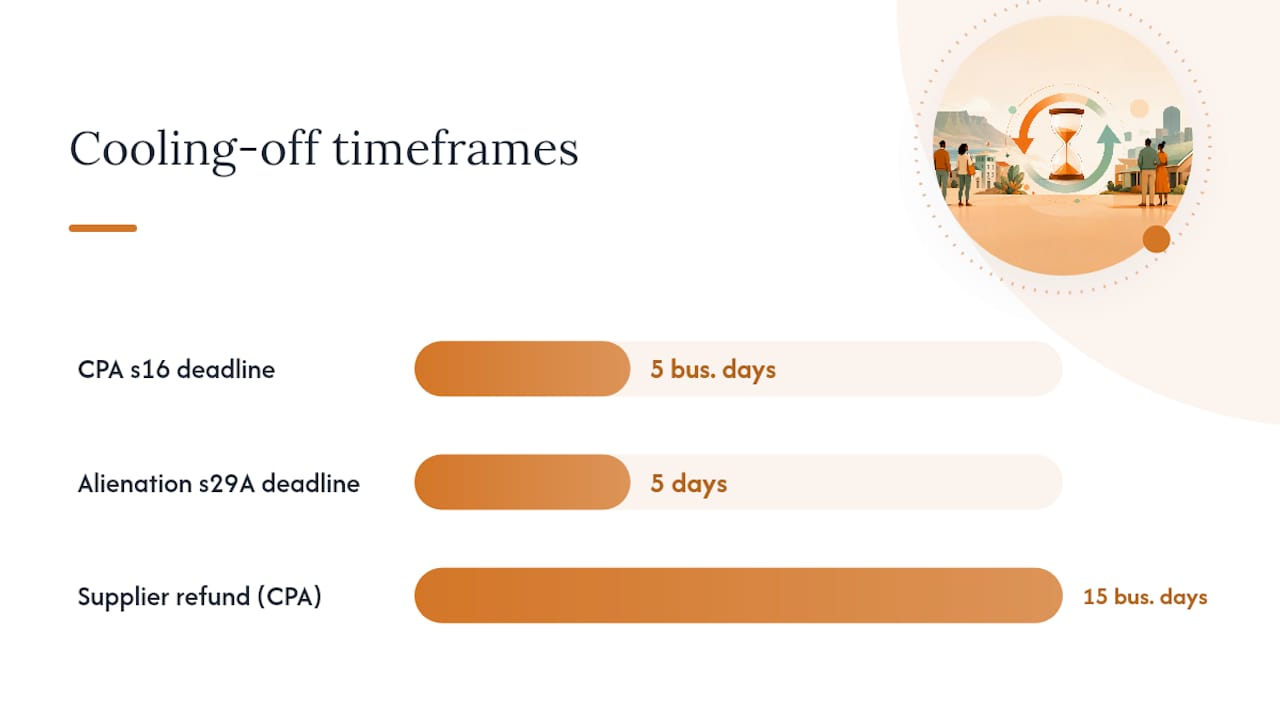
Table of Contents
- What is the cooling-off period under South African law?
- Which transactions does the cooling-off right actually cover?
- Exact deadlines and what suppliers must refund
- How to exercise your right to cancel: step by step
- What the supplier must do after you rescind
- When the cooling-off right does NOT apply
- When should you get legal help?
- A note on why this guide exists
- Find the right attorney for your situation through Justibly
- Sources
- FAQ
What is the cooling-off period under South African law?
A cooling-off period is a statutory window during which a consumer may cancel a contract without giving reasons and without incurring a penalty. It is not a general right to change your mind — it attaches only where a specific law creates it.
Three statutes do the heavy lifting in South Africa:
- Consumer Protection Act 68 of 2008, s16: Covers transactions resulting from direct marketing. Five business days from the later of conclusion of the agreement or delivery of goods.
- Alienation of Land Act 68 of 1981, s29A: Covers offers and deeds of alienation for land (residential property purchases). A statutory short time applies from signature, with particular rules for offers versus concluded deeds.
- Electronic Communications and Transactions Act 25 of 2002, s44: Covers qualifying electronic consumer transactions. Seven days, with a list of excluded categories.
The statutes can overlap. If you bought property through an online platform initiated by the seller, both ECTA s44 and Alienation of Land Act s29A could theoretically apply. You are entitled to elect whichever right is more favourable. Where the CPA and ECTA overlap, the CPA's five-business-day right generally prevails for direct-marketing transactions because the CPA is the later, more specific statute.
Credit agreements under the National Credit Act (NCA) have their own cancellation framework. The NCA does not create a general cooling-off right equivalent to CPA s16, but it does regulate how agreements may be terminated and what charges apply. If your transaction involves credit, check both the NCA and the CPA to see which provisions apply to your specific agreement.
Which transactions does the cooling-off right actually cover?
The right applies more narrowly than most people expect. Here is where each regime fits real-world purchases.
Covered under CPA s16 (direct marketing):
- Door-to-door sales where a salesperson visits your home uninvited
- Telesales calls you did not initiate
- Email or SMS promotions you responded to, where the seller approached you first
- In-home demonstrations that result in a purchase
Covered under Alienation of Land Act s29A:
- Offers to purchase residential property signed by a natural person
- Deeds of alienation (sale agreements) for land, subject to price thresholds and conditions set out in the Act
- The right is purchaser-focused and courts have confirmed it cannot easily be waived by the buyer
Covered under ECTA s44:
- Electronic consumer transactions initiated by the supplier (not by you)
- Online purchases where the seller's platform prompted the transaction
Not covered — common misconceptions:
- Normal in-store purchases you initiated yourself
- Business-to-business contracts (CPA applies only to consumers)
- Transactions negotiated at the supplier's own premises at your request
- Auctions, perishable goods, custom-made goods, sealed audiovisual products once opened, and betting transactions (all excluded under ECTA)
- Most regulated financial services products (excluded from the CPA's cooling-off provisions)
If your purchase does not fit one of the covered categories, your right to cancel depends on the contract's own termination clause or a common-law ground such as misrepresentation, duress, or material breach.
Exact deadlines and what suppliers must refund
Getting the deadline right matters. Miss it by one day and the statutory right is gone.
CPA s16 — direct marketing:
The five-business-day window starts from the later of: (a) the date the agreement was concluded, or (b) the date goods were delivered. Business days exclude Saturdays, Sundays, and public holidays. Once you give valid notice, the supplier must return all payments within 15 business days of receiving your rescission notice or the returned goods, whichever is later.
Alienation of Land Act s29A — property:
The five-day period runs from the date the purchaser signs the offer or deed. For an offer, the clock starts when the purchaser signs, not when the seller accepts. For a concluded deed of alienation, it runs from the date of the purchaser's signature. Days here are calendar days unless the Act specifies otherwise — confirm with an attorney for your specific transaction.
ECTA s44 — electronic transactions:
Seven days from the date of receipt of goods, or from the date the agreement was concluded for services. The supplier must refund within a statutory period after receiving notice.
Count carefully. A common mistake is starting the count from the date you received the seller's signed copy, not your own signature date. For CPA s16, the "later of" test protects you — if goods arrive after you signed, your window opens on delivery day, not signing day. The Government Gazette provisions confirm that suppliers may not attempt any further collection once valid rescission notice is received.
Cancelling a fixed-term consumer agreement (not a cooling-off right, but related) requires 20 business days' written notice under the CPA. A reasonable cancellation penalty may apply, subject to the Conventional Penalties Act and the supplier's duty to mitigate loss.
How to exercise your right to cancel: step by step
Speed and written proof are everything here. Verbal cancellations are almost impossible to enforce.
- Confirm the right applies. Check which statute covers your transaction and calculate the deadline from the correct start date.
- Prepare your written notice. Include: your full name, ID number, contact details, the date the agreement was concluded, the transaction reference or contract number, a clear statement that you are rescinding the agreement under the applicable statute (cite it by name), and the date of your notice.
- Choose a delivery method that creates a record. Registered post, email with a read receipt, or a recorded telephone call (confirm in writing immediately after). Avoid WhatsApp alone unless you can screenshot delivery and read receipts.
- Send the notice and record proof. Keep the registered post slip, the email sent-folder copy with timestamps, or the call log.
- Retain the goods in their original condition until the supplier arranges collection or confirms the return process.
- Follow up in writing if you do not receive a refund acknowledgement within five business days of your notice.
Sample rescission notice (adapt as needed):
To: [Supplier name and address/email]
*Date:
Re: Notice of Rescission — [Contract/Invoice Reference]
I, [Full name], ID number [XXXXXXXXXX], hereby give notice that I rescind the agreement concluded on [date] in respect of [description of goods/services], in terms of section 16 of the Consumer Protection Act 68 of 2008 / section 29A of the Alienation of Land Act 68 of 1981 / section 44 of the Electronic Communications and Transactions Act 25 of 2002 [delete as applicable].
Please confirm receipt of this notice and arrange for the refund of all payments made.
Yours faithfully, [Full name, contact number, email]
Pro Tip: Send your notice on the same day you decide to cancel, even if you are still inside the window. The "later of" test under CPA s16 means your window may be longer than you think, but there is no benefit to waiting — and every day you delay increases the risk of a dispute about timing.
What the supplier must do after you rescind
Once you give valid notice, the supplier's obligations are clear and non-negotiable.
The supplier may not attempt to collect any further payment, enforce the agreement, or report a default after valid rescission notice is received. Any attempt to do so is a breach of the CPA and potentially an unfair business practice.
Specifically, the supplier must:
- Refund all payments within 15 business days (CPA s16) or 30 days (ECTA s44) of receiving your notice or returned goods
- Arrange collection of goods at their own cost where the CPA applies
- Provide a written acknowledgement of the rescission
If the supplier refuses or delays, your escalation path is:
- Document everything. Send a formal written demand by registered post, referencing the statute and the refund deadline.
- Lodge a complaint with the National Consumer Commission (NCC). The NCC investigates CPA breaches and can refer matters for prosecution. Contact the NCC at 012 428 7000 or via the NCC's official website.
- Use the relevant ombud. For financial products, the relevant Financial Sector Conduct Authority (FSCA) ombud may have jurisdiction. For credit agreements, the National Credit Regulator (NCR) is the correct body.
- Small claims court handles disputes up to R20,000 without an attorney.
- Consult an attorney for larger amounts, property transactions, or where the supplier is threatening legal action against you.
Legal practice guides consistently emphasise that acting quickly and keeping written records is what separates successful rescissions from drawn-out disputes.
When the cooling-off right does NOT apply
This is where most consumers get into trouble. The right to rescind is narrower than the right to complain.
Common situations where no statutory cooling-off right exists:
- You walked into a shop and bought something at your own initiative
- You negotiated the contract at the supplier's premises (not your home or a neutral venue)
- The transaction is between two businesses
- The goods are perishable, custom-made, or a sealed audio-visual product you have already opened
- The transaction was conducted at an auction
- The product is a regulated financial service excluded from the CPA's scope
Myths worth correcting:
- "I signed under pressure, so I can cancel." Duress may give you a common-law remedy, but it is not the same as a statutory cooling-off right. You would need to prove the duress in court or negotiation.
- "I have 7 days to return anything I buy online." Only if the transaction was initiated by the supplier. If you searched for and bought the product yourself on an e-commerce platform, ECTA s44 likely does not apply.
- "A verbal cancellation is enough." It is not. Without written or recorded notice, you cannot prove you cancelled within the window.
Practical mistakes that cost people their rights:
- Starting the day count from the wrong date (seller's signature rather than your own, or delivery date when signing was later)
- Relying on a WhatsApp message without confirming delivery
- Returning goods before sending formal written notice, which can muddy the timeline
- Assuming a general "satisfaction guarantee" in the contract is the same as a statutory cooling-off right — it is not, and the contract terms govern it, not the CPA
When should you get legal help?
A free NCC complaint or small claims court filing handles many straightforward refusal cases. But some situations call for an attorney from the start.
Get an attorney if:
- The supplier has refused to refund and the amount exceeds R20,000
- The transaction involves property (Alienation of Land Act s29A cases can turn on technical questions about when the period started and whether the seller's disclosure obligations were met)
- You believe you were misled about the nature of the agreement or signed under duress
- The supplier is threatening legal action or has already issued summons
- The contract involves a credit agreement and you are unsure how the NCA interacts with your rescission right
Escalation path at a glance:
- NCC complaint: Free, handles CPA breaches, can take several weeks
- Industry ombud: Free, sector-specific (banking, insurance, credit)
- Small claims court: Free to file, capped at R20,000, no attorney required
- Attorney: Paid, fastest for complex or high-value matters
Justibly's attorney directory lists over 44,351 LPC-registered attorneys searchable by practice area and location across all nine provinces. For a quick preliminary question, the free Q&A forum connects you with registered attorneys at no cost. Before your consultation, gather: the signed contract, proof of payment, your rescission notice, any supplier responses, and a timeline of events.
A note on why this guide exists
South African consumers lose money every year not because the law fails them, but because they do not know the window exists or miss it by a day. This guide puts the exact statutes, deadlines, and a ready-to-use notice template in your hands so that knowledge gap closes.
If your situation is more complex than a standard direct-marketing rescission, the right attorney makes a material difference. Justibly's directory is built specifically to connect South Africans with qualified, LPC-registered legal professionals without the guesswork of knowing who to trust.
Find the right attorney for your situation through Justibly
Knowing your rights is the first step. Enforcing them when a supplier pushes back is where professional help earns its keep. Justibly connects South African consumers with LPC-registered attorneys across all nine provinces, searchable by practice area and location, with no pay-to-rank distortion in the listings.
For a cooling-off dispute, a property rescission, or any contract cancellation question, here is how to use Justibly: search the directory by "consumer law" or "property law," browse verified attorney profiles, and book a consultation directly. If you want a quick answer before committing to a consultation, post your question on the free legal Q&A forum and get a response from a registered attorney. Before you reach out, pull together your contract, payment proof, and the timeline of events — it cuts consultation time significantly and gets you to an answer faster.
Sources
- The Consumer Protection Act, No. 68 of 2008 (“the CPA”) Cooling off period
- ZASCA 2006/136 — case law discussing s29A cooling-off (saflii)
- Walking away from a contract: what the law says (IOL)
This article is general information, not a substitute for advice from a qualified lawyer. Consult a qualified legal professional about your own circumstances before acting on anything here.
FAQ
What is the cooling-off period for contracts in South Africa?
Under the Consumer Protection Act s16, you have five business days to cancel a direct-marketing transaction. The Alienation of Land Act s29A gives property purchasers five days from signature, and ECTA s44 provides seven days for qualifying electronic transactions.
Is a 14-day cooling-off period legal in South Africa?
South African statute does not provide a general 14-day right. The CPA gives five business days for direct marketing, ECTA gives seven days for certain electronic transactions, and the Alienation of Land Act gives five days for property. A contract may voluntarily offer a longer period, but that is a contractual term, not a statutory right.
What is allowed during a cooling-off period?
You may use the period to review the agreement and send written rescission notice. You should retain goods in their original condition and avoid using or altering them, as damage or use may affect the supplier's obligation to refund in full.

Can I return a contract phone within 7 days?
Only if the phone was sold to you through direct marketing (CPA s16 gives five business days) or through a supplier-initiated electronic transaction (ECTA s44 gives seven days). A phone purchased in-store at your own initiative does not carry a statutory cooling-off right, though the store's own returns policy may still apply.
What can I do if the supplier refuses to refund after I cancel?
Lodge a complaint with the National Consumer Commission (NCC) at 012 428 7000, use the relevant industry ombud, or approach the small claims court for amounts up to R20,000. For larger amounts or complex disputes, consult an attorney through Justibly's legal directory.
Recommended
By the Justibly editorial team
Published
General legal information for South Africa, checked against the Legal Practice Act, the relevant court rules and the Legal Practice Council roll. It is not legal advice and does not create an attorney-client relationship. For advice on your situation, consult an admitted attorney.
How we research and review · How the Trust Score works · Report an error