Protect Your 50%: Community of Property in South Africa
Know what community of property means in South Africa: how the 50% joint estate works, when spousal consent is required, antenuptial options, and a short...
Published

If you marry in South Africa without an antenuptial contract, you are automatically married in community of property. Your assets and your spouse's assets merge into a single joint estate, as do your debts. Both of you own an equal, undivided shared interest, and both need the other's consent for major financial decisions from the day you sign the register.
TL;DR:
- Marrying without an antenuptial contract in South Africa automatically enrolls couples in community of property, pooling all assets and debts equally.
- Certain transactions, like selling property or standing surety, legally require spousal consent, and joint liability exposes both spouses to each other's debts.
- Community of property benefits those with unequal earnings or caregiving roles by providing automatic shared ownership and legal protection for a non-earning spouse.
- Risks include joint liability for debts, unpredictable contribution value, and the need for mutual consent on major financial decisions, which can complicate financial independence.
- Couples should evaluate premarital assets, business plans, and earning expectations carefully and consult a family lawyer before deciding on a matrimonial regime.
Table of Contents
- What community of property means under South African law
- Which assets need your spouse's consent to sell or mortgage
- The real advantages of marrying in community of property
- The disadvantages nobody mentions at the altar
- Alternatives: antenuptial contracts, with or without accrual
- Can you switch to a different matrimonial regime after the wedding?
- Your pre-wedding checklist: questions worth asking now
- Why this decision deserves more than a five-minute conversation
- Get clarity on your matrimonial property options
- Sources
- FAQ
What community of property means under South African law
The Matrimonial Property Act sets community of property as the default matrimonial regime in South Africa. Skip the antenuptial contract (ANC), and this is what you get, whether you meant to choose it or not.
Once married, your separate estates stop existing as separate legal entities. Everything you owned before the wedding, everything you buy afterward, and everything your spouse brings in too, all pool into one joint estate. You each hold an equal undivided share, 50/50, regardless of who earned what or who paid for the house.
There are exceptions. Inheritances left specifically to one spouse, and damages awarded for non-patrimonial harm (like pain and suffering from a personal injury claim), can fall outside the joint estate depending on the terms attached. The Act itself sets out these carve-outs in detail, and they are worth reading closely rather than assuming they apply automatically.
Which assets need your spouse's consent to sell or mortgage
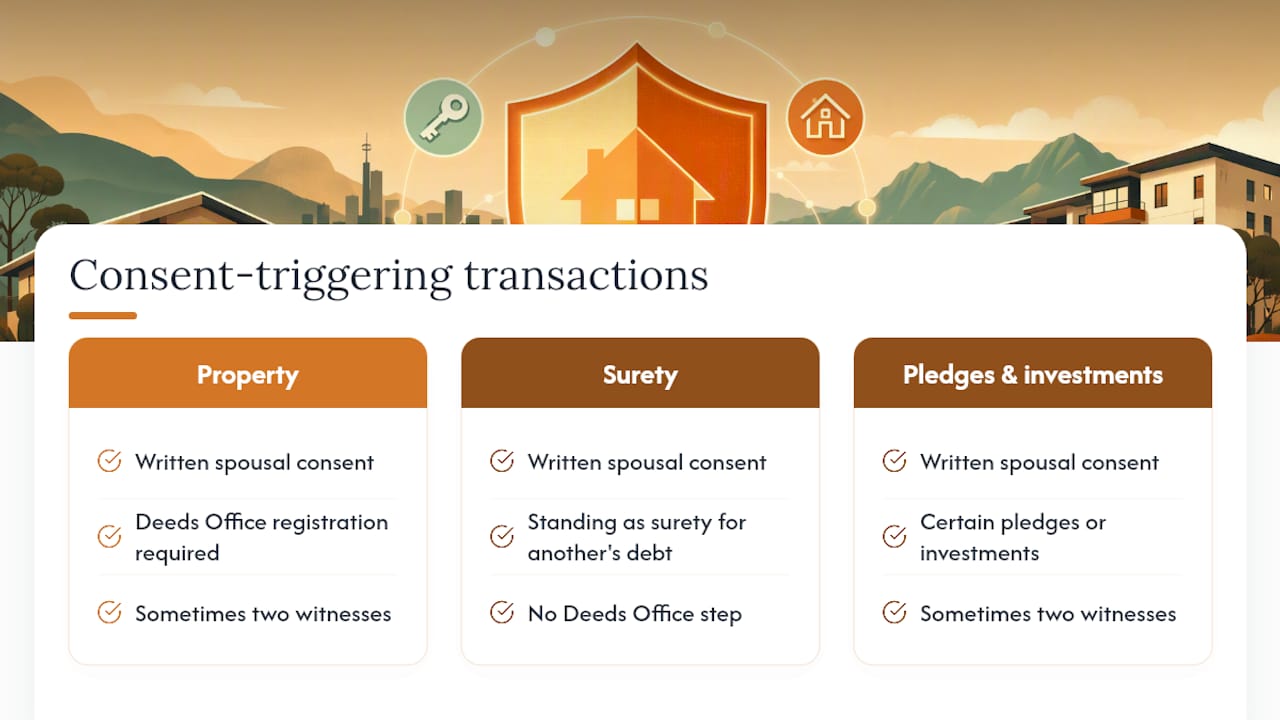
Marriage in community of property makes both spouses equal, concurrent managers of the joint estate. In practice, that sounds more balanced than it is. Certain transactions legally require your spouse's written consent, and without it, the deal can be blocked or later challenged.
The Matrimonial Property Act 88 of 1984 lists the acts that trigger this requirement: selling or mortgaging immovable property, standing as surety for someone else's debt, and certain pledges or investments. Some of these need attestation by two witnesses, and property transactions still have to clear the Deeds Office, which will not register a transfer lacking the required spousal consent.
Debt works the same way, just in reverse. If your spouse ran up debt before the wedding or during the marriage, creditors can generally pursue the joint estate, not just your spouse's "half." Your salary, your savings, and jointly owned property are all exposed.
What happens if consent is refused unreasonably? A spouse can approach the courts for relief, and the law also allows a transaction done without proper consent to be ratified or set aside later, with the court adjusting matters to fix any resulting prejudice.
The real advantages of marrying in community of property
For a lot of couples, especially where one partner earns significantly less or takes time out for caregiving, community of property offers genuine protection. It is also, quite simply, the path of least resistance since it requires no legal paperwork before the wedding.
- Equal ownership from day one. Both spouses automatically hold a 50% share of the joint estate, regardless of who contributed more financially.
- Security for a non-earning spouse. A partner who stays home, raises children, or earns less still owns half of everything acquired during the marriage.
- Simpler outcome if a spouse dies. The surviving spouse automatically retains their undivided half share of the joint estate, without needing to prove a claim to it.
- No upfront legal cost. Signing an ANC costs money and requires a notary. The default regime costs nothing to enter.
The disadvantages nobody mentions at the altar
The flip side of shared ownership is shared risk, and this is where community of property causes the most regret. Practitioner guidance consistently flags this as the biggest blind spot for couples who never considered signing an ANC.
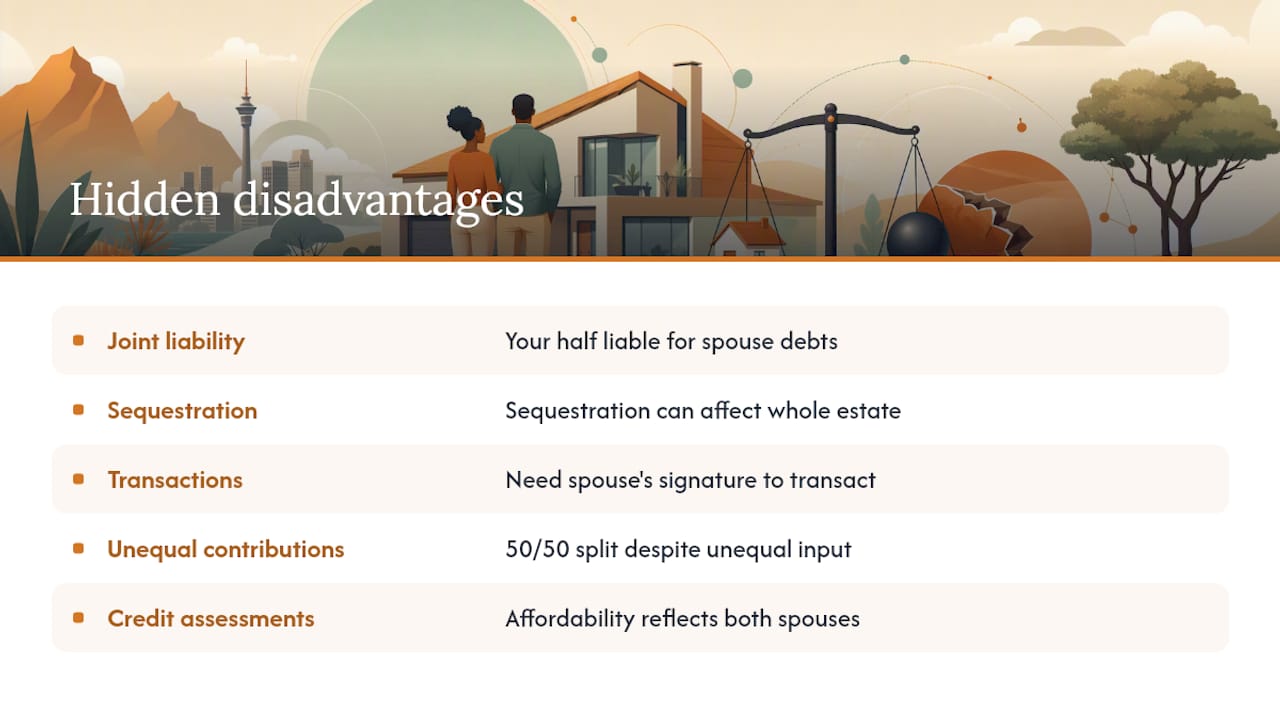
Joint liability cuts both ways. If your spouse's business fails or they're declared insolvent, your half of the joint estate can be affected too, even if you had nothing to do with the debt. Sequestration proceedings against one spouse in community of property typically draw in the whole joint estate.
Day-to-day control also gets complicated. Want to remortgage the house, sell an investment property, or stand surety for a friend's loan? You need your spouse's signature. That's fine when a marriage is healthy. It becomes a serious obstacle when it isn't.
There's also an equity problem that surprises people on divorce or death: contributions rarely match the 50/50 split. A spouse who built a business from nothing, or brought substantial premarital wealth into the marriage, still splits the joint estate down the middle. And because the couple's combined debt and asset profile is treated as one unit, credit applications and affordability assessments often reflect both spouses' financial history, not just one.
Alternatives: antenuptial contracts, with or without accrual
An antenuptial contract lets couples opt out of the default regime, but timing is everything: it must be signed and notarised before the wedding, not after. Once you're married, the window closes for the simple route.
There are two versions worth understanding:
- Out of community without accrual. Each spouse keeps a fully separate estate for the whole marriage. What you earn is yours, what you owe is yours, and nothing automatically shifts to your spouse on divorce or death. This suits people entering a second marriage, business owners protecting a company from a partner's personal liabilities, or anyone who simply wants total financial independence.
- Out of community with accrual. Estates stay legally separate during the marriage, but on divorce or death, the growth in each spouse's estate gets calculated and the poorer estate shares in that growth. This option is often pitched as the balanced middle ground for couples who want independence day to day but fairness if the marriage ends.
Accrual only works if you record your commencement values properly. Skip that step, and the law can treat your starting value as nil, wiping out any credit for wealth you brought into the marriage.
Can you switch to a different matrimonial regime after the wedding?
Yes, but it's neither quick nor cheap. Changing your matrimonial property system after marriage requires a formal application to the High Court, and the court will not approve it if doing so prejudices existing creditors.
Expect to provide detailed financial disclosure, both spouses' informed consent, and likely a court hearing with legal representation on both sides. Legal commentators are blunt about this: converting after the fact is genuinely difficult, and courts prioritise protecting creditors' rights over a couple's change of heart. The practical lesson is to settle your matrimonial regime before the wedding, not after.
Your pre-wedding checklist: questions worth asking now
Before you assume the default regime is fine, or rush to sign an ANC because a friend told you to, work through these questions honestly.
- Does either of you own a business, or plan to start one? Business risk in community of property becomes a shared risk.
- Is either of you bringing significant premarital assets, property, or debt into the marriage?
- Will one of you likely take a career break for children or caregiving? This affects how much protection you actually need from the default regime.
- Do either of you have dependants or obligations from a previous relationship?
- What's your realistic view of each other's spending habits and credit exposure?
Once you've answered those, draft a simple asset list, get valuations on anything significant, and speak to a family law attorney before finalising anything.
Pro Tip: If you're leaning toward accrual, get your commencement values documented and signed off by a notary at the same time as your ANC. Waiting until later to "sort out the paperwork" is exactly how spouses lose the credit they're entitled to.
Why this decision deserves more than a five-minute conversation
Most couples spend more time picking a venue than deciding how they'll own property together, and that's backward. The financial consequences of the default regime last decades longer than the wedding does.
What strikes me most about this area of law is how invisible the risk is until it isn't. Nobody feels the effects of community of property on their wedding day. They feel it years later, when one spouse's business hits trouble, or when a divorce forces a 50/50 split that doesn't reflect either person's contribution. By then, the moment to choose differently has usually passed.
Justibly exists partly to close that information gap. It lists LPC-registered attorneys across all nine provinces, so you can find someone qualified in family law without guessing whether they're properly credentialed. Its free Legal Q&A forum lets you ask a specific question, like whether your situation suits accrual, and get an answer from a registered attorney at no cost. None of the listings are pay-to-rank, so what you see reflects genuine standing, not advertising spend.
— Nkosi
Get clarity on your matrimonial property options
Reading about community of property and actually knowing what fits your situation are two different things, and the gap between them usually needs a real conversation with someone qualified.

Justibly gives you two free ways to close that gap. Search the family law attorney listings by province to find someone who can draft an ANC, review your options before the wedding, or advise on converting an existing regime. Or if you just need a quick, specific answer first, post your question on the free Legal Q&A forum and get a response from a registered attorney at no cost. Every listing reflects real LPC standing, not paid placement, so you're choosing based on who's actually qualified. Start by browsing attorneys in your area, or ask your question today.
This article is general information, not a substitute for advice from a qualified lawyer. Consult a qualified legal professional about your own circumstances before acting on anything here.
Sources
- Matrimonial Property Act (South Africa) — government guidance
- Matrimonial Property Act 88 of 1984 (statute text / Justice Department)
- GroundUp Q&A — practical advice on antenuptial contracts and risks
FAQ
What are my rights when married in community of property?
You own an equal, undivided half share of the joint estate and have equal management rights, but certain transactions, like selling immovable property or standing surety, require your spouse's written consent under the Matrimonial Property Act.
Does paying lobola mean you are married in community of property?
No. Lobola is a customary practice tied to the validity of a customary marriage, not a determinant of matrimonial property regime; without an ANC, any legally recognised marriage in South Africa defaults to community of property regardless of lobola.
Can a will override the community of property regime?
No. A will only disposes of what the deceased is legally entitled to bequeath under their matrimonial regime, so it cannot override the joint estate structure or grant more than the deceased's own share.
What are the main downsides of a community of property marriage?
The biggest risks are joint liability for your spouse's debts, potential exposure if your spouse is declared insolvent, and the need for mutual consent on major financial decisions, which can create real friction or unfair outcomes on divorce.
Recommended
By the Justibly editorial team
Published
General legal information for South Africa, checked against the Legal Practice Act, the relevant court rules and the Legal Practice Council roll. It is not legal advice and does not create an attorney-client relationship. For advice on your situation, consult an admitted attorney.
How we research and review · How the Trust Score works · Report an error