Apostille South Africa: DIRCO process and 2026 booking rules
Learn how to navigate the apostille process in South Africa, including booking rules for 2026, to ensure your documents are valid abroad.
Published

DIRCO's Legalisation Section issues the apostille for South African public documents, but only when your destination country is a member of the Hague Apostille Convention. If it is not, you need a Certificate of Authentication instead, followed by embassy legalisation.
The shortest valid route: check the destination country against the Hague member list, get the correct original document or a properly authorised copy, complete any notarisation or High Court authentication the document type demands, then book a slot through DIRCO's online legalisation portal.
- Confirm Hague membership first. Everything downstream depends on this one check.
- Bring originals, not copies, unless DIRCO's own guidance says a certified copy is acceptable for that document type.
- Book ahead. Since September 1, 2026, DIRCO no longer accepts walk-ins for individuals.
Pro Tip: Photograph the signature and stamp on your document before you leave home. If it looks faded, incomplete, or hand-altered, DIRCO will likely reject it on the spot.
Table of Contents
- What is an apostille and when do you actually need one?
- Which South African documents can be apostilled?
- How do I get an apostille in South Africa step by step?
- What if the destination country isn't a Hague member?
- How much does an apostille cost and how long does it take?
- Why does DIRCO reject apostille applications?
- When should you get an attorney or notary involved?
- Need a notary or attorney to prepare your documents?
- Sources
- FAQ
What is an apostille and when do you actually need one?
An apostille is a certificate that authenticates the signature, seal, or stamp of the official who issued your document. It doesn't verify the content of the document itself. That distinction trips up a lot of people who assume apostilling a degree somehow re-confirms the degree is genuine. It doesn't. It confirms that the signature on the SAQA verification letter, or the registrar's stamp on a marriage certificate, belongs to someone authorised to sign it.
Whether you need an apostille at all depends entirely on where the document is going. The Hague Apostille Convention governs this, and its country list is the single source you should check before doing anything else.
- If the destination country is on the HCCH list, an apostille from DIRCO is enough. No embassy visit required.
- If it's not on the list, DIRCO issues a Certificate of Authentication instead, and you'll then need to take that document to the destination country's embassy or consulate in South Africa for legalisation.
- Some countries have joined the convention only recently, so don't rely on memory or an old blog post. Check the current list each time.
Skipping this check is the single most common planning mistake. Someone prepares a full apostille package for a country that actually requires embassy legalisation, and the DIRCO stamp turns out to be the wrong stamp entirely.
Which South African documents can be apostilled?
DIRCO apostilles public documents, meaning anything issued or certified by a South African government body, court, or recognized institution. Private documents usually need an extra step before DIRCO will touch them.
Documents that typically go straight through:
- Birth, marriage, and death certificates issued by the Department of Home Affairs
- Degree certificates verified by SAQA, and school-leaving documents that may need prior verification through Umalusi
- Police clearance certificates from the SAPS Criminal Record Centre
- Court orders, divorce decrees, and other documents issued directly by a South African court
- Official letters from government departments bearing a valid signature and departmental stamp
DIRCO consistently rejects a shorter list, and it catches people out every week:
- Abridged birth or marriage certificates. You need the unabridged version.
- Computer printouts without an official signature and wet-ink stamp.
- Certified copies that haven't been through the correct certification chain for that document type.
Private documents like powers of attorney or company resolutions follow a different path entirely. These generally need notarisation by a Notary Public first, and in many cases authentication by the Registrar of the High Court before DIRCO will legalise them. Skipping the High Court step is one of the most common reasons applicants get turned away at the counter.
Pro Tip: If your document was issued more than a few years ago, check whether the signing official is still with that department. DIRCO cross-checks specimen signatures, and a retired registrar's signature can stall your application.
How do I get an apostille in South Africa step by step?
Getting a South African apostille in 2026 follows a fixed sequence, and doing the steps out of order is the fastest way to waste a trip.
- Confirm the destination requires an apostille. Check the HCCH member list. If the country isn't a member, skip ahead to the authentication and embassy route covered below.
- Gather the correct originals or authorised copies. DHA certificates should be unabridged. Academic documents typically need a SAQA verification letter first, and school-level documents may route through Umalusi before that.
- Complete any required prior certification. Private documents go to a Notary Public, then, where applicable, to the Registrar of the High Court for authentication. DIRCO will not process a document that's missing an earlier step in this chain.
- Book your DIRCO appointment. Individuals book through the DIRCO legalisation bookings portal. Legal firms and agencies submitting on behalf of clients generally use the courier submission route rather than individual appointment slots.
- Submit the documents. Bring the originals plus whatever single certified copy DIRCO's guidance specifies for that document type. Don't over-prepare with multiple copies DIRCO didn't ask for.
- Collect or receive the apostilled document. Depending on volume and document type, DIRCO has previously indicated same-day turnaround is possible for small batches, though this varies and shouldn't be assumed for every submission.
The booking system matters more than most people realize. Since walk-in submissions stopped in September 2026, showing up without a confirmed slot means being turned away, full stop. Agencies handling multiple clients' documents should route through the courier channel rather than trying to book individual slots for each person, since the booking portal is structured around individual applicants requesting DHA certificates, SAQA verifications, and SAPS clearances.
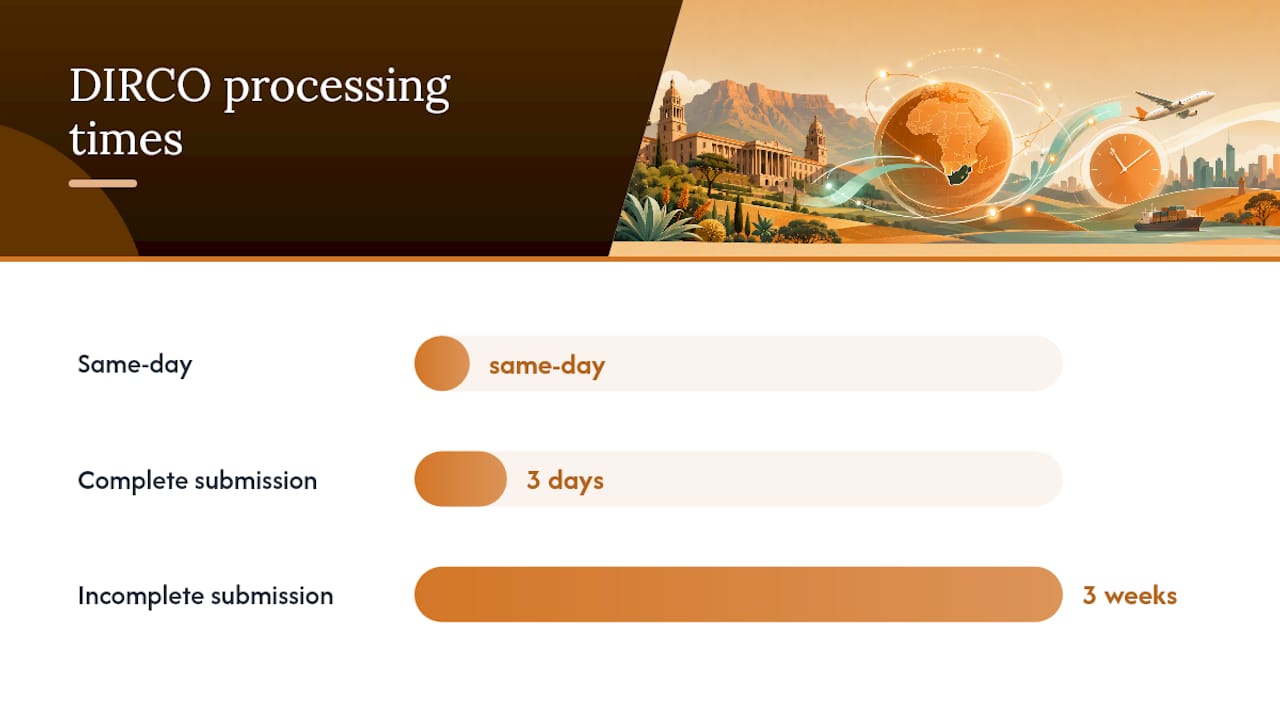
Timing estimates from practitioners who handle these submissions regularly suggest processing can run from a few days to several weeks depending on the document and how complete your submission is on the first attempt. A step-by-step practitioner guide makes the same point: incomplete first submissions are what stretch a three-day process into a three-week one.
Pro Tip: Before booking, call the issuing department and confirm the current authorised signatory list for your document type. A five-minute phone call can save you a wasted appointment slot.
What if the destination country isn't a Hague member?
Some of South Africa's most common migration and work destinations still aren't Hague signatories, which means the apostille route doesn't apply at all. In these cases, DIRCO issues a Certificate of Authentication instead of an apostille, and that certificate then goes to the destination country's embassy or consulate in South Africa for a second round of legalisation.
This adds real time and real cost to the process:
- Expect an additional embassy visit or courier submission after DIRCO has finished its part.
- Embassies charge their own legalisation fees, separate from anything DIRCO charges.
- Each embassy sets its own document requirements, sometimes including certified translations or specific application forms that have nothing to do with DIRCO's process.
DIRCO won't tell you what a specific embassy requires, because that's outside its mandate. Getting the embassy's own checklist before you start the authentication process, rather than after, avoids the frustrating loop of authenticating a document only to learn the embassy wanted something different. This comes up constantly with residency applications abroad, similar to what's outlined in Paraguay's residency documentation guide, where document sequencing errors are one of the most common causes of delay.
Pro Tip: Email the embassy's consular section directly and ask for their exact legalisation checklist in writing. Verbal answers from reception staff are often incomplete.
How much does an apostille cost and how long does it take?
DIRCO itself generally does not charge a fee for issuing the apostille certificate. That surprises a lot of first-time applicants who expect a government stamp to come with a government price tag. What you do pay for are the steps around it: notary fees for private documents, SAQA verification fees for academic documents, courier costs if you're using an agency, and any embassy fees on the non-Hague path.
Processing time depends heavily on document type and how complete your first submission is. DIRCO has previously flagged the possibility of same-day service for small individual batches, but practitioner reports suggest realistic turnaround for standard submissions runs from a few days to a few weeks.
Booking rules shape this timeline directly:
- The online booking system releases appointment slots for individuals seeking DHA, SAQA, and SAPS-related legalisations.
- Agencies and law firms handling bulk or third-party submissions typically use the courier route instead of individual bookings.
- Since walk-ins ended in September 2026, an unbooked visit to a DIRCO office simply won't result in same-day service, regardless of how urgent your travel date is.
Third-party service providers, including notaries and specialist legalisation agents, charge based on the complexity of your document set, not on DIRCO's own fee schedule.
Why does DIRCO reject apostille applications?
Most rejections come down to something small and fixable, if you catch it before submission. DIRCO's process is really a signature and stamp verification exercise, not a content review, so the things that go wrong are almost always procedural.
The recurring causes:
- Missing, faded, or non-standard official signatures and stamps that don't match DIRCO's specimen records.
- Abridged certificates submitted where DIRCO requires the unabridged version.
- Computer printouts without a wet-ink signature and official departmental stamp.
- Certified copies that skipped a required step, most often a private document that went to a Notary Public but never reached the Registrar of the High Court for the additional authentication some document types require.
Run through this before you book anything:
- Is the document the correct version (unabridged, not a printout)?
- Has every required prior verification been completed, in the right order?
- Does the signature and stamp match what the issuing office currently uses?
- If the destination is a non-Hague country, do you have the embassy's own checklist already?
Pro Tip: Ask the issuing department what their current stamp looks like before you submit. Departments occasionally change stamp designs, and an outdated stamp on an otherwise valid document is an easy, avoidable rejection.
When should you get an attorney or notary involved?
Straightforward documents like a single birth certificate rarely need professional help. Where it pays off is with anything that involves a chain of prior steps: powers of attorney, company resolutions, contested court documents, or academic qualifications that need SAQA verification before DIRCO will look at them.
A notary or attorney experienced in this process knows which documents need High Court authentication before DIRCO submission, and can usually spot a defective stamp or an incomplete signature before you waste a booking slot on it. For company resolutions destined for a non-Hague country, an attorney familiar with that country's embassy requirements can also save a second, unnecessary trip.
- Powers of attorney and company resolutions almost always need notarisation first.
- SAQA-related academic documents benefit from someone who deals with verification delays regularly.
- Non-Hague destinations with unusual embassy requirements are easier to navigate with someone who's done it before.
Justibly's attorney directory lets you search LPC-registered attorneys and notaries by location and practice area, which matters if you're near Johannesburg's or Pretoria's High Court registries and need someone who can handle the authentication step in the same trip.
Pro Tip: When calling a notary, ask specifically whether they've handled apostille preparation before, not just general notarisation. The process has its own quirks that a generalist notary may not know.
A practical note from someone who's done this
The single biggest time-saver isn't a clever shortcut. It's calling the issuing department ahead of time and confirming their current stamp and signature format before you show up. On one submission, a certificate came back rejected because the department had quietly switched registrars two months earlier, and the specimen signature on file at DIRCO was already out of date. A two-minute phone call would have caught it.
Pro Tip: Book your DIRCO slot for early morning if you have a choice. Documents submitted first thing tend to get processed the same day more often than later slots.
Need a notary or attorney to prepare your documents?
If your apostille needs notarisation, High Court authentication, or a company resolution drafted correctly the first time, Justibly's attorney directory gets you to a real, LPC-registered legal professional faster than cold-calling firms from a search results page. Search by practice area and location, and you'll see actual attorneys who handle document authentication work, not a generic call center.
Justibly lists attorneys across all nine provinces without pay-to-rank placement, so what you see reflects genuine LPC registration data rather than who paid for top billing. If your question is more general, like which authentication order applies to your specific document, Justibly's free Q&A forum connects you with registered attorneys who can point you in the right direction before you book anything with DIRCO.
This article is general information, not a substitute for advice from a qualified lawyer. Consult a qualified legal professional about your own circumstances before acting on anything here.
Sources
- Guidelines on the provision of Consular Services
- Legalising official documents and end user certificates | South African Government
- Legalisation Bookings - DIRCO
- Hcch
FAQ
How do I get an apostille in South Africa?
Confirm your destination country is a Hague member, gather the correct originals or certified copies, complete any required notarisation or High Court authentication, then book a slot through DIRCO's online portal since walk-ins are no longer accepted.
How much does it cost to apostille a document in South Africa?
DIRCO generally does not charge for issuing the apostille itself. Costs come from associated steps like notary fees, SAQA verification, or courier services if you use an agency.
Can I apostille an abridged birth certificate?
No. DIRCO's own guidance specifies the unabridged version is required; abridged certificates are on the rejection list.
What happens if my destination country isn't a Hague member?
DIRCO issues a Certificate of Authentication instead of an apostille, and you then take that certificate to the destination country's embassy or consulate in South Africa for a second round of legalisation.
Do I need a lawyer to get an apostille?
Not for simple documents, but powers of attorney, company resolutions, and documents requiring High Court authentication usually benefit from a notary or attorney. Justibly's directory can help you find one by location and practice area.
Recommended
By the Justibly editorial team
Published
General legal information for South Africa, checked against the Legal Practice Act, the relevant court rules and the Legal Practice Council roll. It is not legal advice and does not create an attorney-client relationship. For advice on your situation, consult an admitted attorney.
How we research and review · How the Trust Score works · Report an error