What is an administration order and how does it help SA debtors?
Discover how an administration order helps South African debtors simplify payments, protect against legal actions, and regain control of finances.
Published

An administration order is a court order under sections 74 to 74W of the Magistrates' Courts Act 32 of 1944 that places a debtor's affairs under a court-appointed administrator. It applies only when total unsecured debt sits under R50,000. The moment the order is granted:
- An administrator takes over collecting money from you and paying your creditors.
- You make one consolidated payment instead of juggling multiple accounts.
- Creditors listed in the order generally cannot pursue separate legal action against you while it runs.
If your debt fits that threshold and you're drowning in phone calls from different creditors, your next stop is your local Magistrate's Court or a quick conversation with an attorney to check whether this is actually the right tool for your situation.
Key Takeaways
An administration order works only for unsecured debt under R50,000, and its real cost lies in administrator fees and ongoing interest, not the court process itself.
| Point | Details |
|---|---|
| Eligibility threshold | Total unsecured debt must sit under R50,000 to qualify for an administration order. |
| Fee reality | Administrator remuneration around 12.5% plus employer fees up to 5% reduce what reaches creditors. |
| Credit impact | Expect a minimum 10 year credit bureau listing, affecting future loan and finance applications. |
| Exit route | Request the distribution account and apply for rescission or fee taxation if overcharging is suspected. |
| Compare before applying | Debt review often suits debtors better when secured debt or interest renegotiation matters. |
Table of Contents
- How does an administration order work under South African law?
- Who qualifies for an administration order in South Africa?
- What are the pros and cons of going under administration?
- How do you apply for an administration order?
- How much does an administration order cost you?
- What are the legal effects of an administration order?
- How do you rescind or exit an administration order?
- Administration order or debt review: which fits your situation?
- Where can you get trusted legal help with an administration order?
- A real-world walkthrough: how an administration order plays out
- What pitfalls catch people off guard during administration?
- What happens to your finances and credit after the order ends?
- Why the standard advice on administration orders misses the point
- Sources
- FAQ
How does an administration order work under South African law?
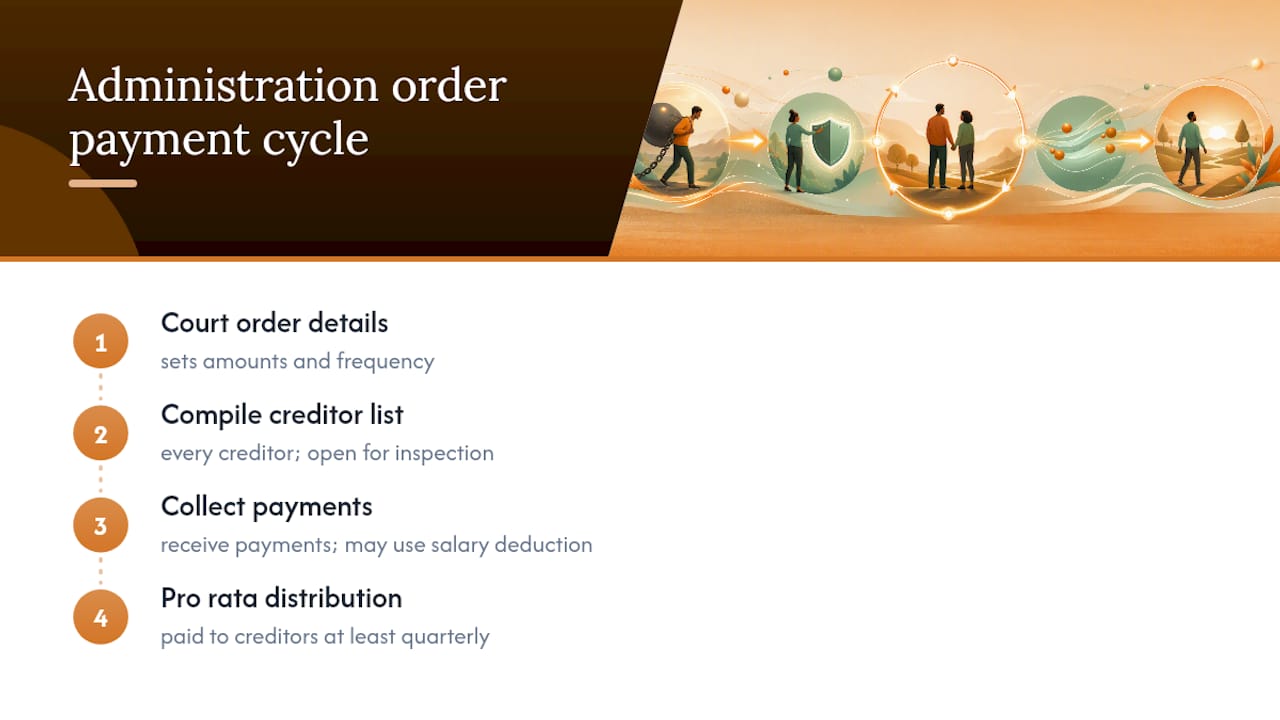
Sections 74 to 74W set out the mechanics. Once granted, the administrator must compile a list of every creditor, keep it open for inspection, collect your payments, and distribute them pro rata to creditors at least once every quarter unless creditors agree to a different schedule.
The order covers unsecured debt only, things like credit cards, personal loans, retail accounts, and store cards. Secured debt with future instalments, such as a home loan or vehicle finance still being paid off, generally falls outside its scope because those creditors have separate legal remedies (repossession, foreclosure) that an administration order doesn't touch.
The court sets out specific payment amounts and frequency in the order itself, and it may also authorise an emoluments attachment order, a direct deduction from your salary, so the money reaches the administrator before you ever see it.
Who qualifies for an administration order in South Africa?
Three things determine whether you can apply:
- Total unsecured debt must be under R50,000. This includes credit cards, personal loans, and unsecured retail credit added together, not per account.
- You apply at the Magistrate's Court covering the area where you live, work, or run your business, whichever is most convenient for you and your creditors.
- Secured debt in arrears complicates things. Courts generally expect you to have a realistic plan for secured obligations like a car or home loan separately, since the order won't manage those.
If you're married in community of property, both spouses' debt typically gets considered jointly, which can push you over or keep you under the R50,000 line depending on how your finances are structured.
What are the pros and cons of going under administration?
The upside is real, but so is the cost. Here's the honest split.
Advantages:
- Court supervision means an independent party, not your most aggressive creditor, controls the process.
- One consolidated payment replaces multiple due dates and multiple creditors chasing you.
- Enforcement actions from listed creditors are generally paused while the order is active.
Disadvantages:
- Administrators charge remuneration and expenses, which come off the top before creditors get paid.
- Interest on your debt often keeps accruing, so the total you owe can grow even while you're paying.
- Repayment periods can stretch on for years depending on how much you owe and how much you can afford monthly.
- The order gets listed with credit bureaus, and government consumer guidance flags this as a real drawback worth weighing carefully before applying.
Pro Tip: Ask the administrator for a distribution account showing exactly what's been deducted for fees and expenses before you assume every rand is reaching your creditors.
How do you apply for an administration order?
The process runs through your local Magistrate's Court and follows a fairly fixed sequence.
- Get the correct forms from the court clerk, usually a statement of affairs and supporting affidavit.
- List every asset, debt, income source, and dependant honestly. The magistrate uses this to judge whether administration is appropriate and affordable.
- Serve notice on your creditors before the hearing date, since the Act requires creditors get the chance to object or ask the court to include or exclude specific debts.
- File the completed documents with the court.
- Attend the hearing, where the magistrate examines your income, assets, dependants, and genuine ability to pay before granting the order.
Once granted, the administrator takes over the practical side:
- Notifies every creditor and, where relevant, your employer.
- Lodges the official creditor list with the court.
- Begins collecting your payment and distributing it according to the schedule the court set.
Expect the whole application process, from paperwork to hearing, to take a few weeks depending on how busy your local court is and how quickly creditors respond to notice.
How much does an administration order cost you?
This is where a lot of debtors get caught off guard. The administrator isn't working for free, and the fees come straight out of what you pay.
- Administrator remuneration is commonly cited around 12.5% of amounts received, deducted before your creditors get their share, according to LegalWise's guidance on administration orders.
- Employer management fees of up to around 5% may apply when an emoluments attachment order is deducting money directly from your salary.
- Court and application fees apply on top, along with the administrator's out-of-pocket expenses.
Those two percentages alone can eat close to a fifth of every payment before a single creditor sees a cent. Always request the distribution account, the document showing what came in, what was deducted, and what went out, and if the numbers look inflated, you can ask the court to tax (review and reduce) the administrator's fees.
What are the legal effects of an administration order?
The order changes your legal position in several concrete ways, and not all of them favour you.
- Your name typically stays on credit bureau records for a minimum of 10 years, a figure government consumer guidance confirms, which affects your ability to get a home loan, vehicle finance, or even some rental applications long after the debt itself is settled.
- While the order runs, creditors named in it generally cannot start separate legal proceedings against you, though narrow exceptions exist, particularly for mortgage bonds or where a creditor gets special leave of the court.
- An administration order does not block a creditor from applying to sequester your estate. The two remedies aren't mutually exclusive, and law reform discussions flag this overlap as one of the regime's rougher edges.
How do you rescind or exit an administration order?
If the order was granted irregularly, or your debt is now paid off, or the administrator is charging more than they should, you have options.
- Apply for rescission at the same Magistrate's Court that granted the order, showing that debts are settled or the order was improperly granted.
- Request the distribution account in writing and check every deduction against what you actually owe.
- Apply to tax the fees or substitute the administrator if the account shows overcharging or mismanagement, a remedy debt practitioners say succeeds fairly often when properly documented.
Pro Tip: Keep copies of every payment you make and every account the administrator sends you. If you ever need to prove overcharging, that paper trail is what wins the argument.
For anything beyond a straightforward paperwork fix, a consumer and debt attorney can guide the substitution or rescission application properly.
Administration order or debt review: which fits your situation?
These two tools solve similar problems very differently, and the differences matter.
- Debt cap: administration orders apply strictly under R50,000 unsecured debt; debt review has no such ceiling and can handle secured debt too.
- Interest renegotiation: debt review counsellors can negotiate reduced interest rates with creditors; administration orders generally can't touch the interest rate itself.
- Oversight: debt review operates under the National Credit Regulator with formal accreditation, while administrators have historically operated with far less regulatory scrutiny, a gap the SALRC discussion paper specifically calls out for reform.
Administration orders still make sense for small, mixed debt portfolios where you want a quick stay on enforcement without the formal debt review accreditation process. For most people with unsecured debt under R50,000 and any secured obligations in the mix, debt review usually delivers a better outcome because it can actually lower what you're paying in interest, not just spread out the payments.
Where can you get trusted legal help with an administration order?
Talk to an attorney if creditors are disputing the order, you suspect the administrator is overcharging, or you're filing a rescission application. These situations move faster and cleaner with proper legal guidance behind them.
- Search Justibly's directory for LPC-registered attorneys handling consumer debt matters, filtered by your province.
- Use the free Q&A forum to get a quick answer from a registered attorney before committing to formal legal action.
- Contact your local Magistrate's Court clerk directly for application forms if you're proceeding without an attorney.
Gather your statement of affairs and creditor list first. Whichever route you take, having your paperwork ready saves everyone time.
A real-world walkthrough: how an administration order plays out
Consider a debtor with three unsecured accounts: a credit card, a personal loan, and a retail store account, totalling R42,000. Monthly take-home pay is modest, and three separate creditors are calling weekly, one has already sent a letter of demand.
The debtor applies at the local Magistrate's Court, submitting a statement of affairs listing income, two dependants, and the R42,000 in unsecured debt. Notice goes out to all three creditors ahead of the hearing date. None of them object, since administration typically recovers more for them than a debtor who simply defaults outright.
At the hearing, the magistrate reviews the numbers and sets a monthly payment based on what's actually affordable after living expenses. An administrator is appointed, notifies the three creditors, and sets up an emoluments attachment order so the payment comes straight off the debtor's payslip before it reaches their bank account.
Each quarter, the administrator collects the payments received, deducts remuneration (commonly around 12.5%) plus the employer's management fee, and distributes the remainder pro rata across the three creditors based on what each is owed. The credit card, having the largest balance, receives the biggest share; the smaller retail account gets proportionally less.

Two years in, the personal loan is fully settled. The order continues for the remaining two accounts until those balances clear too, at which point the debtor can apply for the order to be discharged and eventually work on clearing the credit bureau listing.
What pitfalls catch people off guard during administration?
The paperwork stage trips up more applicants than the actual hearing does. Missing income details, an incomplete list of dependants, or an inaccurate creditor list can delay a hearing by weeks while the court sends you back to fix it.
Underestimating ongoing interest is another common mistake. Because interest frequently keeps accruing on the underlying debt even after the order is granted, some debtors are surprised when their total owed hasn't shrunk as fast as their monthly payments suggested it would.
Fee transparency is the third recurring problem. Many debtors never request a distribution account and simply assume the administrator is handling things correctly. Without that document, there's no way to verify whether deductions match what the court order actually permits, and by the time overcharging is discovered, months or years may have passed.
Creditor objections at the hearing stage occasionally derail applications too, particularly when a creditor believes their debt was miscategorised or omitted. This is where accurate, complete disclosure at the application stage saves real trouble down the line. An incomplete list invites disputes; a thorough one heads them off before they start.
Finally, some debtors treat the order as a permanent fix rather than a temporary measure, missing opportunities to apply for rescission once debts are cleared, which leaves the credit bureau listing running longer than necessary.
What happens to your finances and credit after the order ends?
The order itself is temporary, but its footprint lasts far longer than the repayment period. That 10 year minimum credit bureau listing means your ability to get a car loan, a home loan, or even certain job offers requiring credit checks can be affected well after your last payment to the administrator clears.
On the behavioural side, going through administration tends to make people more cautious about credit generally. Having lived through consolidated payments and restricted access to new credit, many debtors emerge with a sharper sense of what unsecured debt actually costs once fees and interest are added up.
That caution cuts both ways. It can mean healthier borrowing habits going forward, paying accounts in full, avoiding revolving credit, building savings before financing purchases. It can also mean genuine difficulty accessing legitimate credit when it's actually needed, since lenders see the historical listing regardless of how well you've managed money since.
Rebuilding credit after an administration order discharges usually means a slow, deliberate process: settling any remaining accounts in good standing, avoiding new debt you can't immediately afford, and checking your credit report periodically to confirm the listing clears on schedule rather than lingering past the 10 year mark through an administrative error.
Why the standard advice on administration orders misses the point
Most guidance on this topic treats administration orders as either a rescue tool or a trap, when the honest answer sits somewhere less dramatic: it's a narrow instrument that works for a narrow set of debtors, and the marketing language around "debt relief" obscures how mechanical and fee-driven the process actually is.
The conventional advice tends to undersell the cost math. A 12.5% administrator cut plus a 5% employer fee isn't trivial when interest is still running on the underlying balance. Do the arithmetic before assuming administration is cheaper than the stress of managing creditors yourself.
What gets underweighted most often is the paperwork discipline required upfront. A messy statement of affairs or an incomplete creditor list causes more real-world delay than any dispute over the R50,000 threshold itself. If you're applying, get that documentation right the first time.
My honest read: administration orders remain useful for a genuinely narrow slice of debtors, small mixed unsecured balances, a need for quick enforcement relief, no appetite for formal debt review accreditation. For most people reading this, debt review deserves a serious look first, precisely because it can touch the interest rate and comes with regulatory teeth administration orders still lack.
Sources
- Magistrates' Courts Act 32 of 1944 (s74–74W)
- Administration Orders | LegalWise
- Being under administration | Vuk'uzenzele
- SALRC review of administration orders (discussion paper)
FAQ
What is the definition of an administration order?
An administration order is a court order under sections 74 to 74W of the Magistrates' Courts Act that places a debtor with unsecured debt under R50,000 under a court-appointed administrator who collects and distributes payments to creditors.
How do you remove an administration order from your name?
You apply for rescission at the Magistrate's Court that granted the order, typically once debts are paid in full or where you can show the order was granted irregularly.
What happens after 3 years of not paying debt?
Unpaid debt generally continues accruing interest and creditors can pursue legal action or apply for sequestration; an administration order does not automatically expire after a fixed number of years, it runs until debts are settled or successfully rescinded.
What qualifies as an administrative action?
In this context, the relevant action is the court granting an administration order after reviewing your statement of affairs, income, and creditor list at a formal Magistrate's Court hearing.
Can an administration order stop all legal action against me?
Generally yes for creditors named in the order, though narrow exceptions exist for cases like mortgage bonds or where a creditor obtains special leave of the court to proceed separately.
Recommended
By the Justibly editorial team
Published
General legal information for South Africa, checked against the Legal Practice Act, the relevant court rules and the Legal Practice Council roll. It is not legal advice and does not create an attorney-client relationship. For advice on your situation, consult an admitted attorney.
How we research and review · How the Trust Score works · Report an error